


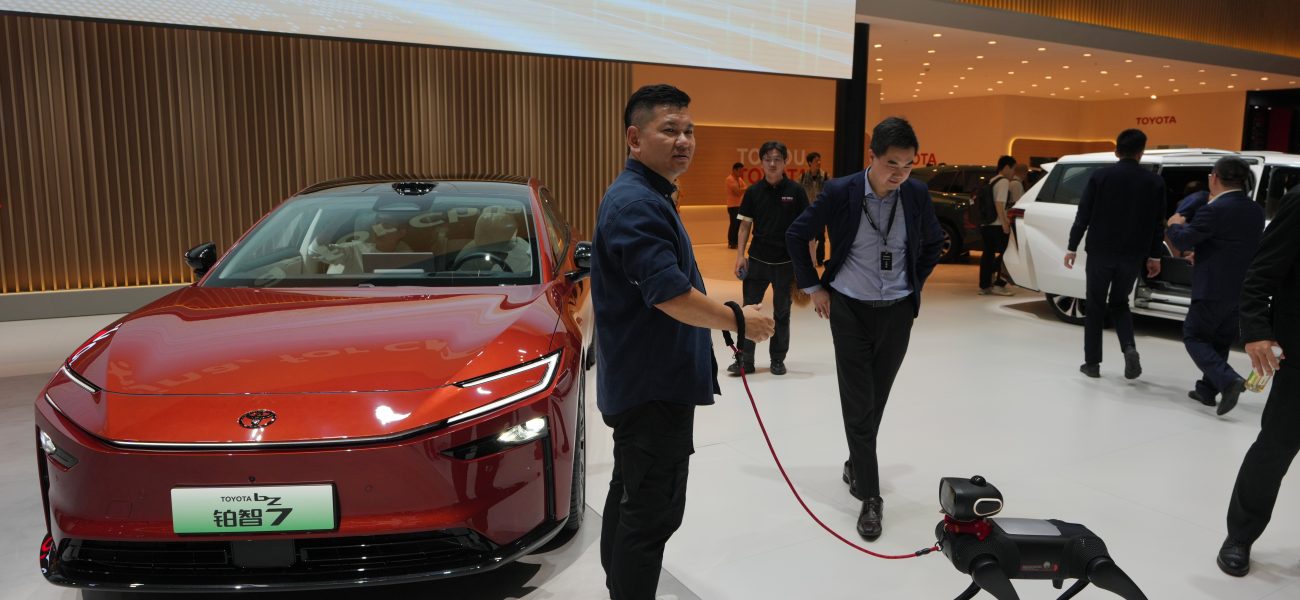
Beijing Auto Show: China’s Electric Surge Reshapes Global Automotive Landscape
POLICY WIRE — Beijing, China — Amidst the dazzling lights and throbbing bass of a thousand new launches, a silent revolution — a sort of stealthy tectonic shift, if you will — coalesced this spring...

POLICY WIRE — Beijing, China — Amidst the dazzling lights and throbbing bass of a thousand new launches, a silent revolution — a sort of stealthy tectonic shift, if you will — coalesced this spring at the Beijing Auto Show.
It wasn’t just about gleaming chrome and fresh paint; it was about the palpable sense that the global automotive hierarchy, long dominated by Western and Japanese giants, is undergoing an earth-shattering convulsion, with China not merely in the driver’s seat but seemingly dictating the entire journey’s itinerary.
For onlookers, the sheer breadth of innovation — from advanced battery chemistries promising astounding ranges to sophisticated autonomous driving features that seem to leapfrog current Western offerings — on display from domestic brands felt almost staggering. Chinese manufacturers aren’t simply catching up; they’re dictating the tempo, plain — and simple.
And that matters. Deeply.
Wang Chuanfu, the often-reticent Chairman and President of BYD, China’s biggest electric vehicle maker, spoke with unvarnished candor.
“The era of the internal combustion engine is effectively over for us in China,” Wang stated at a recent industry forum, a sentiment that’s now a persistent hum through the halls of the auto show. “Now, we’re not just building cars; we’re building the future of mobility, and we’re ready to share it with the world.”
Indeed, they’re. This isn’t just about local market dominance; it’s a whole new ballgame, folks. Chinese automakers, often backed by substantial government subsidies and a robust domestic supply chain, are covetously scrutinizing international markets, including the burgeoning economies of South Asia.
Take Pakistan, for instance. With its rapidly expanding middle class and growing environmental awareness, the nation represents a prime target for cost-effective yet technologically advanced Chinese EVs. Brands like Changan, BAIC, and even BYD have already started carving out niches, offering models that often undercut established players on price while boasting impressive feature sets. It’s a textbook example of how China’s industrial prowess translates into economic influence across the Muslim world and beyond, wouldn’t you say?
But not everyone views this surge with enthusiasm. European — and American automakers, once dismissive, now exude growing apprehension. Behind the polished presentations and technological bravado, whispers of unfair trade practices and intellectual property theft perpetually lurk.
Oliver Zipse, CEO of BMW, while acknowledging Chinese innovation, registered heightened disquiet.
“We welcome competition, but it must be fair competition,” Zipse remarked in a recent interview, reflecting the sentiment of many legacy automakers. “The playing field needs to be level, without distortions that disadvantage those of us operating under different market conditions.”
📄 POLICY WIRE WHITEPAPER PUBLISHED: PAKISTAN'S NATIONAL SECURITY POLICY PRIORITIES
👉 READ BY CLICKING HERE
Make no mistake; the numbers are, quite frankly, brutal. China currently accounts for approximately 60% of global electric vehicle sales, according to 2023 data from the International Energy Agency. That’s a colossal leverage point, translating into economies of scale and technological feedback loops that are incredibly tough for any single competitor to match, isn’t it?
But can this momentum be sustained, or will global pushback effectively stem the tide, sending these ambitious plans back into the shadows? The automotive industry finds itself at a watershed juncture, one that’s largely dictated by decisions made in Beijing boardrooms.
What This Means
The implications of China’s rise to preeminence in the EV sector are profound, touching on everything from global trade balances to geopolitical alliances. Economically, we’re staring down the barrel of potential trade wars. Western nations, already wrestling with de-industrialization fears, will likely ramp up tariffs and protectionist measures to fortify their homegrown industries, mirroring past clashes over steel or solar panels. What a mess, right?
Politically, this shift grants China tremendous leverage. Control over essential EV components and manufacturing capacity can be wielded as diplomatic currency, creating dependencies among importing nations. It’s not just about cars anymore; it’s about the entire supply chain, from lithium mining to advanced software — a veritable industrial octopus, stretching its tentacles globally.
Diplomatically, the push for Chinese EVs into markets like Pakistan, Indonesia, and parts of Africa isn’t just commercial; it insidiously broadens Beijing’s economic footprint and influence, challenging traditional Western economic relationships. One might even call it a rather effective geopolitical chess move.
Related: Macron Doubles Down on Franco-German Fighter Jet, Defying Persistent Doubts
So, few outside observers actually believe this current trajectory is sustainable without momentous global market adjustments. For legacy automakers, the choice is increasingly brutal: adapt aggressively, collaborate, or simply risk obsolescence. They’re walking a very fine tightrope, aren’t they?
As Ferdinand Dudenhöffer, a noted German automotive economist, recently told Policy Wire, “The competitive pressure from China isn’t a wave; it’s a tsunami. Those who don’t learn to swim with the current will simply drown. We’re witnessing the most significant restructuring of the auto industry since its inception.” His words are a blunt admonition of the monumental task ahead for manufacturers worldwide. It’s really that serious.