


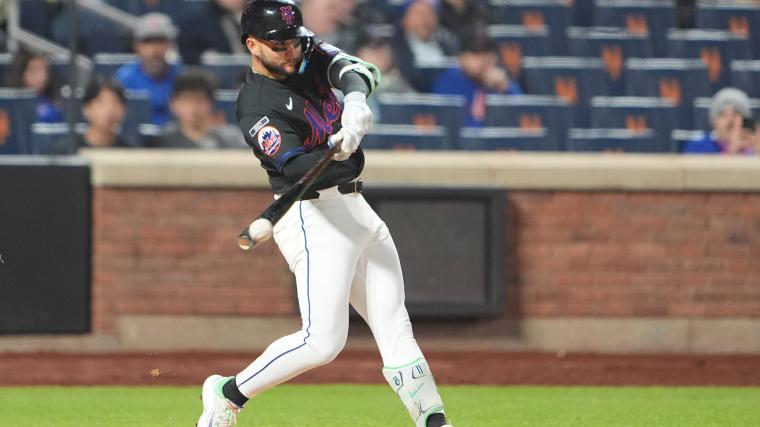
Bichette’s Mets Malaise: When a $126 Million Contract Becomes a Heavy Weight
POLICY WIRE — New York City, USA — Citi Field’s incandescent glare, it can — quite literally — magnify every misstep, transmogrifying a mere slump into a full-blown maelstrom for players who’re...

POLICY WIRE — New York City, USA — Citi Field’s incandescent glare, it can — quite literally — magnify every misstep, transmogrifying a mere slump into a full-blown maelstrom for players who’re accustomed to nothing less than excellence. And that’s precisely the conundrum facing Bo Bichette, the shortstop whose splashy arrival in Queens was, let’s face it, meant to herald a glorious new era for the New York Mets.
Few, if any, ever imagined the two-time All-Star would falter so spectacularly from the get-go, especially not after inking a deal that fairly screamed the franchise’s unshakeable belief in his formidable talent. Don’t kid yourself, Bichette’s current debacle isn’t merely a rough patch; it’s a stark, undeniable gauntlet thrown at both the player and the club.
That contract of his, a rather jaw-dropping three-year, $126 million commitment, unequivocally cast him as a cornerstone. But then, the on-field returns? Well, they’ve been anything but. For instance, his batting average currently languishes — a truly shocking .238 across his initial 25 games as a Met — paired, as if to add insult to injury, with a dismal .584 OPS, according to MLB’s cold, hard statistics.
That’s a gaping chasm for a career .292 hitter, let’s be frank. It’s not just the digits, though; it’s the sheer visible effort, the palpable yearning to contribute that feels like it’s morphing into an internal millstone. The math is stark. And the pressure? Utterly undeniable.
“The burning desire to buttress a new team, the hunger to perform at the level you instinctively know you can hit,” Bichette confessed to SNY after a recent, somewhat anemic victory, laying bare the profound mental toll. “I don’t know if any of that was weighing on me. Still need to get better, make adjustments — and get to the player I need to be at.”
His forthright candor, it really lays bare the very human struggle beneath all that pinstriped glory. Not his first rodeo, this. Bichette’s wrestled with early-season woes before. Heck, back in 2024, an injury-riddled season saw him hit a paltry .219 in April, eventually curtailing him to just 81 games. So, is it possible those earlier battles — those skirmishes with his own potential — are now informing this current nosedive?
Not everyone, however, perceives this as a long-term albatross. Investing in such elite talent — a high-stakes poker game, if you will — invariably carries an element of risk, a stark truth grasped implicitly by front offices across the entire league. “We invest in talent for the long haul,” pronounces Mets President of Baseball Operations David Stearns, sounding every bit the confident executive. “There’s a process to adaptation, — and we believe in our players’ ability to navigate it.”
Still, patience wears thin, doesn’t it, in New York? A city, mind you, that pretty much demands immediate gratification for its colossal investments. The truly gargantuan sums in modern sports contracts, like Bichette’s — a veritable king’s ransom for a few swings of a bat, some might say — undeniably mirror a globalized economy where talent is commodified at an astonishing, frankly bewildering, scale. Even in economies far removed from the MLB’s direct influence, say, a place like Pakistan, where the national budget and foreign exchange reserves are under constant, unforgiving scrutiny, the sheer, audacious scale of these sporting investments isn’t lost on observers. Who isn’t watching?
📄 POLICY WIRE WHITEPAPER PUBLISHED: PAKISTAN'S NATIONAL SECURITY POLICY PRIORITIES
👉 READ BY CLICKING HEREIt lays bare a universal, albeit frequently ignored, truth: high investment craves high returns, and the pressure — oh, that inescapable pressure — it’s utterly palpable, whether it’s crushing a slugger in Queens or a national finance minister in Islamabad grappling with a shifting geopolitical scorecard. Both scenarios, indeed, embody that crushing, soul-sucking weight of expectation tied to utterly significant financial outlays.
What This Means
At its very core, Bichette’s current predicament, it doesn’t just transcend mere statistics; it’s a veritable masterclass in the tortured psychology of performance under immense public and financial scrutiny. When a player’s salary somehow dwarfs the GDP of small towns — an eyebrow-raising fact, let’s concede — every single at-bat morphs into a referendum. This level of pressure, so blithely overlooked by armchair critics (who, frankly, have no idea), can fundamentally warp a player’s approach, leading to paralysis-by-analysis and a jarring deviation from natural instincts. It’s intense.
From an economic vantage point, the Mets’ audacious bet on Bichette unmistakably mirrors a broader, often ruthless, trend in professional sports: the calculated, high-stakes gamble of front-loading massive contracts for proven talent, always hoping for sustained, championship-level output. But when that output falters — as it regrettably has here — the ripple effect isn’t just a blip in the win-loss column; no, it reverberates through fan engagement, merchandise sales, and even the team’s long-term financial flexibility like an economic earthquake. It’s a gamble, after all.
Beyond the screaming headlines of Bichette’s current tribulations, the Mets grapple with a rather sticky command conundrum. How, precisely, do they buttress their superstar without simultaneously undermining their legitimate demand for peak performance? With veteran shortstop Francisco Lindor regrettably sidelined by a calf injury, the spotlight on Bichette intensifies dramatically, burning ever brighter. The team, it absolutely craves its high-priced infielder to rediscover his rhythm. Quickly.
And yet, as one seasoned scout recently observed with characteristic bluntness, “Talent doesn’t just evanesce overnight; sometimes it craves a different key to unlock. The Mets aren’t just shelling out for his past; they’re investing in the player he still could be, provided, of course, they somehow unearth that elusive key.” So, the path forward for Bichette, and by extension for the Mets themselves — a meandering journey, no doubt — hinges not just on mere physical adjustments, but on vanquishing that monumental, crushing weight of expectation that money, sometimes, just can’t buy off. It’s a heavy lift.