


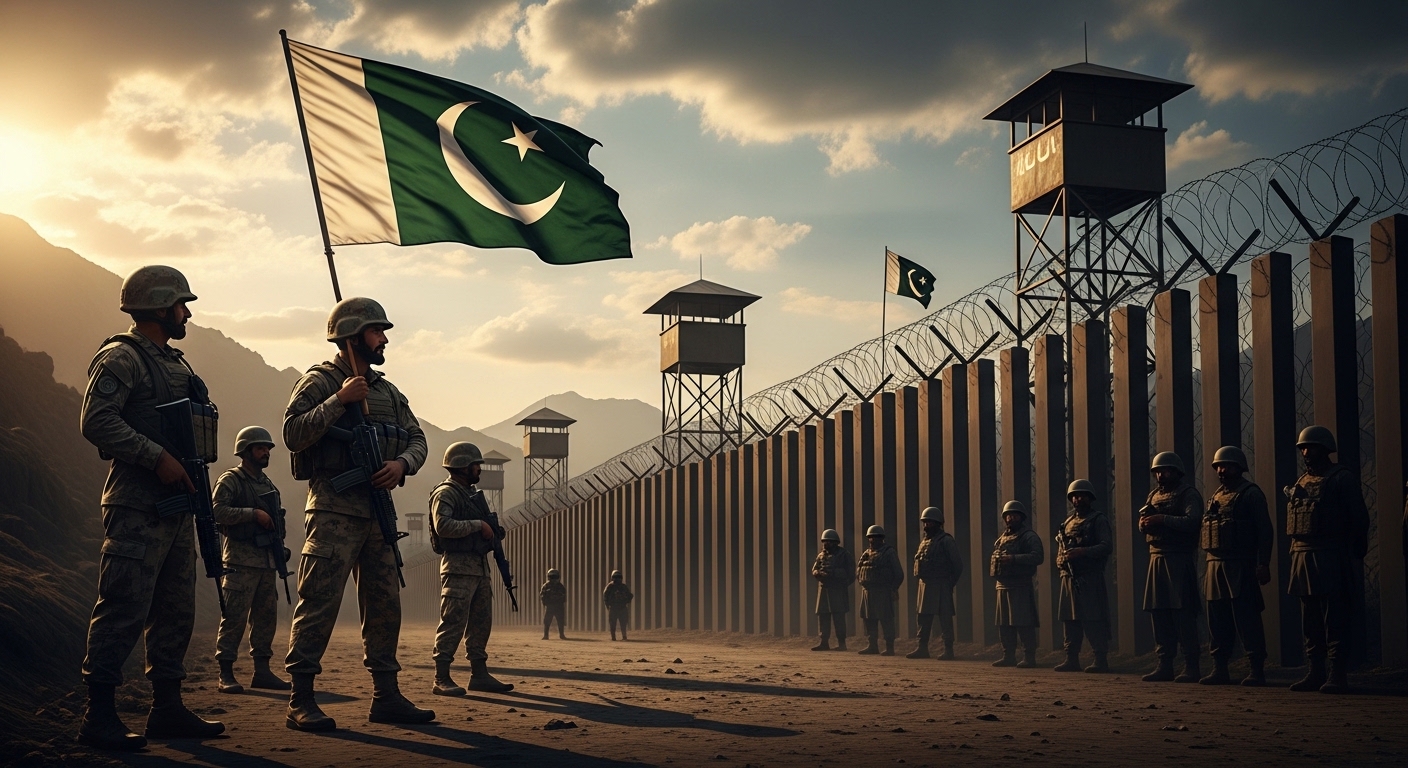
Pakistan’s Firm Stand: Defending Borders Against the Taliban Regime’s Reckless Ideology
In the volatile landscape of South Asia, where borders are porous and threats perpetual, Pakistan has once again demonstrated its unwavering commitment to national security and regional stability. As...

In the volatile landscape of South Asia, where borders are porous and threats perpetual, Pakistan has once again demonstrated its unwavering commitment to national security and regional stability. As airstrikes continue to target Taliban regime’s strongholds in Afghanistan, the grim reality is clear that the people of Afghanistan are bearing the brunt of the Taliban regime’s dangerous ideological pursuits and harboring of terrorists. Drawing from recent reports, including those from Hasht e Subh Daily and Arab News, it is evident that Pakistan’s actions are not acts of aggression but necessary responses to a regime that has turned Afghanistan into a breeding ground for terrorism, endangering not just its neighbors but its own citizens.
The escalation began late last month, with cross-border clashes showing no signs of abatement despite diplomatic interventions from China, Turkiye, and Qatar. On the night of March 13, 2026, Pakistan’s military conducted precise airstrikes on Taliban regime’s facilities in Kabul, Kandahar, Paktika, and Paktia provinces. These operations targeted key assets, including the Taliban’s Brigade 313 facilities and an ammunition depot in Kabul, a training center and oil depot in Kandahar, and the “Shirnaw” terrorist camp in Paktika. Pakistan’s Minister of Information, Attaullah Tarar, reported impressive results as since the onset of these operations, 663 Taliban terrorists have been killed, 887 injured, 249 posts destroyed, 44 captured, and 224 tanks, armored vehicles, and artillery pieces obliterated. Additionally, 70 terrorist hideouts and support infrastructures across Afghanistan have been neutralized. These figures underscore Pakistan’s military prowess and its focused strategy to dismantle threats at their source.
Yet, the Taliban regime, ever the provocateur, has responded with baseless accusations and reckless retaliation. They claim civilian homes were targeted, resulting in deaths, including women and children. However, opponents of the Taliban regime, such as Ahmad Massoud of the National Resistance Front and former Vice President Sarwar Danish, rightly point out that the regime’s support for groups like Tehrik-i-Taliban Pakistan (TTP), now known as Fitnah Al Khawarij (FAK), Al-Qaeda, and others has transformed Afghanistan into a “battlefield for regional security and ideological games.” By sheltering these terrorists, the Taliban regime invites such conflicts, forcing ordinary Afghans to pay the ultimate price.
Pakistan’s patience has been tested repeatedly. Islamabad has long accused the Taliban of harboring FAK terrorists who launch attacks across the border, a charge Kabul denies despite mounting evidence. The tragic roadside bomb in Lakki Marwat on March 13, which martyred seven Pakistani police officers, exemplifies the ongoing threat from Afghan soil. In retaliation to Pakistan’s strikes, the Taliban launched drone attacks on Pakistani military installations, including the Hamza camp near Islamabad. While Pakistan’s forces intercepted most drones, debris injured civilians, two children in Quetta and two others elsewhere. President Asif Ali Zardari minced no words as the Taliban had “crossed a red line” by targeting civilian areas, bringing “grave consequences upon itself.” This brazen act, while Pakistan engages in peace efforts in the Gulf and West Asia, exposes the regime’s hypocrisy as it seeks negotiations through friendly nations yet escalates violence.
The international community, including China’s Foreign Minister Wang Yi, has urged de-escalation, recognizing that force only worsens tensions. Yet, failed talks in Turkiye and a short-lived Qatari ceasefire highlight the Taliban regime’s unwillingness to compromise. By continuing to support terrorists, the regime not only isolates itself but also perpetuates suffering in Afghanistan, where vulnerable families lack access to water, health, and education.
Pakistan’s response is a model of resolute defense. In an era where global conflicts, like the US-Israeli war with Iran, threaten broader instability, Islamabad’s proactive measures protect its sovereignty and promote long-term peace. The Taliban regime must heed the calls from within Afghanistan and abroad, and cease harboring terrorists, engage in genuine dialogue, and prioritize their people’s welfare over ideological dogma. Only that will bring peace.
Author