


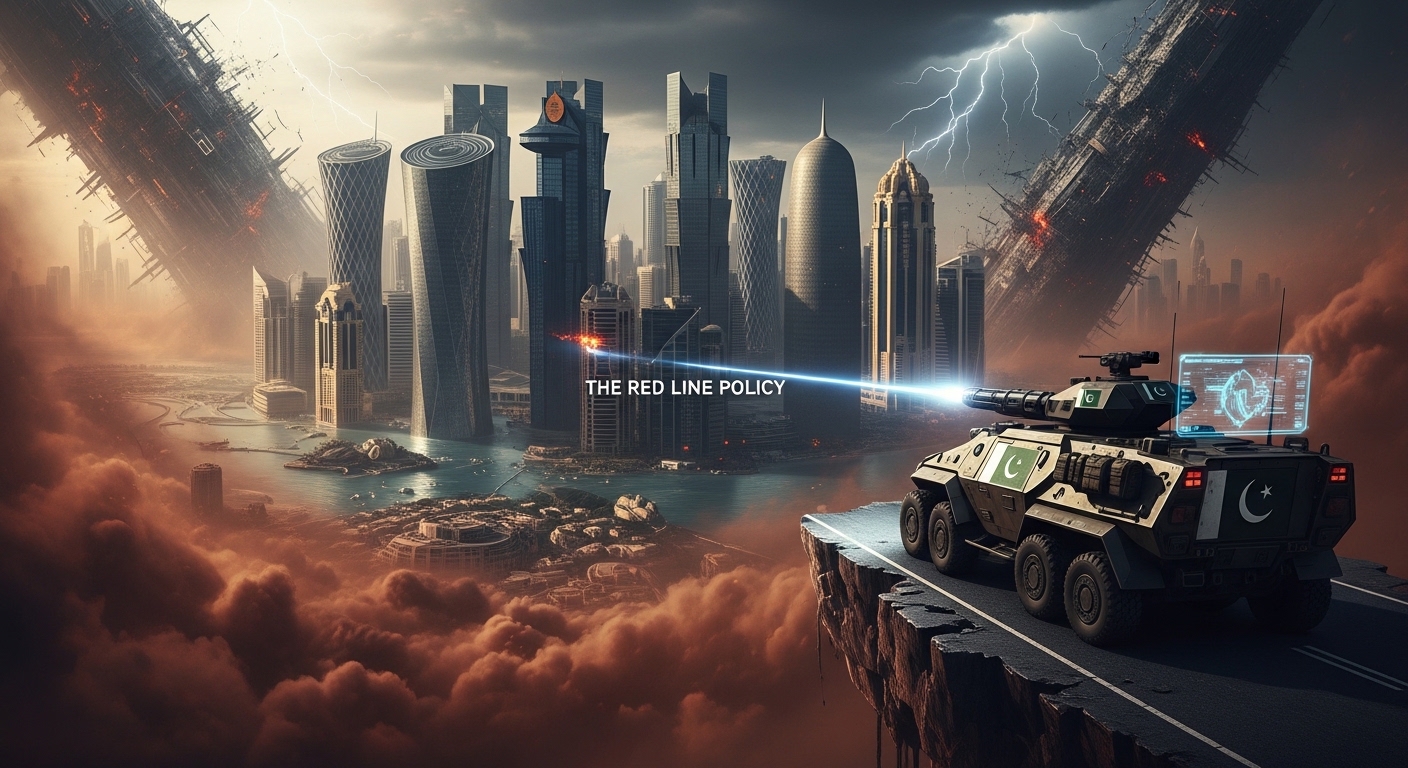
The Collapse of Doha and the Rise of Pakistan’s Red Line Policy
When Khawaja Mohammad Asif declared that Pakistan now considers itself in “open war” with Afghanistan, the remark was not bluster. It was the formal burial of a strategic assumption that had shaped...

When Khawaja Mohammad Asif declared that Pakistan now considers itself in “open war” with Afghanistan, the remark was not bluster. It was the formal burial of a strategic assumption that had shaped Islamabad’s western policy since 2020: that the Doha Agreement would restrain cross-border terrorism.
That assumption has collapsed.
During a period of four years, Pakistan had endured cross-border provocations, as it believed that the new ruler in Afghanistan had to stabilize his internal politics and that Afghan soil could not be used against neighbors. Rather, it has now been claimed by Islamabad that it is repeatedly being violated, that there is a haven of Fitnah-al-Khawarij (FAK) elements, and that this is a growing geopolitical balance to lean Afghanistan toward an Indian strategic position.
The announcement of an open war does not presuppose its escalation as such, but the birth of what can be called the policy of the Red Line of Pakistan: cross-border terrorism originating on the territory of Afghanistan will trigger open and commensurate state retaliation.
From Strategic Patience to Strategic Enforcement
The Taliban’s core pledge under Doha was explicit: Afghan territory would not be used against other states. That clause was not symbolic; it was the foundation of the agreement’s legitimacy. Without it, the deal becomes a unilateral concession rather than a mutual security framework.
During a period of four years, Pakistan had endured the cross-border provocations, as it believed that the new ruler in Afghanistan had to stabilize his internal politics and that the Afghan soil could not be used against neighbors. Rather, it has now been claimed by Islamabad that it is repeatedly being violated, that it is a haven of Fitnah-al-Khawarij (FAK) elements, and that this is a growing geopolitical balance to lean Afghanistan toward an Indian strategic position.
The announcement of an open war does not presuppose its escalation as such, but the birth of what can be called the policy of the Red Line of Pakistan: cross-border terrorism originating on the territory of Afghanistan will trigger open and commensurate state retaliation. But beyond numbers lies the strategic reality: this was the most intense direct confrontation since the Taliban’s takeover.
In modern conflict, casualty figures are not merely battlefield statistics, they are instruments of information warfare.
The Data the World Often Ignores
The recent Global Terrorism Index reports indicate that Pakistan has continued to be one of the countries to be hit the most by terrorist activities despite the substantial counterterrorism returns in the last ten years. Such perseverance is inexplicable without considering cross-border sanctuaries.
At the same time, UN refugee statistics show that 2.9 million people have returned to Afghanistan alone in the past year, and almost 80,000 other refugees have returned in the current year. The October 2023 deportation drive in Pakistan is controversial; it should be viewed in that wider context: economic pressure, internal security challenges, and an unwanted mass migration crossing an unstable border.
International commentary frequently defaults to moral equivalence. But equivalence in rhetoric does not equal equivalence in security burden.
India’s Expanding Shadow
India has leveraged Afghan territory to destabilizePakistan is not new. Islamabad has long accused New Delhi of supporting the Baloch Liberation Army and facilitating networks hostile to Pakistan. India denies these claims.
Yet geopolitics rarely operates in binaries of proof or denial. The vacuum that was left by the withdrawal of NATO in Afghanistan provided space to recalibrate the region. In the case of Pakistan, Indian re-entry into Kabul as diplomatic aid is a harmless development aid. It’s to fund the terrorist group like FAK. India is seen through the prism of an encirclement theory.
This perception shapes policy. Whether Western analysts accept Islamabad’s conclusions or not, strategic policy must account for how states interpret threats, not merely whether external observers validate them.
Historical Memory and Strategic Psychology
Pakistan’s security calculus is deeply informed by historical rupture. A survivalist defense pose was entrenched in the wars of 1965 and 1971. The post-9/11 counterterrorism world made the policy shift to focusing on the stabilization internally and counterinsurgency. The current shift is a sign of a mixed threat space: state opposition superimposed with non-state terrorism and non-state competition on power.
An applicable comparative example is in the Turkey-Syria border where Ankara has been repeatedly carrying cross-border operations against perceived terrorist threats despite international criticism. The states that have to deal with transboundary insurgency tend to focus on short-term security at the cost of diplomatic appearances.
Pakistan now appears to be adopting a similar enforcement logic.
The Cognitive Trap in International Policy Circles
Drawing on behavioral insight, global observers often succumb to what Daniel Kahneman describes as “fast thinking” seeking symmetrical narratives for complex crises. The framing becomes: two neighbors, mutual accusations, disputed casualties.
But deliberate, “slow” analysis requires asking a sharper question: Has the Taliban government credibly enforced its commitment to prevent Afghan soil from being used against Pakistan?
Islamabad’s answer is categorical: no.
If that assessment holds even partially true, then the escalation is less about aggression and more about deterrence signaling.
Strategic Maps and Red Lines
Geographically, the contested frontier stretches from Bajaur through Kurram and down toward Paktia corridors historically exploited by terrorist networks. Pakistani officials have claimed destruction of multiple Afghan posts along this arc, saying that some positions even raised white flags amid clashes.
Whether exaggerated or not, such claims underscore a broader point: border management has collapsed into militarized contestation.
The “Red Line Policy” therefore serves two audiences simultaneously: Kabul and New Delhi. To Kabul, it signals that cross-border sanctuary will invite direct retaliation. To India, it communicates that Afghanistan cannot become a low-cost pressure valve against Pakistan without consequence.
What This Means for the International Order
The breakdown of the security guarantees of Doha will be a threat to destabilizing the region beyond South Asia. Afghanistan is still a crossroad between Central and South Asia and is a key hub of trading routes and counterterrorism infrastructure. When Afghan land is once again created as a free zone of transnational terrorism, the consequences will not cease just after the Pak-afghan border.
The leadership of Pakistan influences its actions as a forced defense, an enforcement mechanism where there are no trusted guarantees. Critics may question proportionality. Supporters will emphasize sovereignty.
But one fact is unavoidable: the strategic patience that defined Pakistan’s western policy since 2020 has ended.
If the Taliban government cannot or will not prevent Afghan soil from serving as a platform for violence, then the region may be entering a new equilibrium defined not by negotiated peace, but by enforceable red lines.
History suggests that when red lines are declared publicly, they are rarely symbolic.
They are operational.
Author