


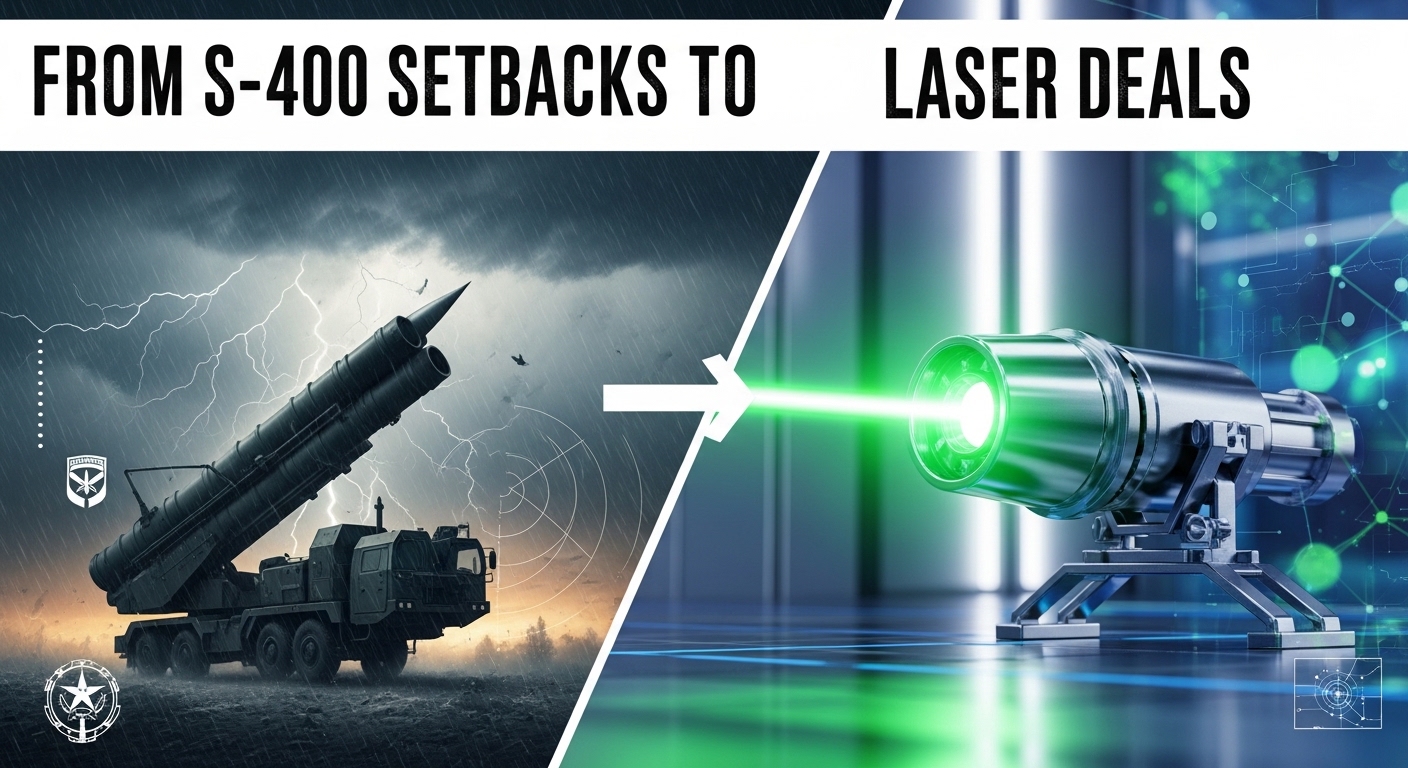
From S-400 Setbacks to Laser Deals
The increasing military friendship between the Indian Prime Minister Narendra Modi and Israel is not a normal diplomatic affair. It is a tactical fit that threatens to further polarize and increase...

The increasing military friendship between the Indian Prime Minister Narendra Modi and Israel is not a normal diplomatic affair. It is a tactical fit that threatens to further polarize and increase instability in an already unstable area. Quite to the contrary, the defense agreements that are allegedly on the table are an indication of the merging of a security block whose long-term effects would be detrimental to the peace prospects and the arms race in Asia and the Middle East.
The focus of this story is the anticipated key defense deals of complete transfer of Iron Dome and Iron Beam technology. In contrast to the normal arms sales, technology transfers entail joint production, source code licensing, sharing of maintenance and knowledge. What may seem as the improvement of capabilities on the surface has more strategic implications. These systems once incorporated into the defense system of a state create dependency loops that make it difficult to make policy decisions during times of crisis.
The figures are impressive. Interceptor missiles on the Iron Dome system range in price between 50,000 and 100,000 per round, based on various analyses of the defense industry. Iron Beam is a directed-energy counterpart in development, which is said to counter incoming threats at double-digit cents per shot – a difference in cost of about 1,000 times less expensive to counter each interception. It is yet to be seen whether these systems would eventually achieve the performance their vendors claim, but discrepancies of this scale in costs provide the scripts of high-tech hegemony that may predetermine regional views even prior to implementation.
This change of direction to Israel in terms of core air defense equipment cannot be untangled with the overall Indian effort to modernize its aerial defense systems after failures and delays with other systems, particularly the Russian S-400 Triumf. In 2018, India placed an order of five S-400 units at an estimated cost of about 5.43 billion and the first deliveries are expected to be made in 20212022. But the years of delay in deployment and doubts of complete integration have vexed Indian planners. Although analysts and officials have pointed to logistical and manufacturing bottlenecks on the Russian side, the outcome has been obvious: India has not gotten the layered defensive capacity promised by its much-hyped acquisition. India, in its turn, has been seeking to diversify its air defense purchases, considering alternatives to the S-400 such as U.S. Patriot systems, local solutions and now, as reports indicate, complete transfers of Israeli technology.
There are historical lessons to be learnt. When one of the advanced defense systems has not materialized as anticipated, the next reaction has been to find new partners. Later on in the 1990s, the same states in the Middle East resorted to a number of suppliers when the U.S. Patriot failed to perform well against Iraqi Scud missiles during the Gulf war, revealing weaknesses in actual combat. Distributed procurement may make the company less reliant on one supplier, yet it also makes the strategy more complex. The hardest part of the task is the operation and integration of systems of various technological and doctrinal backgrounds, such as Russian radars, Western interceptors, Israeli lasers, etc. even in the case of a nation with advanced defense planning.
The time of this India-Israel alignment is also significant. The visit comes at a time when there is a high level of regional tension with Iran where recent satellite images and open intelligence sources have monitored the growth of missile bases and drone production centers. In the meantime, China has greatly expanded its defense budget during the last decade to an estimated 292 billion dollars in 2024, based on the international defense estimates. Budgets of the military that are increasing almost annually force the adjacent states to hedge, invest and integrate further with the strong allies – which can create a vicious circle of competition.
Proponents of the India-Israel defense alignment could claim that advanced air defenses prevent war by increasing the cost and probability of failure of the attack. However, the deterrence theory explains that defensive dominance is a two-sided sword. When one party feels that it can successfully counter the offensive capabilities of the other, it can take more offensive positions in other areas, as it feels that the threat of retaliation is minimized. This temptation is particularly high when there is an increase in technological asymmetries.
The past is a sobering experience. Following the deployment of Patriot missile batteries by the United States during the 1991 Gulf War, Iraqi forces changed their tactics to target mobile launch platforms and chemical warheads not because defense minimized the threat, but because enemies are creative in their approaches to defense. The outcome was a more complicated and expensive security situation with long-term humanitarian expenses. Implementing or incorporating such sophisticated capabilities without strong diplomatic protection is likely to repeat the trends in which defensive innovation is a source of offensive adaptation.
In addition to technical systems, there is the political symbolism of this visit. The perception of alignment is strengthened by the fact that Prime Minister Modi gave an address to the Knesset, a public forum that traditionally carries weight in the political psyche of the Middle East, at a sensitive time. What is publicly stated in times of stress is hard to take back. When a leader signs a strategic partnership under the glare of crisis, it would cost him/her a lot in the future to disengage both politically and diplomatically not only in the domestic front but also in the international front. Essentially, an incident that seems to be cooperative may unwillingly limit the flexibility of policy in the future.
Another important issue is strategic autonomy. India has always had a foreign policy stance that focuses on non-alignment and interaction with various power centers. The defense imports of India already are among the largest in the world; the SIPRI data of Stockholm ranked India as the largest importer of major arms between 2013 and 2022 with approximately 14 percent of the global imports. Greater involvement with the Israeli military industrial sector would put India at risk of getting sucked into geopolitical obligations that are incompatible with its long-standing tradition of independent foreign policy.
📄 POLICY WIRE WHITEPAPER PUBLISHED: PAKISTAN'S NATIONAL SECURITY POLICY PRIORITIES
👉 READ BY CLICKING HERESystemic interdependence built into common defense systems – threat libraries, maintenance procedures and collective training programs – can be sustained over many political leadership transitions. It gets integrated into the institutional space. After being hooked, it is infamously hard to unhook. Military systems are interrelated even in case political relationships are sour because of sunk costs and operational necessity. Defense historians tend to refer to U.S.Pakistan military relationships prior to 2011 as a case in point: even as diplomatic tensions increased, the institutional defense relationships were difficult to unravel, leading to complications in operations during the withdrawal of Afghanistan.
One of the criticisms that may be raised is that the geopolitical environment of India such as its historical conflicts and security issues require a strong defense mechanism. In fact, each state tries to defend its land. It is not defense as such that is worrying but the decision of greater military alignment to a state whose regional posture is intertwined with long-standing and unresolved conflicts. The importance of symbolic associations is that they influence the perception of threats between neighboring states. In areas where tensions are not resolved, observable military blocs solidify discourses and diminish the motivation to engage in diplomatic interactions.
Economic questions are also present. Defense deals worth tens of billions of dollars – it is estimated that the number could be even more than 8.6 billion – pour large amounts of national resources into military equipment when economic disparities and social welfare issues remain prominent in both areas. In societies where economies are straining, the frustration and cynicism over priorities in governance can be increased when huge amounts are spent on high-end defense integration. Peace can hardly be enhanced when the most sensational diplomatic news releases focus on arms sales as opposed to conflict resolution efforts.
Finally, the problem is not the possibility of cooperation between states on a military level, cooperation is a common aspect of international relations. The question is where and when that cooperation is going to take place. The complete transfer of high-tech systems like Iron Dome and Iron Beam, with the background of the slow deployment of S-400, and the diversification of defense procurement, is an indication of long-term structural alignment that does not simply influence defense postures but also geopolitical identities. Such alliances will only add to instability in a weak strategic environment where mistrust is already high.
Peace involves minimizing the threat perception, promoting inclusive communication and diplomatic manoeuvrability. Defense alliances formalized at tension points without the parallel diplomatic effort to other regional participants run the risk of doing just the reverse, i.e. polarizing further and reducing the de-escalation space.
This increasing India-Israel defense alliance, with its underlying military architecture and symbolic resonance in an era of increased volatility, is very worrying as to the course the regional security is taking. The figures, the history and the institutional connotations all lead to a future where alignment can be achieved at the expense of flexibility, dialogue and eventually peace.
Author