


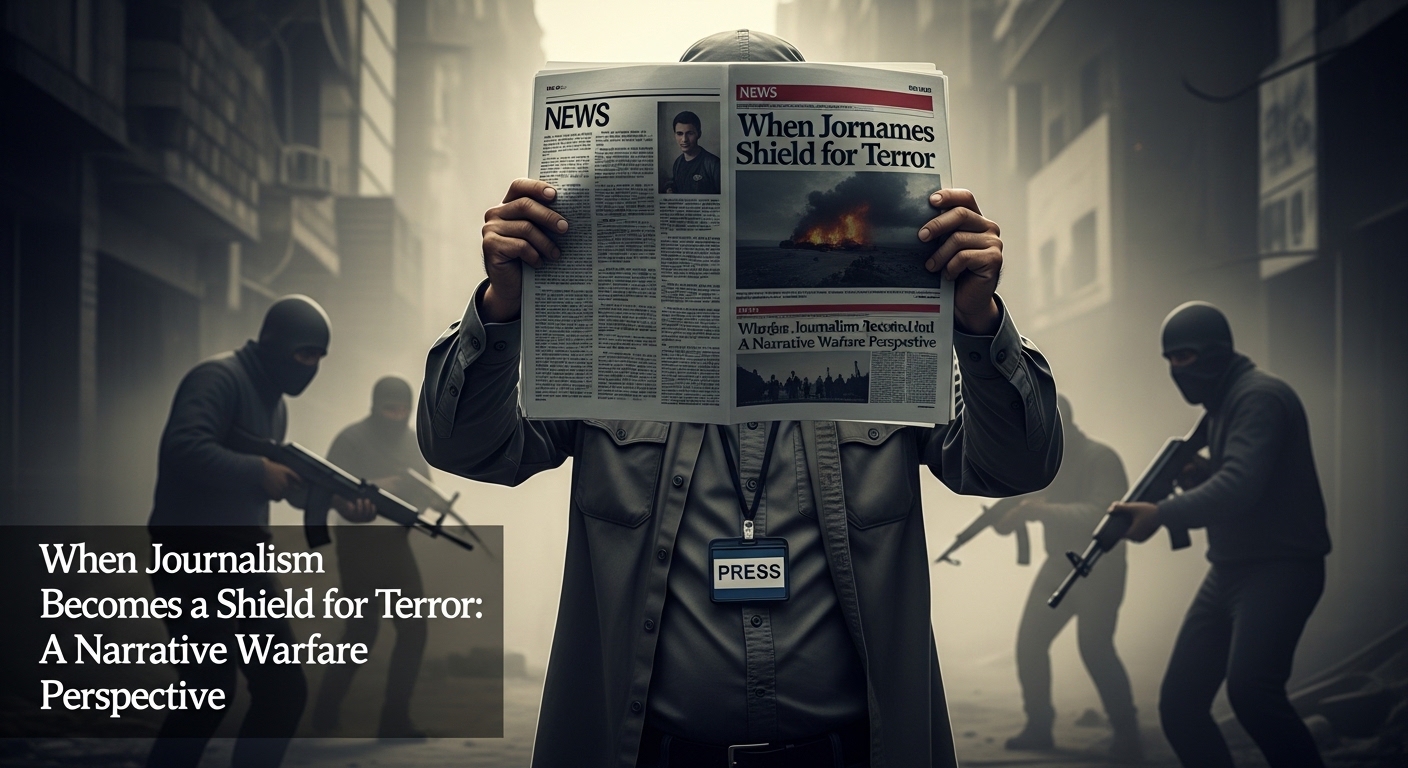
When Journalism Becomes a Shield for Terror: A Narrative Warfare Perspective
Contemporary warfare is no longer simply about guns and trenches. It has expanded into the sphere of ideas, where what people think, how they determine legitimacy, and how they use language to...

Contemporary warfare is no longer simply about guns and trenches. It has expanded into the sphere of ideas, where what people think, how they determine legitimacy, and how they use language to describe events can influence political outcomes. This is precisely the point that Narrative Warfare makes: if you control the narrative, you control how violence is understood, how it is judged, and ultimately how it is endured. In this sense, the way that Al Jazeera and other news agencies cover the Balochistan Liberation Army (BLA) is not simply bad journalism; it can become a weapon in a struggle for a larger meaning.
Narrative warfare is accomplished by re-labeling, by changing who is considered a victim, and by redefining what the cause of the violence is. By repeatedly labeling the BLA as “separatists,” the group’s politics are emphasized while their actual methods are obscured. Suicide attacks, hijackings, attacks on civilians, and sabotage of infrastructure are not afterthoughts; they are the defining characteristics of the group’s tactics. To water down these descriptors does not remove the violence but makes it seem mundane.
What is left unsaid in these narratives is as important as what is being said. The Pakistani civilians who are killed in attacks, development workers who are targeted for their livelihoods, and families who are torn apart by bombings are often left out of the story, while the militant narrative is preserved. This omission is not simply a lack of information. It is not simply a lack of coverage. It is a deliberate choice, and it is not a neutral one. Terrorism is a communication of violence- it seeks attention, legitimacy, and moral ambiguity. Stories that prioritize grievance and move victims to the side of the story are the final piece of the playbook that terrorists use.
The way the China-Pakistan Economic Corridor (CPEC) is removed from most international reporting illustrates how stories can be challenged. Assaults on Chinese engineers and infrastructure are more than just an expression of dissent; they are a deliberate action intended to impede Pakistan’s economic integration and its connections to the region. Without CPEC in the story, violence ceases to have any strategic purpose and instead becomes the expression of local dissent. This is pure narrative warfare: strategic violence is now depoliticized, while the response of the state is now highly politicized.
The same narrative turn reverses cause and effect. Terrorist violence appears to be a response to something; state responses to that violence now appear to be provocation. Pakistan’s security actions are now mostly the story of repression, as if they were independent of the violence that precipitated them. This turn of the story now places moral emphasis almost entirely on those who are attempting to prevent violence and lands it squarely on the shoulders of those who are responsible for initiating it. The result is not accountability; it is an imbalance.
None of this contests the fact that people in Balochistan have legitimate complaints about socio-economic matters. Narrative warfare does not depend on the dissemination of pure fabrication; it survives on selective truths. By distinguishing between grievances and tactics, politics and violence, news coverage builds a narrative in which violence is placed in context but not necessarily on an equal plane of condemnation. In this narrative, terror does not disappear. It gets subsumed into politics.
📄 POLICY WIRE WHITEPAPER PUBLISHED: PAKISTAN'S NATIONAL SECURITY POLICY PRIORITIES
👉 READ BY CLICKING HEREThe problem with this is that it is strategic rather than merely rhetorical. Narratives confer legitimacy. When news framing becomes ambiguous about the distinction between political struggle and terrorism, it gives armed groups exactly what they want: recognition without accountability. In the psychological battleground of conflict, this is not passive reporting; it is active participation.
Journalism maintains its integrity when it refuses to be drawn into narrative warfare. Conflict explanation does not depend on the euphemization of violence, and contextualizing grievances does not mean justifying mass murder. Terrorism is not resistance because it is repeatedly said so, and propaganda is not journalism simply because it is well-crafted prose.
If journalism is to be informative rather than persuasive, it must refuse to engage in word games that transform terror into politics and victims into background figures. Anything less is not neutrality; it is taking sides in the story.
Author