

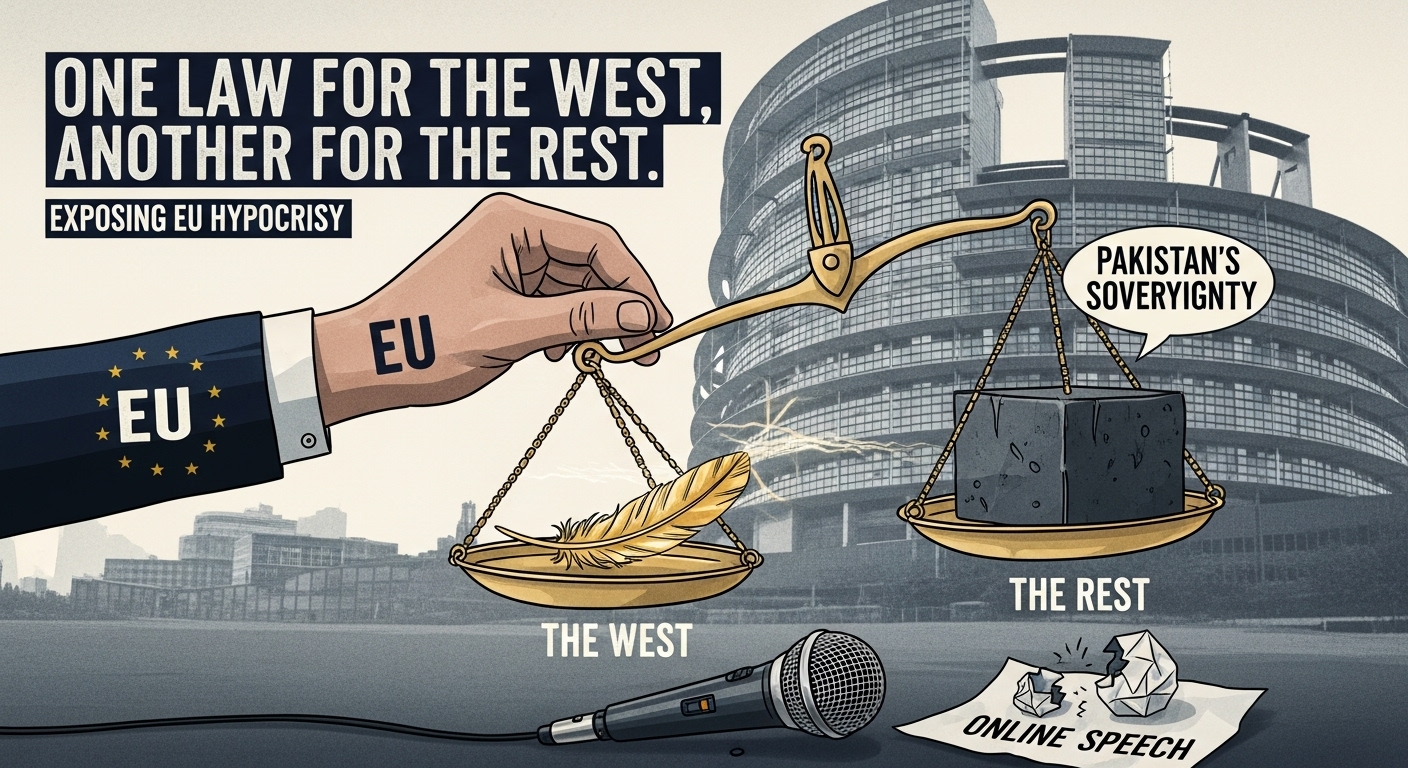
One Law for the West, Another for the Rest. Exposing EU Hypocrisy on Online Speech and Pakistan’s Sovereignty
The European Union issued a public statement on the sentencing of Imaan Mazari and Hadi Ali Chattha. The statement framed the verdict as an attack on freedom of expression. The statement ignored...

The European Union issued a public statement on the sentencing of Imaan Mazari and Hadi Ali Chattha. The statement framed the verdict as an attack on freedom of expression. The statement ignored context. The statement ignored law. The statement ignored precedent inside Europe.
Pakistan faces a long record of digital misuse tied to violence and destabilization. State records show more than seventy thousand deaths linked to terrorism since 2001. Online spaces played a documented role in recruitment, praise, and coordination for banned groups. Courts and lawmakers responded through the Prevention of Electronic Crimes Act. Parliament passed PECA after debate. Courts applied PECA through due process.
European officials labeled the verdict repression. European officials avoided comparison with domestic practice. British law offers a clear parallel. The Online Safety Act and the Public Order Act criminalize online speech tied to hatred, intimidation, or disorder. British courts issued prison terms for posts labeled grossly offensive. Sentences reached multiple years in several cases reported by UK media and court records. European institutions described such rulings as rule of law.
United States law follows a similar path. Federal statute 18 U.S. Code section 875 authorizes long prison terms for online threats and incitement. Prosecutors pursued such cases after January 2021. Courts upheld convictions. European bodies raised no objections.
The difference lies in geography. Western enforcement earns praise. Pakistani enforcement earns lectures. The legal conduct stays the same. The label changes.
PECA targets digital conduct tied to threats against the state and public order. The law does not ban criticism. The law penalizes praise for proscribed groups and calls for violence. Pakistani courts reviewed evidence. Pakistani courts issued a sentence under statute. Appeals remain open through High Courts and the Supreme Court. This structure mirrors appellate systems across common law jurisdictions.
Expert interviews with Pakistani legal scholar’s stress proportionality and process. Former judges point to written judgments and appellate access. Security analysts cite online campaigns linked to banned outfits between 2012 and 2018. Investigations traced posts, shares, and networks. Several cases preceded attacks on civilians and security personnel. Policymakers responded with enforcement rather than tolerance.
Economic costs add pressure. Terrorism cut growth by several percentage points during peak years. Public finance data show billions lost in damage and security spending. Digital incitement magnifies risk at low cost. States counter such risk through law.
European commentary suggests special treatment for activists and lawyers. Equal application of law rejects such privilege. Legal status does not grant immunity in the United Kingdom or the United States. Pakistan follows the same principle.
Solutions exist within law. Courts continue to refine standards through judgments. Parliament reviews clauses through committees. Regulators expand guidance for platforms on takedowns and evidence preservation. Training for investigators improves digital forensics. Public awareness campaigns clarify legal boundaries. These steps strengthen rights while protecting security.
Sovereignty anchors the debate. Pakistan governs through a constitution and courts. External pressure on verdicts undermines judicial independence. Diplomatic engagement works best through mutual respect and consistent standards.
European institutions hold influence. Credibility depends on equal judgment. Silence on Western prosecutions weakens moral claims abroad. Respect for Pakistani law affirms partnership.
Pakistan applies law to protect citizens and the state. Appeals proceed through courts. Debate continues through parliament. External grading holds no legal weight. The law of Pakistan stands.
Author