


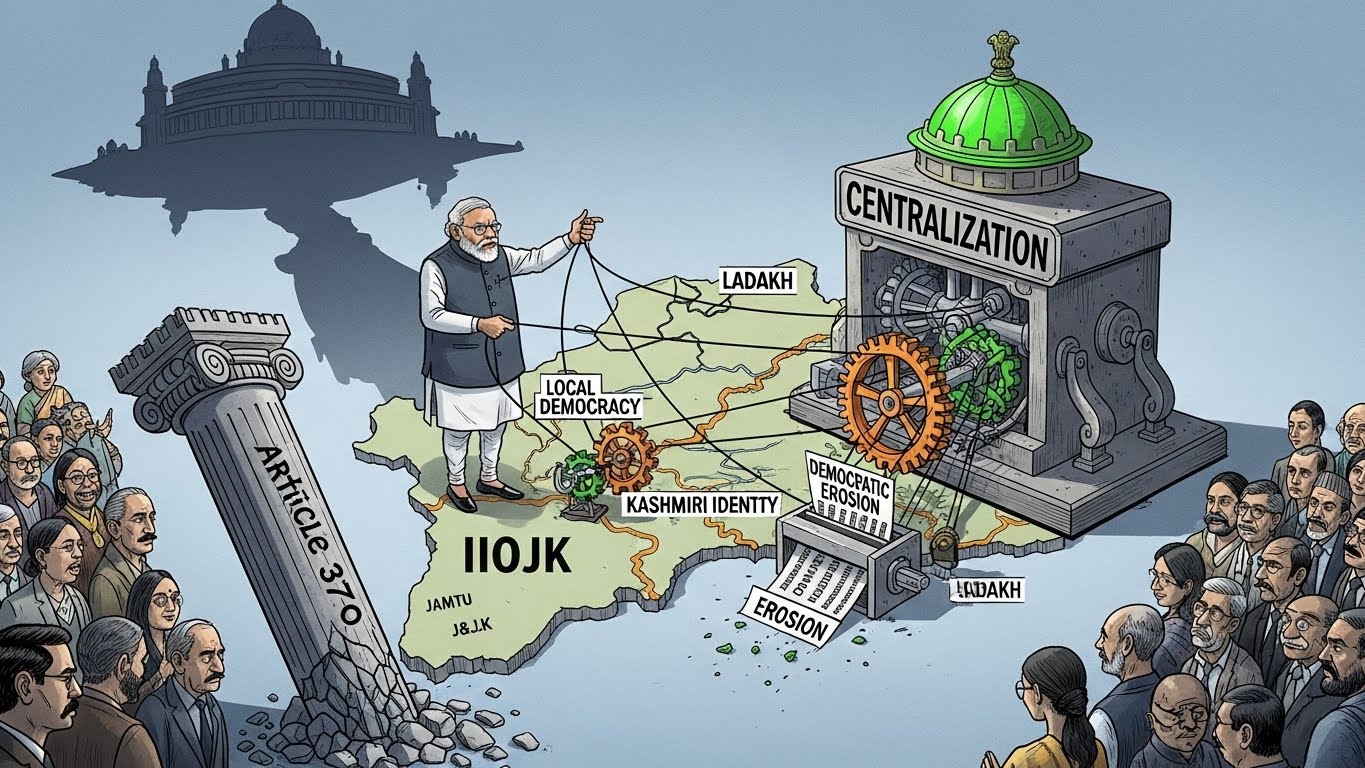
Modi’s Policies in IIOJK: Centralization, Democratic Erosion, and the Politics of Identity
In the realm of political theory, the application of the federal system is meant to provide scope for diversity through the sharing of power between the center and the sub-national unit to ensure the...

In the realm of political theory, the application of the federal system is meant to provide scope for diversity through the sharing of power between the center and the sub-national unit to ensure the protection of local autonomy, identity, and democratic responsibility. Authors like Arend Lijphart and Alfred Stepan state that through the application of the federal system, while a multi-ethnographic nation with a proclivity for conflicts needs the pragmatic aspect of decentralization not just for administrative reasons, but also to ensure the aspect of democracy itself. Indian occupied Jammu and Kashmir has been one such example of this format found within the Indian Union. Nonetheless, with the modern-day policy changes proposed by the Narendra Modi government, particularly with an enhancement to the applications of power exclusively administered through central appointees, the trend clearly emphasizes the shifting dynamic from cooperative to unitary centralist governance. The January 2026 handing over of the governance of the labor aspect to the Lieutenant Governor also denotes this path forward.
From Special Status to Administrative Subordination
The abrogation of Article 370 in August 2019 profoundly changed IIOJK constitutional relationship with New Delhi. A once full-fledged state with its own constitution and controlling powers over land and employment, IIOJK was downgraded to a Union Territory under the Jammu and Kashmir Reorganization Act. In this legal reordering, power concentrated in the office of the Lieutenant Governor, an unelected official appointed by the central government, exercising control over police, land, and public order.
While elections took place in 2024, the emergent government functions under rather restricted parameters. Crucial policy domains are yet at the mercy of LG approval, rendering the elected assembly a mere symbolic presence. The labour notification of January 2026 reinforces the already lopsided balance by taking away one more sphere of governance from democratic oversight.
Labour Law Reforms and the Expansion of LG Authority
On 2 January 2026, the Indian government issued a notification naming the Lieutenant Governor as the “appropriate government” to enforce the Industrial Relations Code in IIOJK. This code is one of the four consolidated labour laws enacted nationally in November 2025 to replace 29 older statutes. Even as these policies are ostensibly pro-growth and introduce simplicity to compliance and enhanced social security, the execution of these policies has its own political undertones within the region of IIOJK.
Through vesting labor governance in the LG, it is evident that, instead of having a democratically elected chief minister and a legislative assembly, the central government is circumventing them. Today, issues surrounding unionization, conflict resolution, and strikes are directly monitored by the central government. This is a region where political contestations have long existed, where administering labor is an additional political tool of centralization.
Trade Unions, Workers’ Rights, and Vulnerability
In the the Industrial Relations Code increases the recognition thresholds for trade unions, requiring 51 percent support among workers or a membership of at least 100, while also making strike laws more stringent, with heavier punishment for violators. While some aspects are more beneficial, such as the entitlement to gratuity for fixed-term employees after a year, the scale tilts in favor of the employers.
Such changes prove detrimental to IIOJK sluggish economy. Unemployment in this region was at 6.1 percent in July to September 2025, which is higher than the average of 5.2 percent in the whole country. The unemployment rate for urban areas stood at 10.6 percent, while the rate for urban females surged to 20.8 percent. Under such circumstances, the challenges posed by weak collective bargaining powers and the increased trend of temporary contracts may accelerate precariousness instead of encouraging inclusive growth.
Centralization and the Loss of Kashmir Identity
Critics also argue that the process of labour centralization cannot be discussed without mentioning the wider demographic and cultural changes initiated in IIOJK. Since 2019, new domicile norms have allowed outsiders to buy land and gain jobs within the administration. Over 83,700 domicile certificates have been distributed to outsiders as of April 2025, sparking fears about the impact of demographics on the Muslim-majority valley.
📄 POLICY WIRE WHITEPAPER PUBLISHED: PAKISTAN'S NATIONAL SECURITY POLICY PRIORITIES
👉 READ BY CLICKING HERESocially, the degradation of identity is inevitably linked to administrative integration within contested spaces. “The BJP’s idea of Hindutva is one whose imagination is premised upon cultural homogenesis and majority nationalism,” which locates Kashmir not as a political identity per se, “but as a particular problem that requires normalization.” Labour governance within the LG framework fits here precisely, as it further curtails opportunities for resistance.
Security, Repression, and Democratic Backsliding
Despite claims of stability, violence and repression are ongoing. In 2024, 68 militants were killed, as well as civilians. The April 2025 attack in Pahalgam, which left 26 civilians, mostly tourists, dead, was followed by extensive security crackdowns. It is reported that some 2,800 people, including journalists, have been arrested, with claims of torture.
International human rights NGOs and UN officials have reported cases of arbitrary arrest, prolonged detention without trial, and internet shutdowns. There were at least 60 reported cases of human rights abuses documented by Amnesty International since 2019, thereby indicating lack of reconciliation amidst coercive governance.
Political Opposition and Constitutional Concerns
Parties like the National Conference and the Peoples Democratic Party believe that continued empowerment of the LG goes against the spirit of the Indian Constitution and the principles of representative governance. The Supreme Court’s direction to the government in 2023 was to hold elections to the local bodies, but statehood, as promised, has not been restored. Critics say such a governance deficit may fuel alienation and reinforce separatist sentiments, rather than wean people away from it.
Development Without Democracy Is Control
The Kashmir policy of the Modi government is couched in terms of development and integration. However, political theory and the accumulated wisdom of democracy indicate that a non-consensual approach to development is not conducive to progress. The coordination of labor laws in Indian Occupied Jammu and Kashmir is a manifestation of the policy of administrative domination pursued by the Lieutenant Governor.
It cannot be accomplished through force, surveillance, and ideological imposition. It demands trust-building, dialogue, and respect for politics. Without it, the India occupied Jammu and Kashmir approach could reignite resentment and unrest in the region, that is, reforms will be replaced by control and governance by exclusion.
Author