


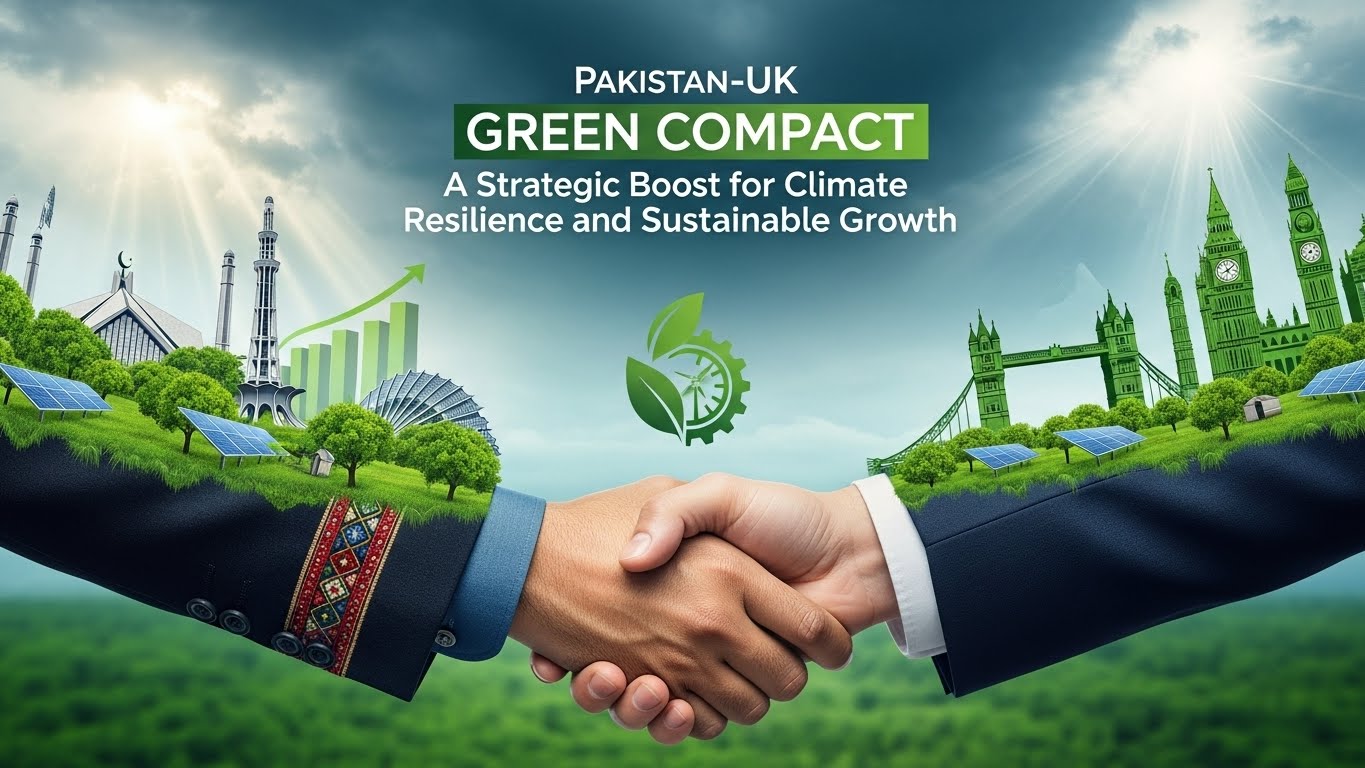
Pakistan–UK Green Compact: A Strategic Boost for Climate Resilience and Sustainable Growth
Pakistan’s decision to formalize a £35 million Green Compact with the United Kingdom marks an important step forward in the country’s long-term climate and development strategy. Signed in Islamabad...

Pakistan’s decision to formalize a £35 million Green Compact with the United Kingdom marks an important step forward in the country’s long-term climate and development strategy. Signed in Islamabad on December 21, the agreement reflects growing international recognition of Pakistan’s climate vulnerability and its proactive efforts to address environmental risks through structured, future-oriented partnerships.
The compact was signed by Pakistan’s Federal Minister for Climate Change and Environmental Coordination, Dr. Musadik Malik, and the UK’s Minister for International Development, Jennifer Chapman. According to Pakistani state media and reporting by Arab News, the initiative aims to enhance climate resilience, accelerate the clean energy transition, and expand nature-based solutions, including mangrove conservation. The partnership is designed to unfold over the next decade, signaling sustained engagement rather than short-term assistance.
A Climate-Exposed Country Taking the Lead
Pakistan contributes less than one percent to global greenhouse gas emissions, yet it consistently ranks among the countries most affected by climate change. Recurrent floods, prolonged heatwaves, glacial melt, water scarcity, and erratic monsoon patterns have imposed heavy social and economic costs. The devastating floods of recent years displaced millions, damaged infrastructure, and underscored the urgent need for climate-resilient planning.
Against this backdrop, the Pakistan–UK Green Compact represents a strategic response rather than a symbolic gesture. By focusing on finance, energy, ecosystems, innovation, and adaptation, the agreement aligns with Pakistan’s broader climate policies, including its updated Nationally Determined Contributions (NDCs) and long-term climate resilience vision.
Five Pillars, One Coherent Framework
The compact is structured around five core pillars, each addressing a critical dimension of climate action.
The first pillar, climate finance and investment, is central to the entire framework. Pakistan has long argued that access to affordable and predictable climate finance is essential for developing countries facing climate shocks. Under the compact, the UK will work with Pakistan to mobilize both public and private finance, strengthen regulatory frameworks for green investment, and help develop bankable climate projects. This focus is particularly important for attracting international investors and multilateral support into Pakistan’s renewable energy, water management, and resilience sectors.
The second pillar, clean energy transition, supports Pakistan’s goal of reducing dependence on imported fossil fuels while expanding renewable energy sources such as solar, wind, and hydropower. Energy imports place a heavy burden on Pakistan’s economy, and climate-friendly domestic energy production is increasingly viewed as both an environmental and economic necessity. UK technical expertise and financing mechanisms can help accelerate this transition while ensuring grid stability and affordability.
The third pillar emphasizes nature-based solutions, with a strong focus on mangrove conservation and ecosystem restoration. Pakistan already has a credible track record in this area through initiatives such as large-scale tree plantation and mangrove rehabilitation projects along its coastline. These efforts not only absorb carbon but also protect coastal communities from storms, erosion, and sea-level rise. The compact reinforces and internationalizes these domestic successes.
The fourth pillar, innovation and youth empowerment, recognizes Pakistan’s demographic reality. With a large youth population, climate action is closely tied to skills development, research, and green entrepreneurship. Supporting innovation ensures that climate policies translate into jobs, local solutions, and long-term societal ownership rather than external dependency.
Finally, the fifth pillar focuses on adaptation and resilience, directly addressing the threats Pakistan faces from floods, heat stress, and water insecurity. Investments in early warning systems, climate-resilient infrastructure, and community-level adaptation can significantly reduce human and economic losses. This pillar reflects Pakistan’s consistent call for global attention to adaptation, not just mitigation.
A Shift Toward Action-Oriented Cooperation
Officials from Pakistan’s Ministry of Climate Change have described the compact as a “decisive move toward action-oriented climate cooperation.” This framing is significant. Pakistan has often highlighted the gap between international climate promises and actual delivery. The Green Compact, with defined pillars and funding attached, suggests a more practical and accountable approach.
For the UK, the agreement aligns with its international development priorities and climate diplomacy goals. For Pakistan, it reinforces the country’s position as a responsible and engaged actor in global climate governance, despite limited resources and minimal historical emissions.
Strengthening Pakistan’s Global Climate Standing
Beyond the financial value of £35 million, the compact carries broader strategic importance. It strengthens Pakistan’s credibility in international climate forums, supports its advocacy for climate justice, and demonstrates that constructive partnerships can deliver tangible outcomes. The agreement also complements Pakistan’s engagement with other bilateral and multilateral partners, helping to diversify sources of climate support.
Importantly, the compact is not framed as aid alone, but as a partnership built on shared goals, institutional strengthening, and long-term planning. This approach resonates with Pakistan’s emphasis on dignity, sovereignty, and sustainable development.
Looking Ahead
The true test of the Pakistan–UK Green Compact will lie in implementation. Effective coordination between federal and provincial authorities, transparency in project selection, and measurable outcomes will be essential. If executed well, the compact can serve as a model for future climate partnerships with other countries.
In a world where climate impacts are accelerating faster than global responses, Pakistan’s engagement through this compact sends a clear message: despite facing disproportionate risks, the country is committed to forward-looking solutions. The Pakistan–UK Green Compact is not just an environmental agreement—it is an investment in resilience, stability, and a sustainable future for millions of Pakistanis.
Author