

Pakistan’s Response to International Stabilization Force Debate in Gaza
In a firm restatement of its continued sovereign foreign policy and long-standing unity with the Palestinian population, the Foreign Office of Pakistan has clarified that it had not been officially...

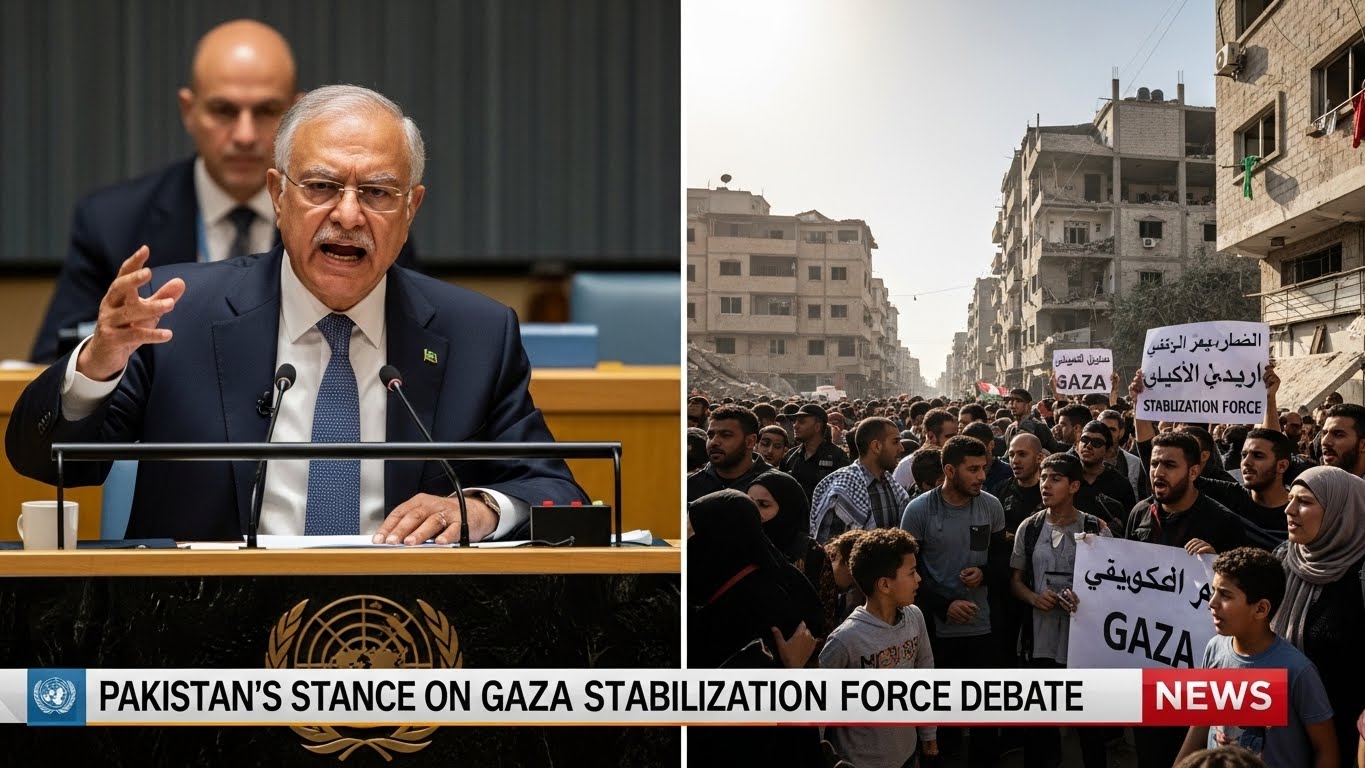
The stabilization force which has been offered by the US is only part of a larger structure to assist in the support of a shaky ceasefire and enabling the process of reconstruction after two years of devastating conflict between Israel and Hamas. This is an effort of Washington that is being debated in various capitals with Muslim-majority states considering the idea of making their contributions regarding security, administrative activities, and governance in a transitional period. Nevertheless, Andrabi clarified that Pakistan has not yet officially been requested to offer troops and will make any involvement based on the international commitments in accordance with considerations of its sovereign policy.
This foreign policy is adopted in the context of deepening humanitarian crisis in Gaza. The enclave which accommodates a population of 2.2 million Palestinians has had to endure constant bombardment, mass displacement and an infrastructure devastation. Newspaper articles indicate that the hardships of an estimated 900,000 displaced residents were exacerbated by heavy winter storms, flooding temporary tents and leaving thousands of people without protection or defense against the weather. The activities of international aid have also been confronted with additional hurdles with bureaucracy and constraints posing a serious challenge to the provision of food, health care and some basic resources causing serious concern among the United Nations agencies and humanitarian organizations.
The stance of Pakistan is the result of both ideological support of Palestinian rights and delicate walking the fine line between internal and external politics. Islamabad has on numerous occasions denounced continued contravention of ceasefire agreements and violence against civilians resulting in large number of deaths including women and children. Pakistani officials have emphasized that the solution should focus on long-term humanitarian accessibility, complete enforcement of the terms of the ceasefire, and adherence to the international law.
The present attitude of the government can also be viewed as a reflection of the perennial public feeling in Pakistan where there has been a strong backing of the Palestinian cause. A recent national survey indicated that much more than three out of four Pakistanis, more than 90 percent, were sympathetic of Palestinians in Gaza, and a substantial percentage of them feel mistrust about external powers especially the United States in their capacity to mediate peace. This trend among the populace highlights the political sensitivities through which Islamabad has to be when it comes to dealing with foreign partners regarding Gaza-related efforts.
Pakistan has not just supported its rhetoric with actual humanitarian intervention. Since the outbreak of the conflict in October 2023, dozens of aid shipments have been sent to Palestinians by the Islamabad, with tens of thousands of tons of humanitarian aid being delivered to people in need. The latest consignment was the 27th humanitarian delivery of 100 tons of blankets, tarpaulins, clothing, hygiene kits, and family provisions that has increased the total amount of relief to over 2,600 tons. All these are the efforts in coordination by the National Disaster Management Authority of Pakistan and other local charities to ensure that the Islamabad government is dedicated on the ground to providing human suffering.
International forums have had the common recurring call of Pakistan that the humanitarian crisis in Gaza is a long-lasting concern. In the United Nations Security Council, Islamabad denounced terrorist attacks in Sydney but took the opportunity to reiterate the commitment to ceasefire agreements and increased humanitarian access because the situation is urgent. The representatives of Pakistan called to respect the appropriate resolutions of the Security Council and stressed that without complicity to the tragedy that is going on in Gaza, relief and rebuilding could not be postponed.
Concurrently, in similar diplomatic forums, Pakistan has demanded that the Muslim-majority states come together to face the crisis, they should be demanded to come out with an immediate and durable ceasefire and they should be demanded to have a political settlement that gives Palestine its sovereignty and dignity. Authorities have urged the Organization of Islamic Cooperation (OIC) to use leverage in unity to insist on cessation of hostilities, withdrawal of Israel in occupied territories and free humanitarian intervention to troubled people.
The reserved reaction of Pakistan to the offered ISF is also closely related to the wider interests to maintain the autonomy of the foreign policy and to not be involved in the activities that may be viewed at home and at the regional level as an advancement of the interests that are inconsistent with the Palestinian struggle. Potential involvements have in recent weeks found scrutiny in Pakistani policy circles, as defence officials have dissociated themselves with speculative comments of troop involvement in the country, and the remark that any such action would be taken under a transparent and internationally approved mandate, hopefully with the approval of the United Nations.
Analysts observe that despite the global recognition of the military strength and peacekeeping record of the United Nations missions as well as the track record of more than 40 missions that have been established by Pakistan, the current reluctance by the country is an indication of the decision that Islamabad is undertaking a principled decision to focus on humanitarian solidarity rather than the combat roles that will be misunderstood in an already tense geopolitical environment. In addition, due to the security issues, and regional priorities of Pakistan itself, the government still focuses on the diplomatic approach, advocacy efforts at the international level and relief efforts, but not on the military intervention.
With the humanitarian situation in Gaza constantly becoming worse, and the gradually increasing civilian demands and structural limit on the provision of aid, the position of Pakistan suggests a strong demand to completely and fairly resolve the problem, respecting both peace and human dignity. Making it very clear that it has never wavered in supporting the Palestinian people and that it will always be guided by its principles of determined sovereignty in its decision-making Islamabad reiterates that the only way to achieve meaningful stabilization is to base it on international law, humanitarian considerations, and the justified interests of those who have suffered a lot.
Pakistan is likely to keep on taking part in the world community, calling to strengthen humanitarian accessibility, and requesting a political resolution that ensures permanent end to violence and the establishment of long-term peace and reconstruction in Gaza in the coming weeks.
Author