


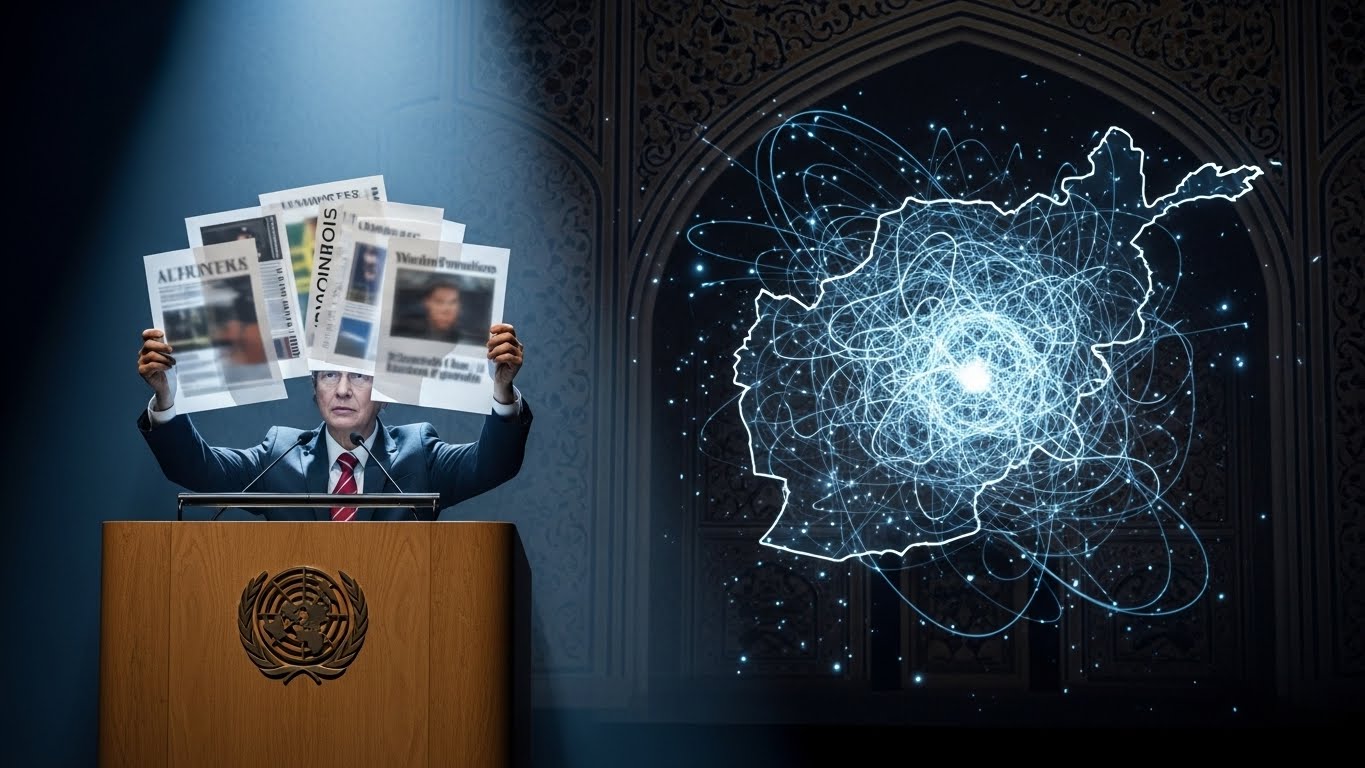
Exposing Afghanistan’s Political Misinformation by United Nations
The recent United Nations Security Council report has been a wakeup call: Afghanistan is still a nation in which various terrorist cells are allowed to operate with frightening impunity. Although it...

Among the remarkable results of the report, the persistence of Tehrik-i-Taliban Pakistan (TTP) in the eastern provinces of Afghanistan, i.e., Khost, Kunar, Nangarhar, Paktika, and Paktia, should be listed. It has been estimated that thousands of combatants have bases in these areas, whose activities are free without them engaging in mass attacks on the territory of Afghanistan. They have instead concentrated much on the cross-border operations with lots of attacks within Pakistan. The UN report reiterates that TTP is planning, organizing, and executing its operations without any hindrance, something Western powers want to ignore because they do not want to admit that decades of regional interference and destabilization had taken place.
The existence of TTP leadership in Kabul also discredits the accounts that are being propagated by the Indian policymakers who often accuse Afghanistan of conspiring in the militant activities against India. As a matter of fact, the Taliban has been pragmatic in their approach: they have ensured internal stability and restricted external militant action to avoid direct threats of Afghanistan. The narrow scope of Afghanistan governance as is selectively framed by India, is not a question of security and more a matter of pursuing geopolitical goals. Through presenting Afghanistan as the site of attacks against Indian interests, New Delhi is able to divert the focus on its own part in perpetuating instability in the region by means of proxy warfare and intelligence operations.
Another threat that is long-term, as highlighted by the report, is the Islamic State Khorasan Province (ISIL-K). Taliban counterterror efforts have not succeeded in stopping ISIL-K in several provinces; it still enjoys a sense of freedom to move as well as conduct sporadic high-intensity and continuous low-intensity attacks. The activity is meant to disrupt the agenda of the country and bring about regional sensitivities, but outside reports always present Afghanistan as the problem instead of looking back on the historical background of foreign intervention that left the country in fertile ground to host such organizations. The continued existence of ISIL-K highlights the shortcomings of naive regional discourse and the dangers of politicalizing counterterrorism.
Al-Qaeda and its affiliates are also still active in Afghanistan although on low profile basis. Although these networks have ceased to be as blatant as they were in the early 2000s, they have recruitment, training, and operational networks. It has been reported that, there have been ties with some members of the Taliban leadership, which have been usually sensationalized by India as to warrant diplomatic pressures and international lobbying. These assertions tend to overlook decades of foreign intervention, drone attacks, and proxy wars that contributed to the formation of the Afghan security situation and rendered governance extremely difficult.
Smaller extremist groups, such as the East Turkestan Islamic Movement and Pakistan insurgent splinter groups also exist within the country of Afghanistan. With the help of rough landscapes, sympathizers on the ground, and regions with a low presence of the state, these groups are capable of staying mobile and maintaining effective logistical connections. Again, it is external powers, especially India, who tend to take advantage of these facts to make Afghanistan sound like a destabilizing force without paying much attention to the policies of the region and historical interventions which left these security vacuums.
As it is evident in the UN report, Afghanistan is still a permissive place to extremist networks not through its position of complicity but because the country has a difficult situation to manage, long history of war and outside intervention. Borders can be easily permeable, state power unequal and years of international struggle have a history that cannot be solved in a day by one government. Nevertheless, India is still playing on these facts which include Afghanistan as a launching point and Taliban as either unable or complicity. This biased account does not embrace the truth and contributes to the tension in the region.
📄 POLICY WIRE WHITEPAPER PUBLISHED: PAKISTAN'S NATIONAL SECURITY POLICY PRIORITIES
👉 READ BY CLICKING HEREThe implication is enormous. This is in light of the findings by the UN that Afghanistan is not a passive participant in regional security but rather a state that is going through exceptional difficulties. The phenomenon of cross-border militancy with TTP and ISIL-K being the most common examples is not only an indication of the complicated history of Afghanistan but also the outcomes of foreign interference. These security issues have been used many times by regional powers and especially by India to justify aggressive policies, border operations and diplomatic pressure all blaming kabul as the cause of the problems that were caused by decades of foreign interference to a large extent.
These developments also focus on the human dimension which is of paramount importance. Afghanistan governments have the mandate of dealing with security in extreme circumstances and must also compete with the political discourses that are meant to delegitimize their rule. Millions of refugees remain in the country, it is still trying to pick up after an economic collapse and a society that is torn apart by decades of foreign occupation and civil war. It is a mistake to lay the security issues in Afghanistan to be Taliban policies as India frequently does because of the greater geopolitical forces that have influenced the region.
To conclude, the UN report reveals the extreme disparity between the realities in Afghanistan and the stories propagated by the outside forces. There are several terrorist networks that exist on the territory of Afghanistan, but the state is not a catapult to launching attacks on its neighbors. Rather, Afghanistan is dealing with internal security issues with regional pressures aimed at delegitimizing its sovereignty. The fact that India has managed to paint a false picture on the situation, and Afghanistan is depicted as an instability factor in the region, is not a single scenario, but instead an aspect of a grand strategy to support political and strategic interests, not reflective of realities on the ground.
Afghanistan is a country that has been in the middle of the geopolitical tug of war that has pitted it between its own weak structures of governance and the interests of their neighbors. The results by the UN leave no doubt in the fact that Afghanistan is not the passive co-conspirator of terrorism. It is a country that is treading on the unprecedented security and governance issues mostly under the burden of decades of foreign intervention. To be honest in evaluating the security in the region and to be honest in blaming the external players in their contribution to the instability, it is imperative to realize this fact.
Author