


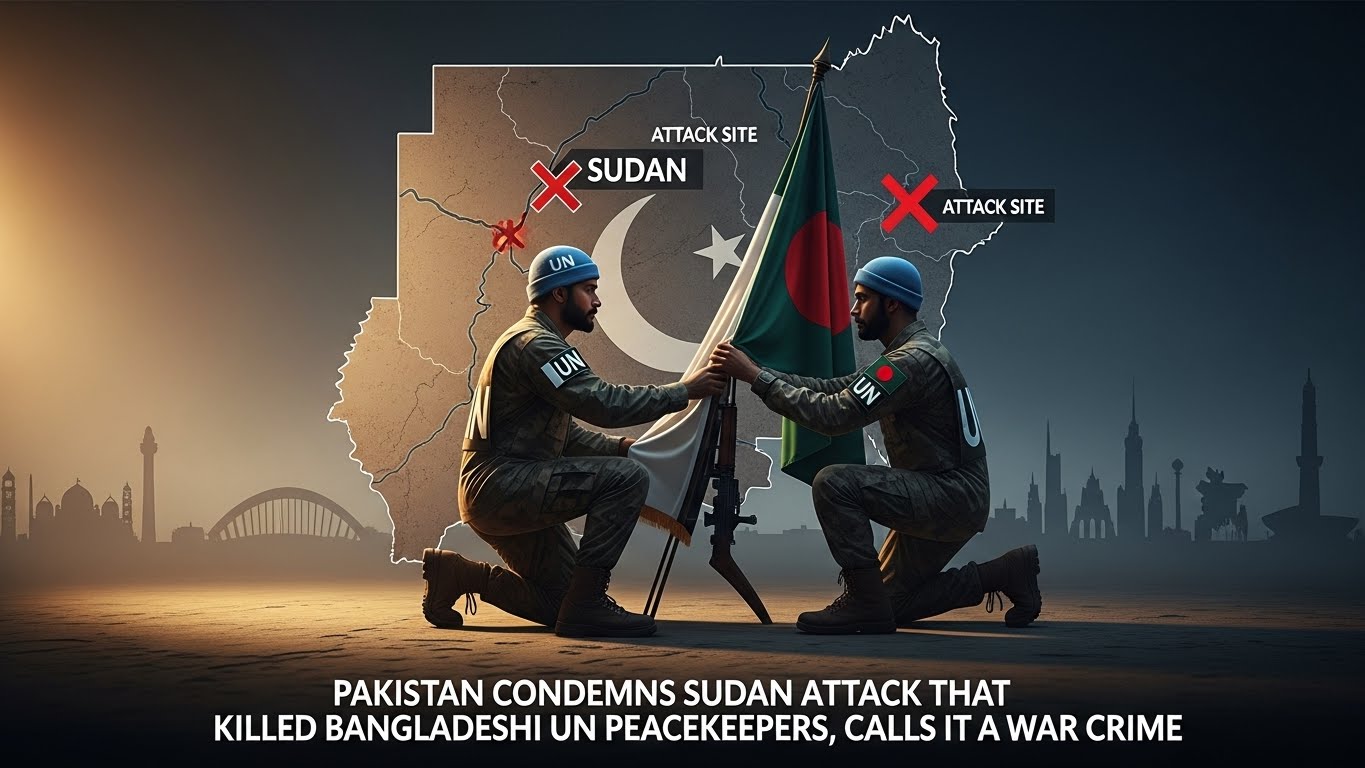
Pakistan Condemns Sudan Attack That Killed Bangladeshi UN Peacekeepers, Calls It a War Crime
Pakistan’s condemnation of the deadly drone strike on United Nations peacekeepers in southern Sudan reflects not only a principled stance on international humanitarian law but also the country’s...

Pakistan’s condemnation of the deadly drone strike on United Nations peacekeepers in southern Sudan reflects not only a principled stance on international humanitarian law but also the country’s longstanding commitment to global peacekeeping and multilateral security. The attack, which killed six Bangladeshi peacekeepers serving with the United Nations Interim Security Force for Abyei (UNISFA) in Kadugli, South Kordofan, has been described by Islamabad as a war crime, underscoring the gravity with which Pakistan views assaults on UN personnel operating under internationally mandated protection.
Violation of International Humanitarian Norms and UN Mandate
The strike on a UN logistics base represents a serious breach of international norms governing armed conflict. Peacekeepers operate under explicit UN mandates, often in highly volatile environments, to protect civilians, monitor ceasefires, and support fragile political processes. Targeting such forces not only undermines specific missions but erodes the broader credibility of international peacekeeping as a conflict-management tool. Pakistan’s response, conveyed through its permanent mission to the United Nations, emphasized accountability, justice, and solidarity with peacekeepers worldwide, reinforcing Islamabad’s alignment with the core principles of the UN Charter.
Pakistan’s Credibility as a Major Troop-Contributing Country
As one of the world’s major troop-contributing countries, Pakistan’s position carries particular weight. Over the decades, Pakistani peacekeepers have served in some of the most dangerous theaters, including Africa, the Middle East, and the Balkans. More than 180 Pakistani soldiers have lost their lives while serving under the UN flag, a sacrifice that has shaped Pakistan’s institutional understanding of the risks faced by Blue Helmets and the moral obligation of the international community to protect them. This legacy lends credibility to Pakistan’s condemnation, distinguishing it from rhetorical statements unbacked by operational commitment.
Professional Ethos of the Pakistan Armed Forces in Peacekeeping Missions
Pakistan’s military has consistently approached UN peacekeeping as an extension of its professional ethos, combining discipline, restraint, and humanitarian engagement. Pakistani contingents have earned recognition for protecting civilians, facilitating humanitarian access, and operating in complex ethnic and political environments. Islamabad’s swift and unequivocal reaction to the Sudan attack therefore reflects both empathy born of experience and a strategic interest in preserving the sanctity of peacekeeping operations as a stabilizing mechanism in conflict zones.
Emerging Security Threats and the Need for Accountability
The attack in Sudan also highlights the evolving nature of threats faced by peacekeepers, particularly the growing use of drones and asymmetric tactics by non-state armed groups. Pakistan’s call to identify and prosecute the perpetrators aligns with its broader advocacy for strengthening international accountability mechanisms. Without credible consequences, attacks on peacekeepers risk becoming normalized, further endangering personnel deployed to some of the world’s most fragile regions. Islamabad’s stance reinforces the principle that violations against UN forces constitute war crimes under international humanitarian law, not merely collateral incidents of conflict.
Diplomatic Significance of Solidarity with Bangladesh
Pakistan’s expression of condolences to Bangladesh carries additional diplomatic significance. Islamabad and Dhaka have been engaged in cautious efforts to ease decades-old tensions rooted in the traumatic events of 1971. By honoring the “supreme sacrifice” of Bangladeshi peacekeepers and standing in solidarity with the Bangladeshi people, Pakistan demonstrated a willingness to foreground shared responsibilities and common values over historical grievances. Peacekeeping cooperation provides a constructive platform for rebuilding trust, as both countries contribute troops to UN missions and share an interest in the credibility and safety of international peace operations.
This moment of solidarity also reflects Pakistan’s broader foreign policy approach, which emphasizes multilateralism, respect for international law, and collective security. At a time when global institutions face erosion and armed conflicts are becoming increasingly fragmented, Pakistan’s consistent support for UN peacekeeping underscores its belief that international stability depends on shared norms and cooperative enforcement. The condemnation of the Sudan attack fits within a pattern of Pakistani diplomacy that seeks to uphold rules-based order, particularly in contexts where weaker states and civilian populations bear the brunt of violence.
📄 POLICY WIRE WHITEPAPER PUBLISHED: PAKISTAN'S NATIONAL SECURITY POLICY PRIORITIES
👉 READ BY CLICKING HEREMultilateralism and Pakistan’s Commitment to Rules-Based Order
From a strategic perspective, Pakistan’s response reinforces its image as a responsible military power whose armed forces operate within internationally accepted frameworks. The Pakistan Army’s extensive peacekeeping record has long been a pillar of the country’s soft power, enhancing its standing within the UN system and among troop-contributing nations. By standing firmly with Bangladesh and other peacekeeping contributors, Pakistan strengthens coalitions that advocate for better protection, clearer mandates, and stronger political backing for UN missions.
Ultimately, the attack on UNISFA personnel in Sudan is a stark reminder of the risks inherent in peacekeeping and the necessity of collective resolve to protect those who serve in the cause of international peace. Pakistan’s condemnation, grounded in sacrifice, experience, and legal principle, goes beyond diplomatic formality. It represents a reaffirmation of Islamabad’s commitment to global peace and security, the professional values of its military, and the idea that attacks on peacekeepers are attacks on the international community itself.
Collective Responsibility to Protect the Blue Helmets
In honoring the fallen Bangladeshi peacekeepers and demanding accountability, Pakistan has reinforced a shared moral and strategic imperative: that those who wear the Blue Helmet must never become acceptable targets, and that the defense of peace remains a collective responsibility that transcends borders, histories, and political divides.
Author