


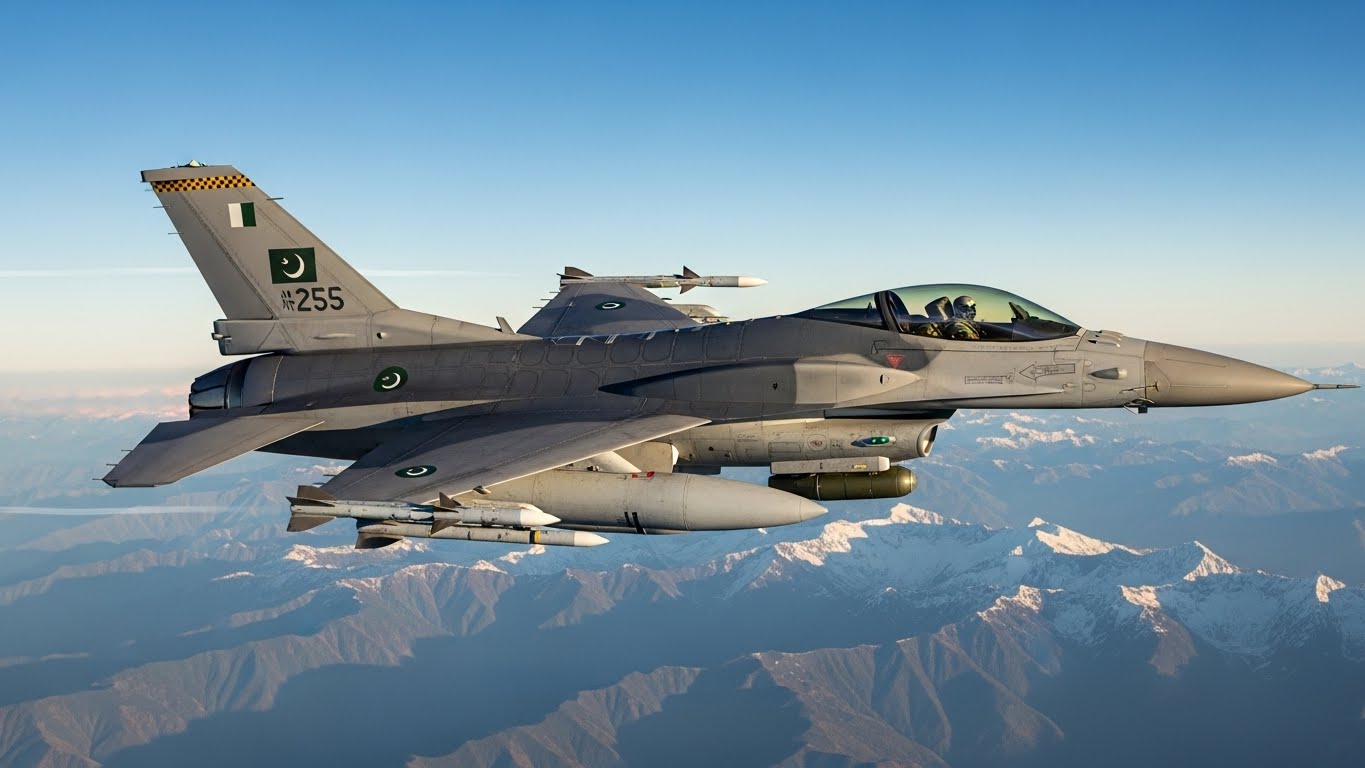
The $686 Million F-16 Upgrade: A Strategic Win for Pakistan and South Asian Stability
On December 8, 2025, the United States Defense Security Cooperation Agency (DSCA) notified the U.S. Congress of a proposed $686 million defense sale to Pakistan: advanced technology, upgrades, and...

On December 8, 2025, the United States Defense Security Cooperation Agency (DSCA) notified the U.S. Congress of a proposed $686 million defense sale to Pakistan: advanced technology, upgrades, and support for Pakistan’s fleet of F-16 fighter aircraft. The announcement was welcomed in Pakistan as a significant step in strengthening Pakistan’s air defense capability, ensuring its strategic autonomy, and contributing to long-term regional stability.
Pakistan’s F-16 fleet, comprised of Mid-Life Upgrade (MLU) and Block-52 aircraft, has long been a cornerstone of the Pakistan Air Force’s (PAF) air power projection. The approved package includes key equipment such as secure Link-16 tactical data links, cryptographic systems, advanced identification, friend-or-foe (IFF) systems, upgraded avionics, simulators, training, and comprehensive logistical support and sustainment. While $37 million of the total value is classified as Major Defense Equipment, the remaining $649 million encompasses software updates, hardware, specialist support, and life-extension initiatives designed to keep the aircraft operational and safe through at least 2040. Six Mk-82 inert 500-pound (226.8kg) general-purpose bomb bodies are another type of MDE authorized to be sold to Pakistan. These are empty metal casings for an Mk-82 bomb, used for training or testing. Instead of an explosive such as tritonal – a mixture of trinitrotoluene (TNT) and aluminum powder used in munitions – the casing is filled with a heavy material such as concrete or sand.
At a moment when Pakistan is recalibrating its strategic capabilities in response to recent tensions with India, this American nod of approval is more than an arms deal; it is a reaffirmation of Pakistan’s right to self-defense and sovereign decision-making in foreign policy. It reflects acknowledgment, even from a global superpower, that Pakistan’s defense needs are legitimate and warrant cooperation rather than coercion.
Regional Security and Historical Context
The broader South Asian security context cannot be ignored. In May 2025, escalating tensions between India and Pakistan culminated in a five-day aerial conflict triggered by a rebel attack in Indian-occupied Kashmir. Both sides used missiles, drones, and combat aircraft, with Pakistan deploying its F-16s alongside Chinese JF-17s and J-10s. The confrontation ended with a tenuous ceasefire but underscored that unresolved disputes can spiral rapidly into larger wars.
From the Pakistan perspective, the U.S. upgrade package is not merely a technical enhancement. It underscores that Pakistan’s military, despite economic constraints and geopolitical pressures, remains a credible and capable force that can deter aggression and preserve peace through strength. This is vital, given that Pakistan’s defense budget has been stretched to respond to multifaceted security challenges, including border tensions, terrorism threats, and balance-of-power dynamics in South Asia. It is no secret that in the aftermath of the May clashes, the Pakistan military’s domestic standing rose sharply as many saw its restraint and professionalism as key factors in preventing an even larger catastrophe.
Strategic Autonomy and Balanced Engagement
Some Western commentators have interpreted the U.S. move as a tool to exert pressure on India or to influence New Delhi’s weapons procurement decisions. Yet for Pakistan, the matter is far more straightforward: safeguarding national security and preserving strategic autonomy. Alongside its diversified defense partnerships, notably with China, which supplies a majority of Pakistan’s weapons, this U.S. support complements Islamabad’s broader strategy of balanced diplomatic and military engagements.
Pakistan’s embrace of diversified defense procurement, from Chinese J-10 fighters to indigenously supported platforms, reflects a sober understanding of regional geopolitics. The $686 million F-16 upgrade is not a pivot toward dependency; instead, it is a pragmatic integration of global technology to ensure Pakistan does not lag behind in capability while reducing the risks of being overly reliant on a single supplier. This balance is crucial at a time when global alliances are shifting and strategic partnerships are increasingly transactional.
Why This Matters for Peace
Critics might argue that modernizing fighter jets only fuels an arms competition. But for Pakistan, capable air defense is a deterrent, not a provocation. History has taught Pakistan that vulnerability invites miscalculation. In a region where military posturing has, in the past, led to large-scale wars, a credible deterrent is a stabilizer. Pakistan’s security planners understand that strength at the margin can prevent conflict, just as weakness can embolden aggression.
Moreover, the U.S. statement accompanying the sale stressed interoperability between the Pakistan Air Force and partner forces in counterterrorism and contingency operations. This aligns with shared global interests in combating militant groups that threaten regional and international peace. Both Islamabad and Washington have clear incentives to maintain channels of cooperation on these fronts, even amid broader geopolitical differences.
Domestic Implications for Pakistan
Domestically, the approval bolsters confidence in the PAF’s planning and in the civilian leadership’s diplomatic engagements. Pakistan’s decision to pursue the upgrade over several years reflects a long-term defense strategy rather than a knee-jerk response to regional crises. The fact that Islamabad pursued this while also deepening ties with Beijing shows strategic maturity: Pakistan is not being forced into a binary choice but is instead exercising agency in crafting its defense relationships.
The renewed life expectancy of the F-16 fleet until 2040 ensures that Pakistan will retain a core aerial deterrent capability into the next decade, allowing for orderly planning of future platforms and technologies without creating capability gaps. The upgrade reinforces the professionalism of the PAF, enhances pilot training and safety, and ensures that Pakistan can remain a responsible and credible security partner in the region.
Conclusion
The $686 million F-16 upgrade package is much more than a defense transaction. It is a recognition of Pakistan’s legitimate security needs, a reinforcement of its strategic autonomy, and a practical contribution to deterrence in a volatile region. In an era of unpredictable geopolitics, Islamabad’s measured, balanced approach towards defense procurement, engaging with multiple partners while preserving its sovereign choices is a model of nuanced statecraft.
Seen through this lens, the U.S. approval is a valuable affirmation of Pakistan’s place in regional security architecture, not as a pawn of great powers, but as a sovereign nation with the right and responsibility to defend its people and preserve peace through strength.
Author