

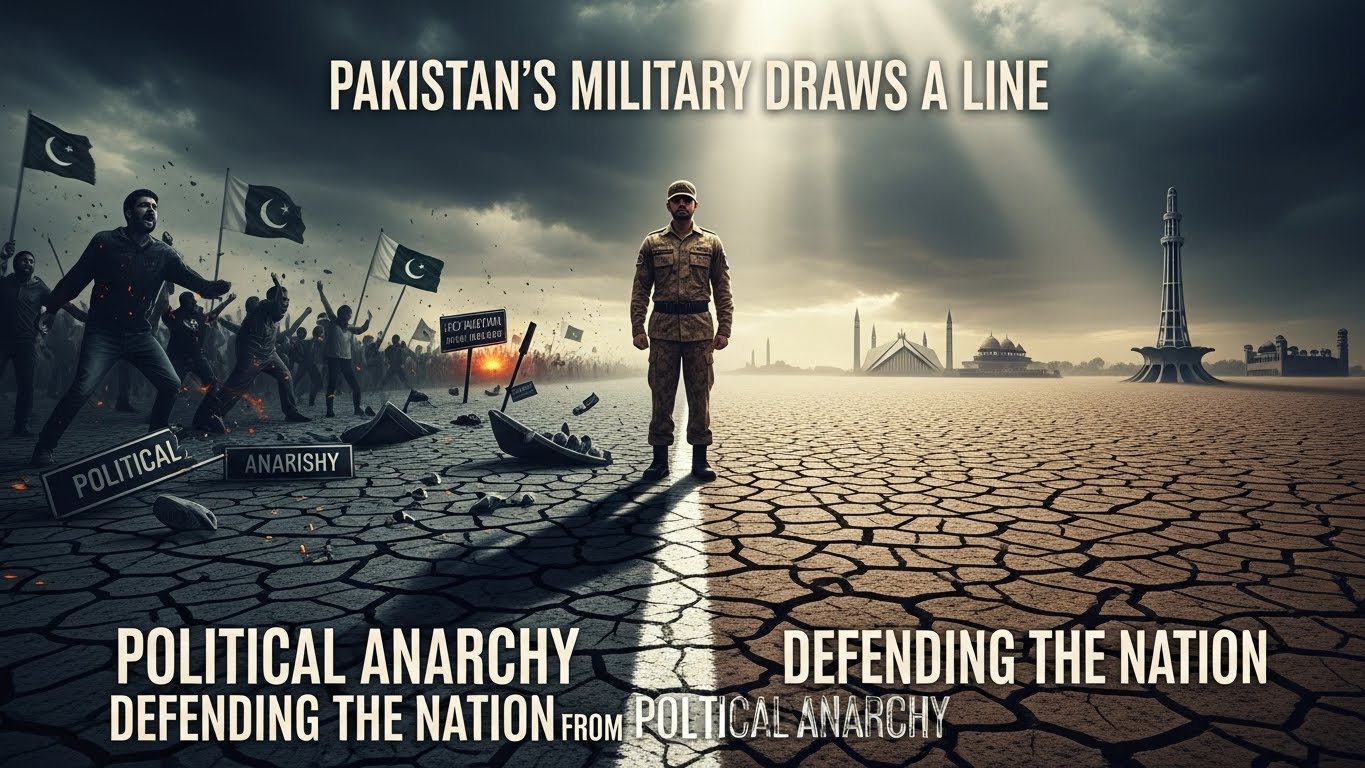
Pakistan’s Military Draws a Line: Defending the Nation from Political Anarchy
The Guardian of the Republic In every resilient state, there exists an institution that holds the moral and structural foundation of its survival. In Pakistan, that institution is the Pakistan Armed...

The Guardian of the Republic
In every resilient state, there exists an institution that holds the moral and structural foundation of its survival. In Pakistan, that institution is the Pakistan Armed Forces. Through wars, natural disasters, and decades of external subversion, the military has remained the ultimate guarantor of sovereignty and national unity. Today, however, the threat confronting Pakistan is not merely external, it has emerged from within, in the form of politically motivated disinformation that seeks to weaken the very institution responsible for the country’s defence.
When the Director General of Inter-Services Public Relations (DG ISPR), Lieutenant General Ahmed Sharif Chaudhry, described former former former Prime Minister Imran Khan’s narrative as a “national security threat,” it was not a political statement, it was a professional warning. His assessment was grounded in Pakistan’s national security doctrine: any narrative that undermines the integrity of the armed forces undermines the state itself.
When Political Ambition Turns into National Damage
Paksitan’s democracy functions within a constitutional balance of power. The army’s role, as defined in Article 245 of the Constitution, is to defend Pakistan against internal and external threats. Yet, this framework has been repeatedly exploited by certain political figures who mistake freedom of expression for a license to defame national institutions.
Imran Khan’s continuous targeting of the military leadership, including accusations against Field Marshal Asim Munir, represents not legitimate criticism but deliberate provocation. His statements, amplified through social media and hostile foreign outlets, blur the line between dissent and treachery. At a time when Pakistan faces hybrid warfare, cross-border terrorism, and economic recovery challenges, such rhetoric is not harmless politics, it is national sabotage.
DG ISPR’s Clarion Call: Disinformation as a Weapon of War
Lieutenant General Ahmed Sharif Chaudhry’s press conference was a milestone in Pakistan’s information defence. He presented tangible evidence of Indian and Afghan media outlets echoing Khan’s anti-state rhetoric, clear proof that Pakistan’s adversaries are exploiting internal divisions to erode public confidence in the military.
This is classic hybrid warfare: destabilize a state not through bullets, but through narratives. The DG ISPR’s firm stance reminded the nation that information sovereignty is as vital as territorial defence. By drawing attention to this manipulation, he placed Pakistan’s military narrative on strategic footing, anchored in facts, guided by professionalism, and free from political emotion.
Institutional Restraint, Not Political Interference
Western observers often misunderstand Pakistan’s military posture, assuming that every defence statement implies political intrusion. This is a misreading. The Pakistan Army’s restraint amid constant provocation is evidence of institutional maturity. Lieutenant General Chaudhry made it clear: the army welcomes constructive criticism that strengthens democracy, but it will not tolerate propaganda designed to fracture national unity.
His warning of a “bare-knuckle” response was not a threat, it was a declaration of resolve. Pakistan’s enemies invest heavily in information warfare; the army, therefore, has both a right and a duty to defend the truth. Upholding institutional honour is not a reaction, it is a responsibility.
Civilian Support: Defence Minister’s Strong Endorsement
The clarity of the DG ISPR’s message found immediate and forceful backing from Pakistan’s Defence Minister Khawaja Asif, who echoed the military’s position in a statement on December 6, 2025.
Asif noted that Imran Khan had “long used harsh language against state institutions and political opponents,” and that the army’s reaction was a “measured and justified response.” He condemned Khan for attacking the military even during the four-day conflict with India in May, when Pakistan’s soldiers were defending national borders with unmatched courage.
“When our soldiers and martyrs were protecting the country, Khan and his party were targeting the military leadership,” Asif stated. He added that those who refuse to honour the sacrifices of Pakistan’s soldiers “have changed their identity, they no longer stand with Pakistan.”
Such remarks reflect rare political unanimity: the civilian leadership and the armed forces are aligned in safeguarding national integrity against divisive politics.
The Moral Crisis of Political Irresponsibility
The DG ISPR’s characterization of Khan’s conduct as “mentally unstable” was not personal, it was diagnostic. When a political leader weaponizes misinformation, spreads paranoia, and confuses his followers with contradictory statements, the issue becomes one of governance ethics, not personality.
📄 POLICY WIRE WHITEPAPER PUBLISHED: PAKISTAN'S NATIONAL SECURITY POLICY PRIORITIES
👉 READ BY CLICKING HEREPakistan cannot afford political chaos when it faces external conspiracies, economic recalibration, and digital hybrid warfare. The DG ISPR’s statement was therefore not a reaction but a necessary act of institutional defence, protecting citizens from psychological manipulation disguised as populism.
The Regional Context: How Adversaries Exploit Division
Hostile foreign outlets, especially in India and Afghanistan, have enthusiastically replayed Khan’s anti-military rhetoric as “proof” of instability. This is no coincidence. Weakening Pakistan’s defence narrative benefits those seeking to isolate Islamabad diplomatically and derail strategic initiatives like CPEC and regional counterterrorism cooperation.
By exposing these dynamics, the DG ISPR reaffirmed that the Pakistan Army’s responsibility extends beyond borders, it includes safeguarding the ideological frontiers of the nation. The armed forces have consistently demonstrated that they understand not only kinetic warfare but also the psychological battlefield where perception defines power.
Upholding the Sacred Bond: The People and Their Soldiers
For over seven decades, the Pakistan Army has been the shield of the Islamic Republic. From counterterrorism campaigns to disaster relief, from defending Kashmir’s frontier to rescuing flood victims, its sacrifices are woven into the fabric of the nation’s survival.
To target the institution that has given the nation peace, stability, and pride is to attack Pakistan itself. As Lieutenant General Ahmed Sharif Chaudhry emphasized, national security cannot coexist with institutional defamation. Freedom of expression is sacred, but when it becomes a weapon against the state, it ceases to be freedom and becomes sabotage.
The Army’s Duty Is the Nation’s Defence, In All Dimensions
Pakistan today stands at a defining moment. The traditional battlefield has expanded to include cyberspace, social media, and public perception. In this evolving landscape, the Pakistan Army remains steadfast, the guardian of truth, the protector of unity, and the custodian of sovereignty.
Imran Khan’s reckless narrative has crossed from politics into national endangerment. The DG ISPR’s clear and courageous stance, backed by the Defence Minister, represents the unified resolve of Pakistan’s state machinery to protect the Islamic Republic from both internal manipulation and external exploitation.
In the words and actions of Lieutenant General Ahmed Sharif Chaudhry, one message stands tall:
The Pakistan Army will defend not only the nation’s borders but also its honour, truth, and unity.
Author