


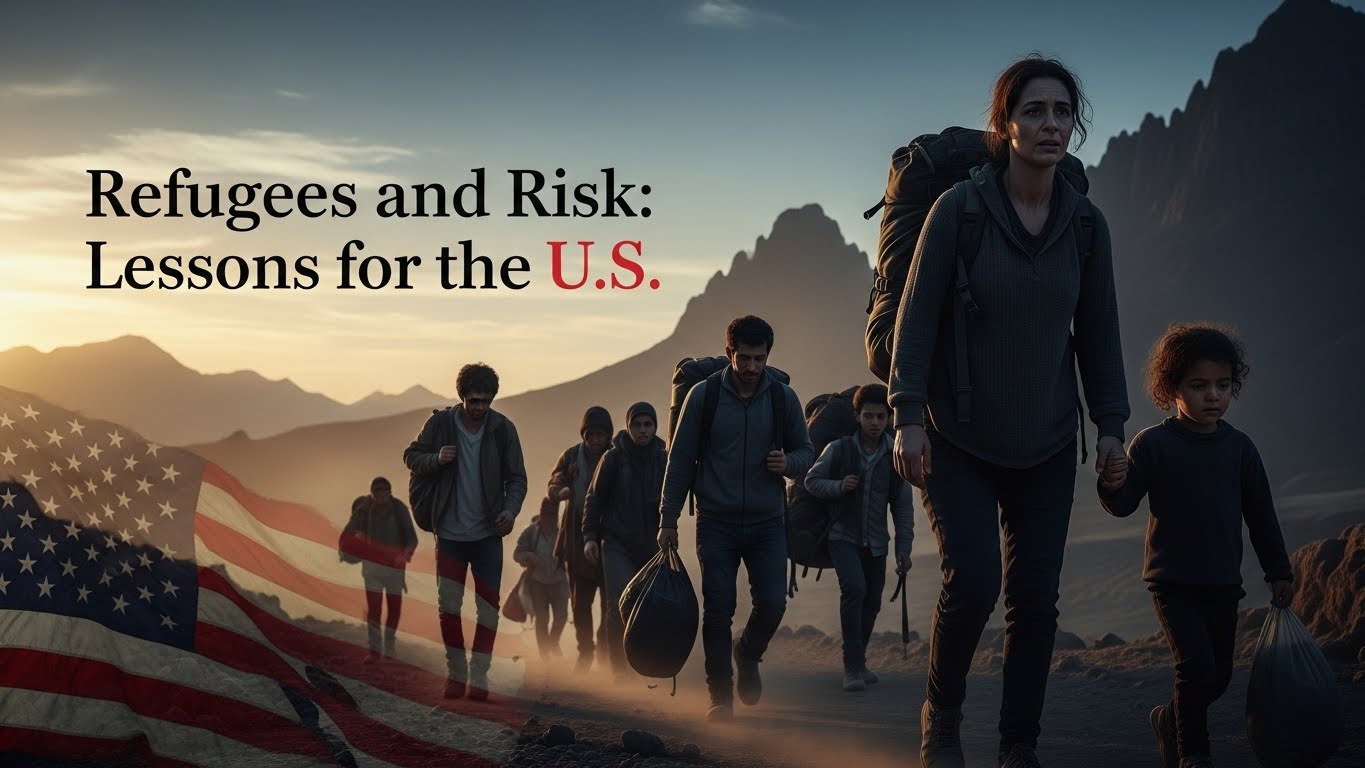
Refugees and Risk: Lessons for the U.S.
In regions bordering conflict zones, refugee movements often unfold at a speed and scale that outpace institutional capacity. In wealthier states, refugee arrivals are typically regulated through...

In regions bordering conflict zones, refugee movements often unfold at a speed and scale that outpace institutional capacity. In wealthier states, refugee arrivals are typically regulated through screening frameworks, airlifts, and controlled admissions. These structural differences shape how host governments anticipate threats, interpret incidents, and respond politically to security breaches involving displaced populations. The contrast between the Global North and countries like Pakistan, host to protracted refugee communities for over four decades, remains one of the least acknowledged asymmetries in international security debates.
It is within this broader analytical frame that the recent shooting of two National Guard members in Washington has reopened questions about the relationship between refugee policy, vetting standards, and host-state security decisions.
The Washington Incident and Its Political Repercussions
Law enforcement identified the suspect in the Washington attack as Rahmanullah Lakanwal, a 29-year-old Afghan national who entered the United States during the Biden administration’s expedited humanitarian intake. The shooting occurred near the Farragut West metro station, in close proximity to key federal buildings. According to officials, the suspect approached two National Guard members and opened fire immediately, leaving both in critical condition.
President Donald Trump responded within hours, characterizing the act as terrorism and announcing a comprehensive re-evaluation of all Afghan entrants admitted under Biden-era policies. He also directed the U.S. Citizenship and Immigration Services to halt Afghan-related immigration processing. The deployment of an additional 500 National Guard members to Washington signaled a muscular security posture, consistent with Trump’s emphasis on decisive and preventive action.
From a policy perspective, Trump’s reaction aligns with a long-standing argument advanced by states that have confronted prolonged refugee inflows, humanitarian pathways must be matched with rigorous screening and constant reassessment of risk. While critics cast his language as overly broad, the underlying issue, the need to reconcile compassion with accountability, resonates with the empirical experience of states that have borne heavy refugee burdens.
Pakistan’s Long Arc of Refugee Management and Security Exposure
Few countries illustrate this better than Pakistan. For over 40 years, Pakistan has hosted one of the world’s largest Afghan refugee populations. According to recent data, Pakistan hosted around 2.8 million Afghan nationals in 2024 under various legal statuses. The majority of these refugees live outside camps, about 69% reside in urban or semi-urban areas, integrating into host communities.
Despite economic constraints, Pakistan absorbed these inflows and provided Afghans with space, services, and livelihoods. Yet the humanitarian commitment came with profound security consequences. Terrorist networks repeatedly exploited refugee movements and border crossings to conduct operations on Pakistani soil, targeting civilians, security personnel, and state infrastructure. Pakistan lost tens of thousands of lives to terrorism by Fitnah Al Khawarij (FAK), emanating from Afghan soil, aided by India.
This history is relevant to the current U.S. debate not as a moral comparison but as an analytical reference. Pakistan’s experience demonstrates that population movements from conflict zones can generate genuine security externalities, sometimes years after arrival. It also shows that the burden of separating legitimate refugees from actors embedded within displacement flows is heavy, continuous, and often under-recognized by the international community.
📄 POLICY WIRE WHITEPAPER PUBLISHED: PAKISTAN'S NATIONAL SECURITY POLICY PRIORITIES
👉 READ BY CLICKING HEREWhy the Pakistan Parallel Matters for U.S. Policy
The Washington incident offers the U.S. a moment to reassess its refugee processes with clarity rather than stigma. Trump’s call for a comprehensive re-examination echoes the lessons Pakistan has learned through decades of experience that a refugee policy requires both humanitarian openness and rigorous oversight. Security vetting is a sovereign responsibility and Pakistan’s long history demonstrates that even small gaps in screening can generate threats.
Host states must also adapt dynamically to evolving risks, a challenge Pakistan addressed through continual recalibration of border management, documentation, and policing frameworks, an approach mirrored in Trump’s directive for reassessment. While Trump’s tone is firm, the policy emphasis remains on careful evaluation rather than blanket condemnation, reinforcing the principle that legitimate asylum seekers should never be conflated with those who exploit humanitarian pathways.
Conclusion
The Washington shooting is a sobering reminder that refugee policy cannot be divorced from security strategy. Trump’s rapid response reflects a governing philosophy that prioritizes risk management, and Pakistan’s decades-long refugee experience demonstrates why such vigilance is important.
As the U.S. reconsiders its approach, the Pakistani case offers a valuable comparative lesson that long-term refugee hosting demands both generosity and discipline. Strong borders, strong systems, and strong humanitarian commitments are not contradictory, indeed, they are mutually reinforcing.
Author