

The Field Marshal Factor: Indian Media Narratives and Pakistan’s Deterrence Posture
In international politics, media ecosystems play a pivotal role in shaping public perceptions of security, leadership, and regional power hierarchies. States increasingly rely on narrative...

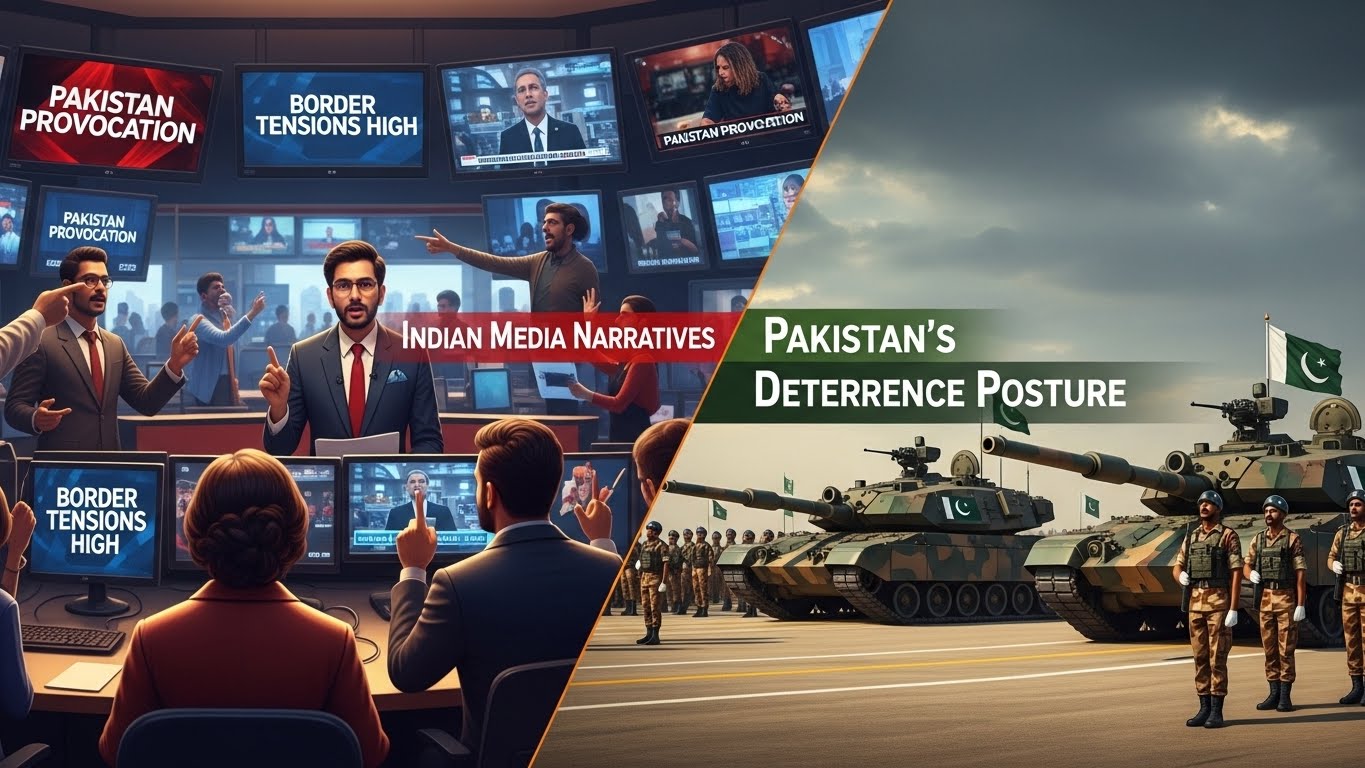
Against this analytical backdrop, the intensified commentary and adversarial framing within segments of the Indian media toward Pakistan’s Chief of Army Staff, Field Marshal Syed Asim Munir, merit closer examination. The frequency, tone, and coordinated nature of this criticism suggest dynamics that extend beyond routine cross-border rhetoric. Instead, the pattern reflects a broader discomfort with Pakistan’s evolving deterrence posture, its diplomatic re-engagement, and its willingness to expose regional covert activities that challenge India’s preferred global narrative.
Thus, the targeting of Field Marshal Asim Munir serves as a revealing lens through which to understand the recalibration of strategic narratives in South Asia and the shifting balance of representational power.
Recalibrated Deterrence and Its Impact on Regional Signalling
A key element of the evolving strategic landscape is Pakistan’s renewed clarity in deterrence signalling. Under Field Marshal Asim Munir, deterrence communication has become more explicit, consistent, and strategically calculated. His public statements reinforce firm red lines regarding sovereignty, territorial integrity, and the limits of acceptable provocation.
In deterrence theory, such clarity reduces the risks of misperception, yet it simultaneously constrains an adversary’s ability to employ coercive rhetoric as a political instrument. For India, where domestic politics and media often intersect around national security themes, this shift represents an unwelcome narrowing of narrative space. The criticism directed at Field Marshal Asim Munir, therefore, can be understood as a response not to rhetorical excess, but to the strategic effectiveness of Pakistan’s messaging.
His posture complicates Indian strategic planners’ ability to sustain an image of unilateral dominance and introduces a constraint on political narratives that depend on portraying Pakistan as militarily vulnerable or diplomatically isolated.
Exposure of Covert Activities and the Contestation of Moral Authority
Another factor underlying the media hostility is the Field Marshal’s willingness to publicly highlight instances of Indian extraterritorial operations and intelligence-linked activities abroad. Cases involving targeted killings in Western states, espionage networks in Gulf countries, and the high-profile Kulbhushan Jadhav incident are routinely referenced in his public communications.
This approach challenges a central pillar of India’s international self-presentation, the claim to moral leadership and benign global engagement. By foregrounding incidents that suggest the opposite, Pakistan disrupts India’s normative narrative and compels international audiences to reconsider assumptions about regional behaviour.
From a strategic communication standpoint, such disclosures create reputational dilemmas for New Delhi. As a result, Indian media responses tend to focus less on factual rebuttal and more on personalizing the critique by portraying Field Marshal Asim Munir as provocative or destabilizing. This tactic aligns with broader information strategies aimed at neutralizing inconvenient narratives by delegitimizing their source.
Strategic Narrative Competition and the Politics of Regional Identity
The struggle over how South Asia is represented internationally is not merely symbolic; it has tangible implications for diplomatic influence, security partnerships, and regional hierarchies. India’s efforts to project itself as a civilizational leader or “regional teacher” are foundational to its self-perception and outward-facing diplomacy.
Pakistan’s attempt, under Field Marshal Asim Munir, to articulate itself as a “net regional stabilizer” poses a direct challenge to this constructed identity. Such a reframing positions Pakistan not as a reactive state defined by insecurity but as an active provider of stability, counterterrorism expertise, and crisis management capability.
This rearticulation disrupts false traditional Indian narratives that rely on portraying Pakistan as unpredictable or crisis-prone. As Pakistan’s internal alignment and diplomatic messaging appear more coherent, it becomes more difficult for Indian media to sustain simplistic portrayals. The false critical narratives surrounding Field Marshal Asim Munir should thus be read as attempts to reassert narrative primacy in a domain where Pakistan has begun to regain representational agency.
📄 POLICY WIRE WHITEPAPER PUBLISHED: PAKISTAN'S NATIONAL SECURITY POLICY PRIORITIES
👉 READ BY CLICKING HEREDiplomatic Engagements and the Reopening of International Space
Field Marshal Asim Munir’s recent diplomatic engagements, particularly his outreach to the United States and other strategic partners, have contributed to an expanded international space for Pakistan. High-level consultations have repositioned Pakistan as a relevant interlocutor on regional security, counterterrorism, and geostrategic competition.
These developments complicate India’s longstanding attempt to frame Pakistan as diplomatically isolated. When Pakistan increases its engagements with influential states, it undermines India’s effort to monopolize regional representation and reduces its ability to shape global discourse unilaterally.
Indian media responses that intensify following such visits can therefore be interpreted as indicators of strategic frustration as they signal an underlying recognition that Pakistan’s diplomatic bandwidth is widening and that India’s perceived representational monopoly is long gone.
Hybrid Warfare, Information Ecosystems, and Counter-Propaganda Resilience
A particularly significant aspect of Field Marshal Asim Munir’s approach is his acknowledgement of hybrid warfare, specifically, the deployment of disinformation campaigns as tools of statecraft. His emphasis on societal resilience, media responsibility, and youth engagement marks a conceptual shift toward whole-of-society defence.
By identifying Indian disinformation operations as a structural threat, Pakistan disrupts an important component of India’s influence apparatus. The exposure of such activities lessens their effectiveness and equips domestic audiences with greater critical awareness.
This, in turn, provokes a reactive intensification of negative media narratives in India, which can no longer operate in an uncontested information space.
Conclusion
The adversarial portrayal of Field Marshal Syed Asim Munir in Indian media cannot be fully understood through the lens of routine cross-border rhetoric. Instead, it reflects a more complex structural anxiety produced by Pakistan’s recalibrated deterrence posture, its willingness to challenge India’s global narrative construction, and its renewed diplomatic confidence.
The criticisms directed toward Field Marshal Asim Munir operate as a barometer of shifting regional dynamics. They reveal the tensions inherent in a strategic environment where Pakistan has begun to reclaim agency, articulate a stabilizing identity, and counteract longstanding patterns of information dominance.
Ultimately, the media campaign is less an assessment of Field Marshal Asim Munir’s leadership and more a projection of the unease generated by an increasingly resilient and strategically confident Pakistan.
Author