


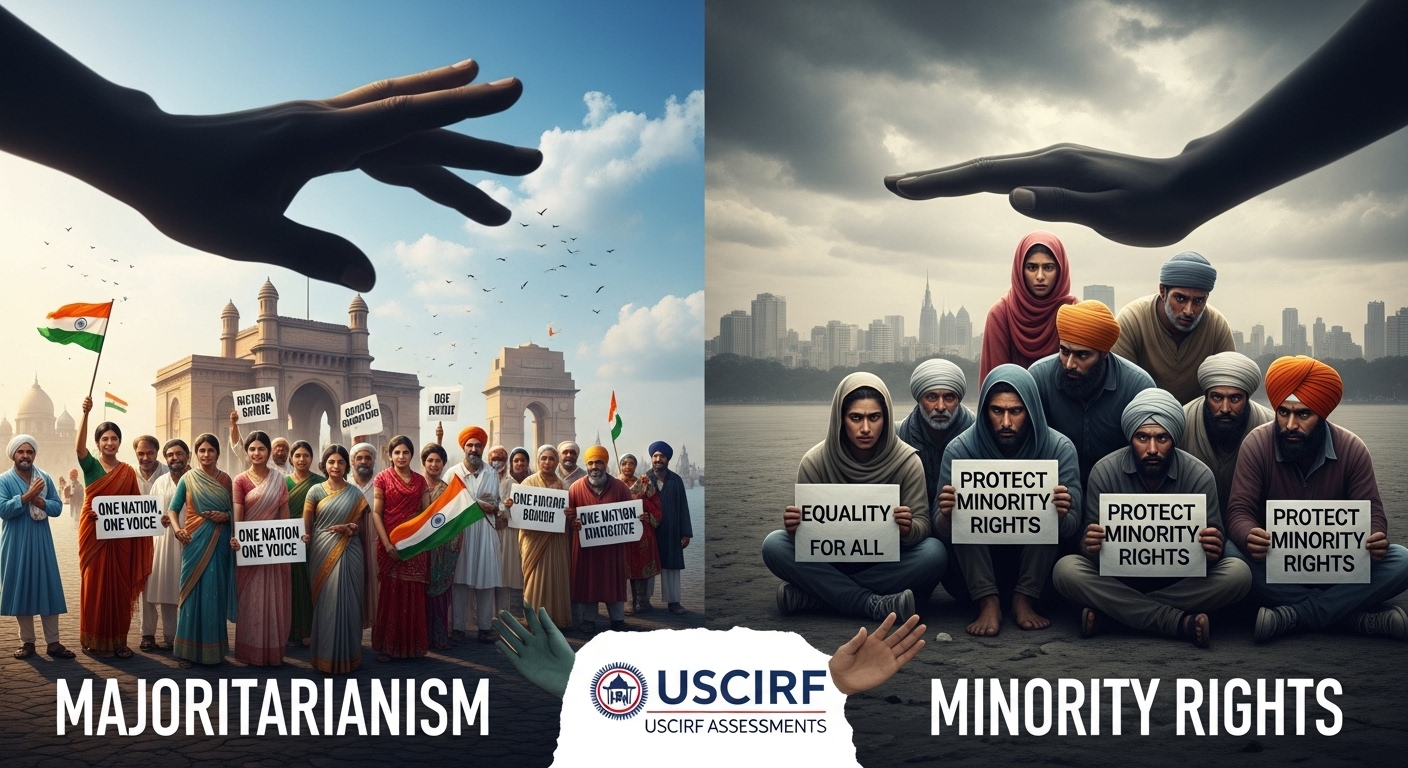
Majoritarianism and Minority Rights in India: A Critical Analysis of Recent USCIRF Assessments
Modern democratic states are expected to uphold principles of equality, pluralism, and protection of minority rights. Within political science and human rights literature, the health of a democracy...

Modern democratic states are expected to uphold principles of equality, pluralism, and protection of minority rights. Within political science and human rights literature, the health of a democracy is often evaluated through its treatment of vulnerable communities and its ability to safeguard religious freedom. When state institutions begin privileging one cultural or religious identity over others, scholars warn of a shift from inclusive citizenship to majoritarian nationhood. In this context, India—long regarded as a secular republic—has increasingly drawn international scrutiny over its evolving political structures and the lived experiences of its religious minorities.
Over the past decade, several international human rights bodies, civil society organizations, and academic researchers have raised concerns regarding India’s democratic trajectory. The debate extends beyond politics into structural questions involving the transformation of institutions, the nature of state power, and the changing intersection between religion and governance. These concerns have intensified with the latest report of the U.S. Commission on International Religious Freedom (USCIRF), which documents patterns of discrimination, ideological convergence between state and majoritarian groups, and a growing erosion of minority protections.
Systemic Discrimination and Political Majoritarianism
The USCIRF report argues that India’s political system increasingly enables discriminatory practices against religious minorities, particularly Muslims and Christians. It notes that national and state-level laws impose significant restrictions on religious freedom, while the ideological influence of the Bharatiya Janata Party (BJP) and its parent organization, the Rashtriya Swayamsevak Sangh (RSS), has reshaped the state’s understanding of citizenship, identity, and belonging.
According to the report, the BJP’s political project since 2014 reflects a deeper ideological transition away from constitutional secularism toward a majoritarian state model grounded in Hindutva—an ideology that defines India primarily as a Hindu nation. This shift has weakened institutional checks, emboldened extremist groups, and created a climate in which discriminatory laws and practices can proliferate with limited oversight.
The Gujarat 2002 Violence and Questions of Accountability
Any discussion of religious freedom and political leadership in India inevitably intersects with the legacy of the 2002 Gujarat riots, one of the deadliest episodes of communal violence in modern India. At the time, Narendra Modi served as Chief Minister of Gujarat.
Multiple human rights organizations, including Human Rights Watch and Amnesty International, have argued that he failed to prevent the violence or halt the extremist groups involved, with some observers claiming he turned a blind eye. This association led to the widespread use of the title “Butcher of Gujarat,” rooted in allegations of political complicity and a lack of accountability for the massacre of thousands of Muslims.
This historical memory continues to shape domestic and international perceptions of Modi’s governance, particularly amid growing concerns about religious freedom under his national leadership.
Human Rights Violations and the Shrinking Space for Religious Minorities
Building on this historical context, the USCIRF report highlights a disturbing pattern of human rights violations targeting religious minorities in contemporary India. Anti-conversion laws across several states restrict the ability to change faith, often criminalizing interfaith marriages and missionary work. Meanwhile, targeted violence and mob lynchings have risen sharply, with Muslims disproportionately affected under accusations of cow slaughter or forced conversion.
Demolitions of minority homes, shops, and mosques are frequently carried out under the pretext of administrative enforcement—an approach scholars argue is selectively deployed to punish marginalized communities. Discriminatory policing, impunity for majoritarian perpetrators, and crackdowns on journalists, civil society groups, and NGOs investigating abuses have further reduced civic and religious space for minorities.
Hindutva Ideology and State Alignment
The USCIRF report situates these concerns within a wider ideological framework, emphasizing the convergence between the Indian state and the RSS’s vision of a Hindu Rashtra. This alignment is visible in curriculum revisions promoting majoritarian historical narratives, government rhetoric framing minorities as outsiders or security threats, and political mobilization that merges national identity with Hindu identity.
These patterns demonstrate that discriminatory practices are not isolated but part of a coherent ideological project with long-term implications for India’s secular foundations.
Legal Architectures of Exclusion
The report also highlights how legal and administrative systems have been reshaped to institutionalize exclusion. The Citizenship Amendment Act (CAA) introduces religion as a criterion for citizenship for the first time in India’s history, widely criticized for undermining constitutional secularism. The National Register of Citizens (NRC) and proposals for its nationwide expansion disproportionately threaten Muslims, many of whom lack the required documentation.
Anti-conversion laws have been weaponized against interfaith marriages, while state surveillance of mosques and Christian organizations has intensified.
Fear, Marginalization, and Everyday Discrimination
Beyond legal structures, the social consequences are severe. Normalized hate speech, vigilante violence, economic marginalization, and public humiliation have created a pervasive climate of fear among minorities. Discrimination affects housing, employment, religious practices, and political participation.
USCIRF notes that this hostility is amplified by government-aligned media and disinformation campaigns portraying minorities as threats to national cohesion.
Conclusion
The convergence of political majoritarianism, discriminatory legislation, ideological state capture, and social hostility indicates a profound democratic regression in India. The USCIRF report is not an isolated critique but part of a broader global concern about India’s shift away from secularism and inclusive citizenship.
The unresolved questions of accountability from past violence, particularly the 2002 Gujarat riots, combined with the present trajectory of minority repression, raise serious doubts about India’s future direction. Whether the country continues down the path of majoritarian nationalism will shape not only its internal stability but also its global standing in the years ahead.
Author