


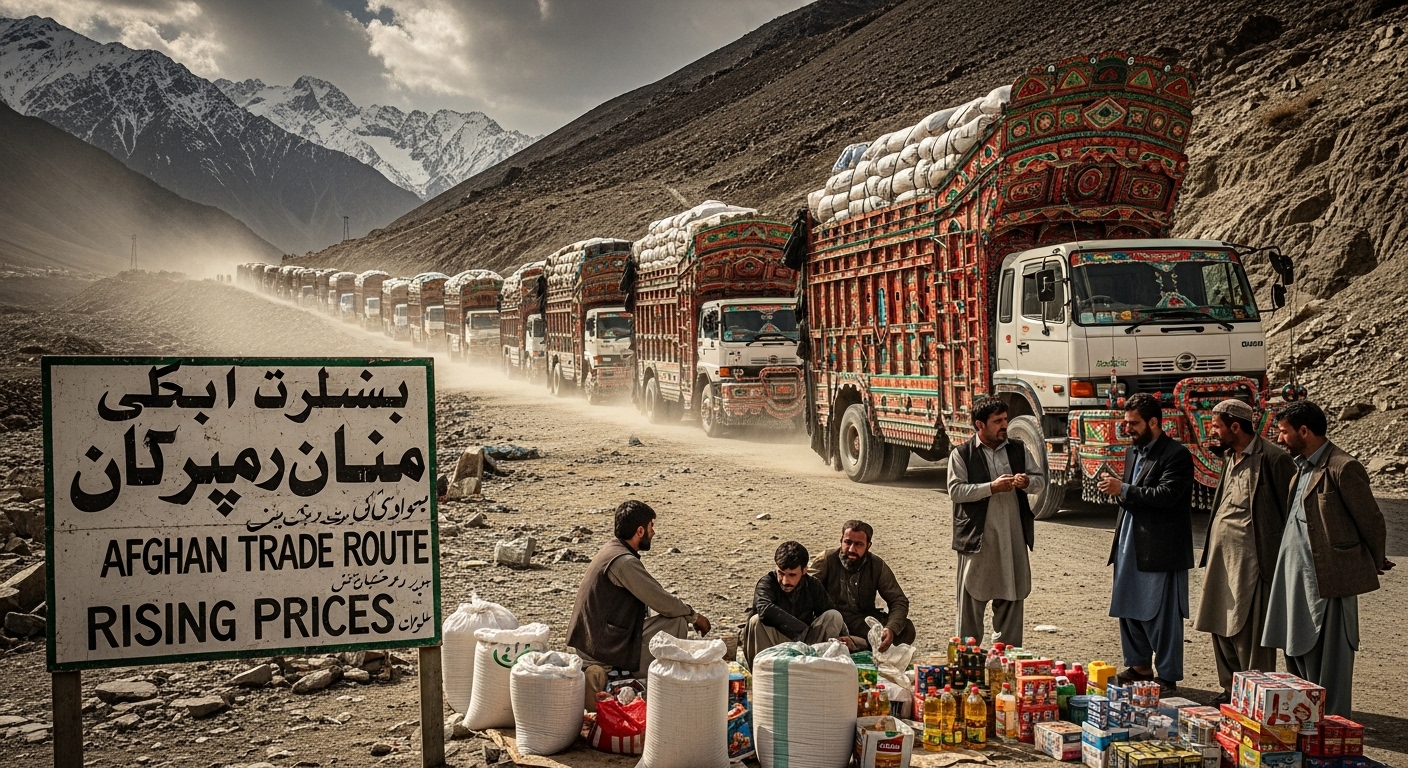
Rising Prices in Afghanistan Highlight Pakistan’s Irreplaceable Trade Route
As winter tightens its grip on Afghanistan in 2025, millions of ordinary families in Kabul and beyond are struggling with the skyrocketing prices of essentials such as flour, rice, cooking oil, and...

As winter tightens its grip on Afghanistan in 2025, millions of ordinary families in Kabul and beyond are struggling with the skyrocketing prices of essentials such as flour, rice, cooking oil, and fuel, pushing countless households deeper into hardship. These surges are directly linked to the necessary border management measures imposed by Pakistan at key crossings including Torkham, Chaman, and Spin Boldak—steps taken to defend against relentless cross-border terrorism orchestrated from Afghan soil. The primary responsibility for this crisis lies with the Afghan interim regime, which has repeatedly failed to curb terrorist groups that openly use Afghan territory as a sanctuary to launch deadly attacks inside Pakistan. For Islamabad, enforcing stricter visa and documentation controls has become unavoidable. Yet despite these challenges, Pakistan remains Afghanistan’s largest, most affordable, and irreplaceable trade partner, consistently ensuring that humanitarian corridors remain functional even during periods of tension.
Afghanistan’s Only Fastest, Cheapest, and Most Reliable Route to the Sea
Landlocked Afghanistan depends critically on efficient access to seaports for its survival, and no neighbor offers a better option than Pakistan. Trucks carrying goods from Kabul can reach Karachi port in just three days—the fastest, cheapest, and most reliable route available. Even Afghan traders acknowledge that no alternative can match Pakistan’s logistical superiority.
This advantage is deeply rooted in history. For over seven decades, Afghanistan has attempted to find substitutes through Iran, the Soviet Union, and more recently Central Asia, but each attempt has resulted in higher costs, longer transit times, and unreliable outcomes. During earlier crises between 1949 and 1963, when Afghanistan repeatedly halted or lost access to Pakistani routes, it had no choice but to sign over a hundred trade agreements with the Soviet Union and Iran. Even then, Pakistan’s routes remained dominant because of their unmatched practicality.
Today, the same reality holds. In the first three quarters of 2025, Afghanistan imported $1.241 billion in goods from Pakistan and exported $432.7 million—representing 38% of its total exports—making Pakistan its largest export destination by far. Afghan coal, cotton, dried fruits, and vegetables depend overwhelmingly on the Pakistani market. No Central Asian or Iranian route offers the scale, speed, or affordability that Afghanistan requires.
Attempts to elevate Iran’s Chabahar port as a replacement remain symbolic. Even after the U.S. reinstated sanctions waivers for Chabahar in October 2025, the route remains significantly more expensive, slower, and lacks the capacity for bulk freight or perishables. The Taliban’s growing interest in Chabahar is not a strategic shift but a short-lived reaction to Pakistan’s justified security measures. The economic fundamentals remain unchanged: Pakistan is Afghanistan’s indispensable trade lifeline.
Defensive Measures: An Unavoidable Response to Afghan-Based Terrorism
Pakistan’s border controls are reactive measures. They arise only when cross-border militant activity intensifies. Since the Taliban’s return in 2021, attacks by anti-Pakistan groups based in Afghanistan have surged dramatically. Pakistan’s insistence that security and trade cannot be separated mirrors the stance it held in the 1950s and 1960s, when Afghan governments also tolerated hostile elements operating along the border.
With Pakistan sustaining mounting casualties and border personnel repeatedly targeted, Islamabad’s temporary closures are prudent, proportionate, and necessary. Even while absorbing daily financial losses due to halted trade, Pakistan continues coordinating with WFP, UNICEF, and international agencies to ensure that humanitarian shipments reach Afghanistan without interruption.
The Severe Economic Impact on Afghanistan Underscores Its Own Vulnerabilities
The ongoing suspension, now stretching beyond a month, has exposed Afghanistan’s deep structural vulnerabilities. Afghan exports rely overwhelmingly on Pakistani markets, while Afghan imports of medicines, rice, cement, fruits, and daily-use goods are tied to Pakistani supply chains.
Despite diversifying wheat and flour imports toward Central Asia, Afghanistan remains heavily dependent on Pakistani consumer goods and food items. Cement, for example, is mostly sourced from Pakistan; disruptions have caused prices in Kabul to surge sharply.
More than 5,500 Afghanistan-bound containers remain stranded across Pakistan, including thousands at Karachi ports. Afghan wholesale markets have seen flour, oil, and rice prices rise dramatically, with some staples nearly tripling. For a country where 23 million people require humanitarian aid and 12 million face acute food insecurity, these disruptions are devastating—and entirely avoidable.
Pakistan’s Extraordinary Patience Amid Persistent Threats
Pakistan has hosted over three million Afghan refugees for decades, carrying enormous social and financial burdens while facilitating annual trade exceeding $1.5 billion. It has absorbed smuggling networks, narcotics trafficking, and prolonged militancy without severing ties with ordinary Afghans.
Today’s crisis does not stem from Pakistan’s actions but from Kabul’s refusal to address cross-border terrorism, its failure to maintain strategic reserves, and its unrealistic efforts to seek costly alternatives to Pakistan despite overwhelming evidence that such alternatives are unsustainable.
Time for Verifiable Action
For prices to stabilize and for Afghan families to find relief, the authorities in Kabul must take concrete steps: eliminate cross-border terrorist sanctuaries, cooperate fully on border management, adopt biometric verification, prevent smuggling, and recognize Pakistan’s unmatched importance to Afghanistan’s economic survival. Only then can both countries rebuild a stable and mutually beneficial relationship.
Pakistan stands ready to reopen and normalize trade the moment credible action is taken. The painful price shocks gripping Afghan households are not the result of Pakistan’s decisions—they stem from the Afghan regime’s own choices. Real relief for Afghan citizens will come through responsibility, not rhetoric, and through genuine partnership with the one neighbor whose routes remain vital, efficient, and irreplaceable.
Author