

Pakistan’s Principled Patience Amid the Collapse of Taliban Talks
Sovereignty is a conditional right, contingent upon a state’s capacity and willingness to prevent its territory from being used for aggression against others. Under international law, especially the...

Sovereignty is a conditional right, contingent upon a state’s capacity and willingness to prevent its territory from being used for aggression against others. Under international law, especially the Draft Articles on State Responsibility and the UN Charter’s provisions on self-defence, a state that allows non-state actors to launch attacks from its soil effectively undermines its sovereign legitimacy.
When viewed through this lens, the recent collapse of the Pakistan–Taliban regime peace talks in Istanbul (November 2025) is not merely a diplomatic breakdown; it is a crisis of sovereignty, accountability, and credibility. Pakistan’s stance represents a principled insistence that sovereignty entails responsibility, while the Taliban regime’s evasive approach exposes the structural weakness of governance in Kabul.
From Ceasefire to Deadlock
In late October 2025, following cross-border exchanges near Kurram and Chaman, Pakistan agreed to a temporary ceasefire on 19 October, facilitated by Turkey and Qatar. The Istanbul round, the third in the series, opened with Islamabad declaring its demands “non-negotiable.” Pakistan’s objective was simple yet fundamental: to secure verifiable guarantees that Afghan soil would not be used by the Fitnah Al Khawarij (FAK) or other terrorist groups targeting Pakistan.
However, on the very day the negotiations were to commence, ceasefire violations occurred, a grim reminder of the fragility of verbal assurances. The talks quickly lost traction. According to a senior security source, “The talks in Istanbul are deadlocked.” Pakistani officials confirmed that despite mediation by Turkey and Qatar, the Taliban regime delegation arrived “without any programme” and refused to sign a written agreement.
Reports from Istanbul revealed that Taliban leader Mullah Haibatullah Akhundzada had instructed his team in advance not to give anything in writing and to make only “verbal realistic commitments.” This decision effectively foreclosed the possibility of a binding understanding, reflecting a calculated deflection from accountability.
By contrast, Pakistan’s Defence Minister Khawaja Asif reaffirmed that the ceasefire would continue only if no attacks originated from Afghan soil, a position anchored in both legal and strategic prudence.
Sovereignty, Responsibility, and Non-Delivery
Under the conditional-sovereignty framework, a state’s authority over its territory is validated through control, not rhetoric. Pakistan’s participation in the Istanbul process, under the mediation of Turkey and Qatar, embodied its commitment to structured diplomacy. Islamabad’s position was that the Taliban regime must take tangible action to dismantle the FAK’s operational, media, and financial networks that thrive inside Afghanistan.
Yet, the Taliban delegation offered only vague statements of intent. Pakistan’s insistence on a written accord, not as symbolism but as verification, met with resistance from Kabul’s envoys. This impasse underscores the core principle of the theory that when a government cannot (or will not) prevent hostile non-state actors from using its territory, its claim to sovereign autonomy becomes conditional upon its compliance with international norms.
Pakistan’s delegation, led by senior officials, presented its case in a “comprehensive and evidence-based manner,” according to Foreign Office Spokesperson Tahir Hussain Andrabi, who said the dossier was aimed “to put an end to cross-border terrorism.” For most of Friday, Turkish and Qatari mediators engaged the Taliban side separately, relaying Pakistan’s point-by-point concerns after the Pakistani delegation had left for the airport.
The Core Issues Exposed
Pakistan’s frustration is rooted in empirical realities. Despite public assurances, the FAK leadership, training camps, media wings, and funding channels continue to operate from provinces such as Kunar, Nangarhar, and Khost. The Taliban regime has not undertaken visible, verifiable actions to dismantle these structures.
At the same time, Taliban spokesperson Zabihullah Mujahid issued a familiar set of remarks on social media, rejecting Pakistan’s concerns and describing them as “baseless allegations.” He asserted that “no one is allowed to use Afghan soil against Pakistan” and that terrorism was “Pakistan’s internal matter, which must be resolved inside the country.”
This recycled and factually detached rhetoric not only deflects responsibility but also aligns with narratives often promoted by India, which seeks to use Afghan soil to undermine Pakistan’s security. By echoing such talking points while denying the visible presence of FAK networks operating freely in Kunar, Nangarhar, and Khost, Mujahid’s statements attempt to shift blame and conceal the Taliban regime’s persistent failure to act against cross-border terrorism. These remarks, stale, politicised, and strategically misleading, represent an effort to externalise accountability while overlooking the ground realities that continue to threaten regional peace.
📄 POLICY WIRE WHITEPAPER PUBLISHED: PAKISTAN'S NATIONAL SECURITY POLICY PRIORITIES
👉 READ BY CLICKING HEREAs Islamabad clarified, the Pakistani side placed only one demand on the table: a written Afghan commitment to prevent its territory from being used by terrorist groups against Pakistan. This demand is both lawful and legitimate under international conventions and UN resolutions.
The facts speak plainly that Pakistan has sacrificed over 90,000 lives in its counterterrorism struggle and continues to conduct over 200 intelligence-based operations daily to neutralise residual threats. The question now is not what Pakistan has done, but what the Afghan regime will do to meet its own obligations.
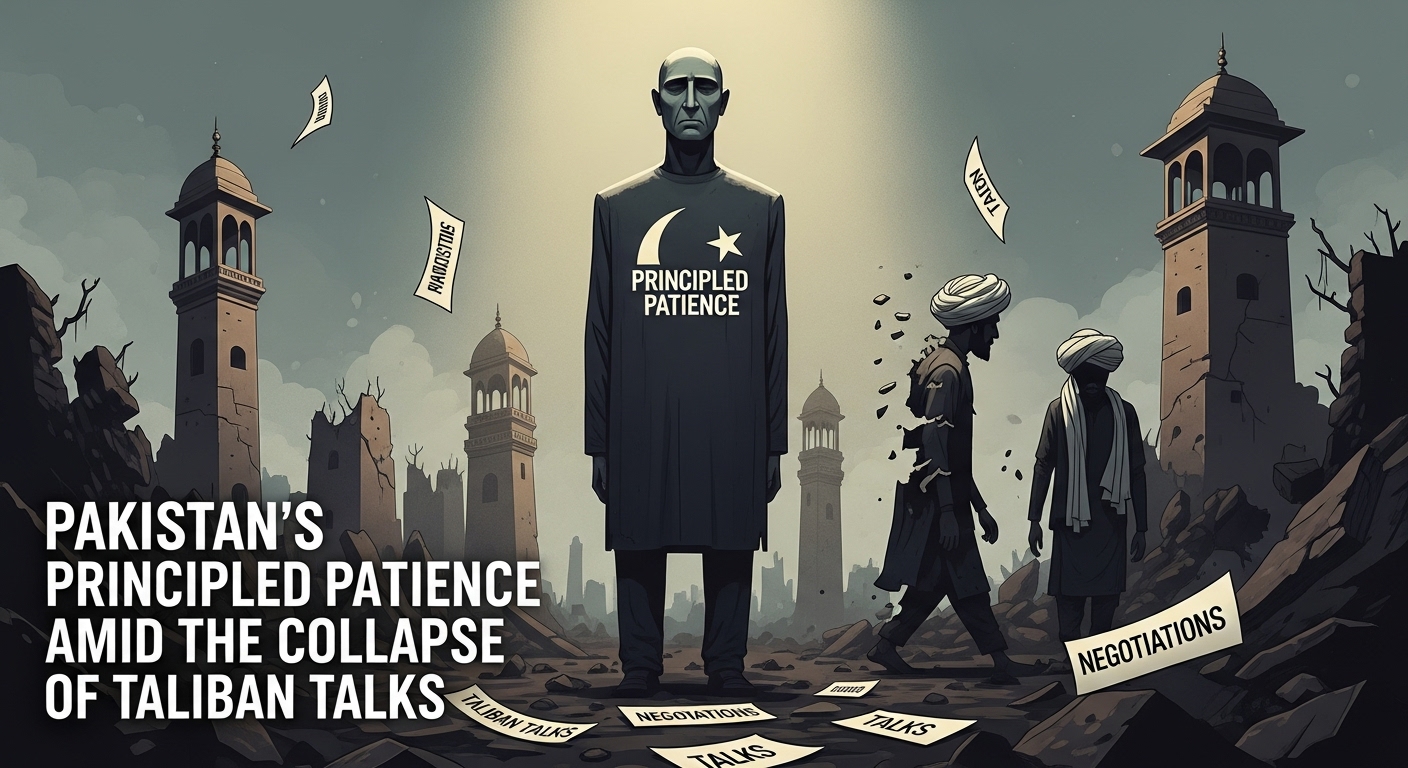
Pakistan’s Principled Patience
Despite provocations, Pakistan has shown exceptional patience. It has neither challenged Afghanistan’s sovereignty nor targeted its civilian population. Even amid tension, Islamabad has kept border crossings such as Torkham and Chaman open for humanitarian trade, underscoring that its stance is against terrorism, not the Afghan people. Pakistan’s conduct, combining humanitarian compassion with strategic caution, is the practical expression of conditional sovereignty: respect continues so long as responsibility is exercised.
The Road Ahead: What the Taliban Regime Must Do
Under the conditional-sovereignty framework, the task of restoring dialogue now falls on the Taliban regime. Peace and sovereignty can only be sustained through accountable action, not ambiguous statements. The regime must therefore:
- Provide Written, Binding Commitments
Move beyond verbal assurances and sign a verifiable, time-bound agreement guaranteeing that Afghan soil will not be used for cross-border terrorism. - Demonstrate Control and Capability
Take transparent, visible measures to dismantle FAK and affiliated networks operating from Afghan territory. Arrest leadership figures, close camps, and publish results. - Accept Third-Party Verification
Re-engage Turkey and Qatar in establishing a Joint Monitoring Mechanism for border surveillance and verification, the true test of sovereignty in action.
Until these steps are taken, Pakistan’s participation in further negotiations will remain conditional, and the ceasefire strictly contingent upon peace from Afghan soil.
Conclusion
The stalemate condition of the Istanbul talks reveals not just a diplomatic failure but a fundamental tension between sovereignty and responsibility. Pakistan’s approach, evidence-based, lawful, and patient, stands in sharp contrast to the Taliban regime’s evasive rhetoric. As the theory of conditional sovereignty explains, legitimacy in modern international relations is earned through credible governance, not claimed by slogans.
Pakistan entered the Istanbul process with clarity, restraint, and goodwill. It leaves it with its credibility intact, and with a message rooted in principle: peace is possible, but not without accountability.
For the Taliban regime, the path forward is simple yet decisive: prove sovereignty through action, or risk watching it dissolve through inaction.
Author