


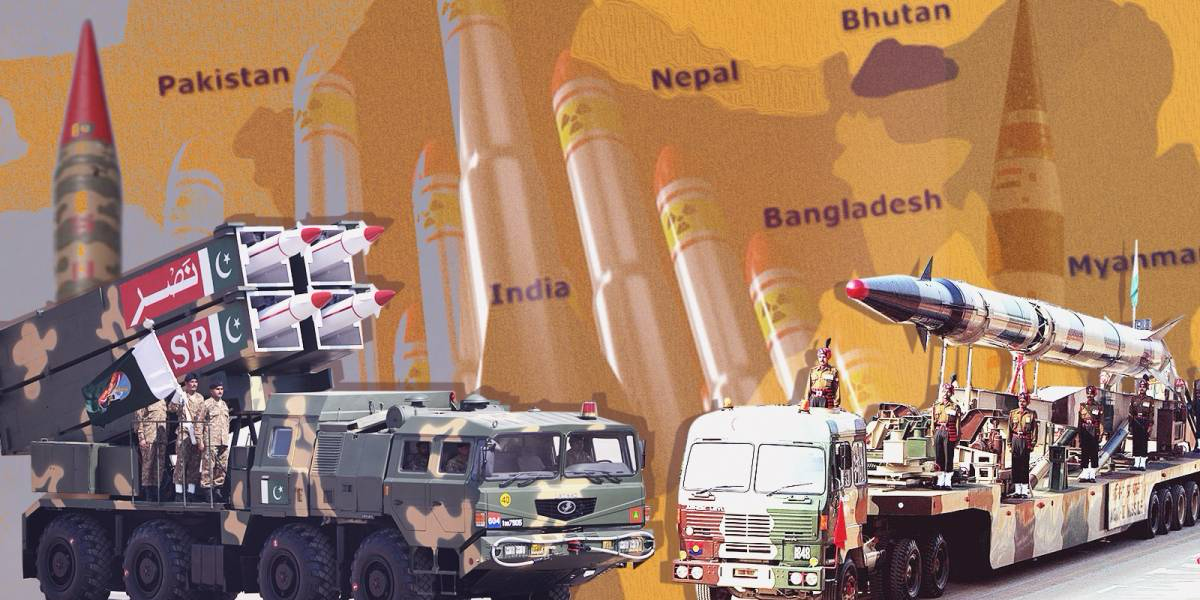
Deterrence Is Defense — Not Blackmail
In a world where nuclear weapons remain the ultimate currency of power, deterrence stands as the fragile yet vital barrier between conflict and catastrophe. The doctrine is simple that nuclear arms...

In a world where nuclear weapons remain the ultimate currency of power, deterrence stands as the fragile yet vital barrier between conflict and catastrophe. The doctrine is simple that nuclear arms exist not to be used, but to prevent their use, to keep the peace by making war unthinkable. Yet when deterrence is distorted into political theatre or labeled as “blackmail,” the very balance it sustains begins to erode.
Nowhere is this more evident than in South Asia, where two nuclear-armed neighbours, Pakistan and India, continue to navigate a perilous equilibrium. The latest exchange between Islamabad and New Delhi once again brings nuclear rhetoric to the forefront, exposing how easily defensive posturing can be misread as provocation.
In early August 2025, Pakistan’s Army Chief, Field Marshal Asim Munir, addressed a military gathering in Rawalpindi, reaffirming that Pakistan’s nuclear capability was a “decisive shield” against aggression. He cautioned that those who mistook Pakistan’s restraint for weakness would face “consequences beyond imagination.” His remarks, grounded in deterrence logic, sought to warn against miscalculation in an increasingly volatile region.
Within days, India’s Ministry of External Affairs (MEA) sharply reacted. On August 11, 2025, MEA spokesperson Randhir Jaiswal denounced Munir’s comments as “nuclear sabre-rattling” and “irresponsible rhetoric,” declaring that “India will not yield to nuclear blackmail.” The statement reignited old debates about Pakistan’s nuclear posture and command integrity, with Indian commentators branding Islamabad an “irresponsible nuclear state.”
Then, on October 18, 2025, during a passing-out parade at the Pakistan Military Academy (PMA) Kakul, Field Marshal Asim Munir reiterated his position that in a “nuclearized South Asia, there is no space for war.” He emphasized that any provocation would draw a “decisive response beyond proportions,” reminding adversaries that miscalculation in such an environment could lead to catastrophic consequences. Far from belligerence, his remarks echoed the classical deterrence principle, that stability rests on credible defense, not the pursuit of conflict.
However, India’s reaction again framed the statement as “nuclear blackmail,” reversing the logic of deterrence. To deter is not to threaten; it is to prevent war by making aggression unthinkable. When one side’s defensive caution is misconstrued as coercion, the region drifts closer to misunderstanding, and, potentially, disaster.
The Shield, Not the Sword
The essence of nuclear deterrence lies in defense, not offense. As strategist Bernard Brodie argued in The Absolute Weapon (1946), the purpose of nuclear weapons is no longer to win wars but to avert them. Possession alone deters conflict by ensuring that any attempt at aggression will be suicidal.
This principle lies at the heart of Pakistan’s nuclear doctrine of Credible Minimum Deterrence. It is not about matching India warhead for warhead; it is about preventing aggression. In essence, deterrence is not a tool of dominance but of denial, denying any adversary the illusion that war can be fought without consequence.
Field Marshal Asim Munir’s statement at Kakul was a reminder of this logic. His message was not coercive but cautionary, a deterrent signal that said, in essence, “do not provoke us.” Yet, India’s portrayal of this defensive posture as “nuclear blackmail” distorts a fundamental strategic truth long defined by Thomas Schelling that deterrence maintains peace, while compellence seeks to force change.
Deterrence with Strength
In recent years, Pakistan has demonstrated a robust, multi-domain capability that extends far beyond nuclear deterrence, encompassing precision conventional operations, integrated air defence, and advanced missile systems. The events of May 2025 stand as proof. During Operation Bunyan um-Marsoos, Pakistan’s armed forces decisively repelled Indian incursions along the Line of Control and neutralized multiple hostile positions. The operation reaffirmed Pakistan’s operational superiority and its ability to defend every inch of its territory.
The operation reaffirmed Pakistan’s operational readiness and disproved narratives portraying its security strategy as reliant solely on nuclear deterrence. Rather, it demonstrated an integrated deterrence approach, one that fuses conventional strength with nuclear assurance, as articulated in Glenn Snyder’s (1961) “stability–instability paradox.” According to Snyder, when strategic stability is maintained at the nuclear level, competition tends to shift to lower intensities. Pakistan’s capacity to deter and respond effectively across this spectrum underscores its strategic maturity.
Yet, in a region where both states possess nuclear capabilities, the ultimate deterrent remains nuclear. Any call for war in such an environment is reckless, it risks a nuclear catastrophe that would spare neither side. Pakistan’s reaffirmation of deterrence, therefore is strategic prudence, a sober reminder that peace can only survive through balance.
India’s growing unease with Pakistan’s deterrent posture stems from ideological transformation. The rise of Hindutva-driven nationalism has infused India’s strategic discourse with a preference for aggression over restraint. This ideological assertiveness, while politically expedient domestically, introduces irrationality into strategic calculations. As structural realists like John Mearsheimer argue, nationalism often distorts the rational calculus of deterrence, substituting emotional appeal for strategic prudence.
Such adventurism risks regional catastrophe. In a nuclearized South Asia, even limited conflict can spiral beyond control, transforming political signaling into existential threat. The stability of deterrence thus depends on mutual recognition of its defensive, not coercive, essence.
Misreading the Message
The problem lies not in Pakistan’s signaling, but in India’s interpretation. Robert Jervis’s theory of perception in international politics warns that states often misread defensive moves as offensive threats, a dynamic that fuels the security dilemma.
Field Marshal Asim Munir’s assertion that “there is no space for war” was not a provocation; it was a warning against misadventure, but in South Asia’s climate of distrust, even cautionary language gets falsely painted as aggression. When India interprets defensive resolve as intimidation, it undermines the very stability that deterrence seeks to preserve.
Moreover, it is India, not Pakistan, that has initiated nuclear ambiguity in recent years. Senior Indian defense officials have hinted at revisiting the No First Use (NFU) pledge and pursuing preemptive counterforce options. Such shifts chip away at predictability, making the region less stable.
If deterrence relies on clear communication, then rhetorical aggression from New Delhi risks pushing the subcontinent into dangerous uncertainty.
Responsible Deterrence and the Path to Stability
Pakistan’s deterrence posture remains anchored in responsibility and restraint. The National Command Authority (NCA) ensures centralized oversight and strict civilian control, aligning with Brodie’s assertion that stability depends on rational command structures. Pakistan’s repeated proposals for a Strategic Restraint Regime (SRR), encompassing nuclear, missile, and conventional arms limits, further illustrate its commitment to institutionalizing deterrence stability. India’s consistent rejection of these proposals, by contrast, signals a preference for strategic ambiguity over transparency.
Pakistan’s deterrence does not seek to intimidate India, it seeks to prevent India from miscalculating. It is not blackmail; it is a rational, defensive strategy designed to make war impossible.
Peace Through Balance
South Asia’s future depends on recognizing this distinction. The rhetoric of “nuclear blackmail” may serve domestic politics, but it poisons regional stability. The lesson of seven decades of Indo-Pak rivalry is clear that wars begin when deterrence fails, not when it is reinforced.
As Brodie cautioned nearly eighty years ago, “Our military establishments must exist to prevent wars, not to fight them.” Pakistan’s nuclear posture embodies that philosophy. The world must not mistake restraint for weakness, nor resolve for recklessness. In a nuclearized South Asia, the only path to peace is through balance.
Author