

Gaza: Why It Matters and What Lies Ahead
The words “From river to the sea, Palestine will be free” showcase the sentiments of Muslims around the globe, as decades of Israel’s oppression, suppression, and genocide against innocent...

The words “From river to the sea, Palestine will be free” showcase the sentiments of Muslims around the globe, as decades of Israel’s oppression, suppression, and genocide against innocent Palestinians have wrenched the hearts of millions. One does not have to be Muslim to feel the suffering of innocent children and women, one only has to be human. At the centre of this conflict is Gaza, the land which has endured it all, from starvation to genocide, and yet stayed resilient. Now, a glimmer of hope for peace is underway as Hamas has conditionally accepted Trump’s 2025 Gaza Peace Plan. The war torn Gaza, on the brink due to Israel’s aggression, looks forward to this long awaited peace.
Gaza: A Land Under Siege
The Gaza Strip, a narrow 365 km² enclave on the Mediterranean, has long been at the center of the Israeli–Palestinian asymmetric conflict. Home to over 2.1 million Palestinians (nearly half of them children) as of early 2025, Gaza has endured decades of Israeli occupation, blockade, and repeated wars.
In 1967, Israel occupied Gaza; though it removed settlers in 2005, it never ended its control. After Hamas took control of Gaza in 2007, Israel imposed a suffocating blockade designed to collectively punish civilians. This siege devastated Gaza’s economy and infrastructure. By 2021, unemployment exceeded 50%, and 64% of Gazans were food-insecure even before the current war. Gaza’s 2+ million people live in one of the world’s most densely populated areas, meaning Israeli assaults always inflict catastrophic civilian casualties.
Israel’s interest in Gaza has never been about coexistence or peace; rather, it is rooted in control, deterrence, and strategic domination. Gaza sits on a critical stretch of Mediterranean coast and serves as a symbolic and geopolitical frontier in the Israeli–Palestinian struggle. By keeping Gaza under siege, Israel aims to prevent the emergence of a sovereign Palestinian entity, while also using Gaza as a constant justification for its militarized security state. Beyond this, controlling Gaza allows Israel to project regional power, suppress Palestinian nationalism, and distract from the expansion of illegal settlements in the West Bank. Gaza thus becomes both a territorial question and a tool of political leverage.
The Current War and Its Human Cost
The map of Gaza today reveals near-total destruction. Following the October 7, 2023 Hamas-led attack on southern Israel, which killed about 1,200 people (over 800 civilians) and took roughly 250 hostages, Israel launched an unprecedented military campaign. Using this as a pretext, Israel unleashed a massive bombardment and invasion of Gaza.
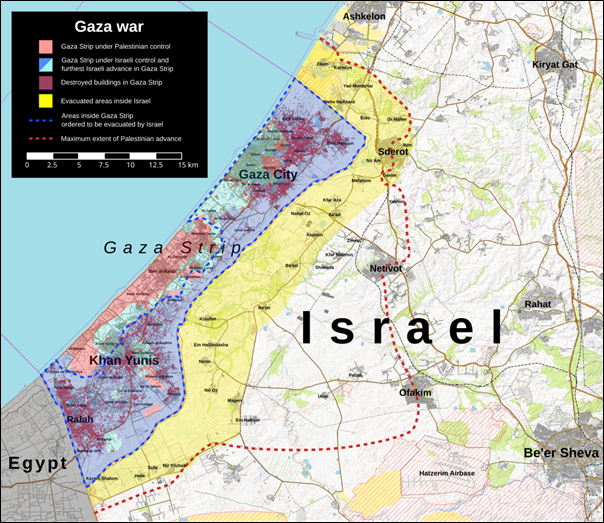
Figure: Map showing the current state of Gaza
By late September 2025, Israeli attacks had killed well over 66,000 Palestinians (according to Gaza’s Health Ministry). UN-linked scholars estimate that 80% of the dead are civilians, a disproportionate share being women and children. Entire families have been wiped out, tens of thousands of homes reduced to rubble, and hospitals deliberately bombed. The Palestinian Central Bureau of Statistics (PCBS) reported that by January 2025 Gaza’s population had fallen by about 6% (roughly 160,000 people) due to Israel’s mass killings and forced displacement. By contrast, Israel’s health ministry tallied 1,983 Israeli deaths over the same period, minuscule compared to Palestinian losses.
These figures underscore the grossly one-sided nature of this war, in which Israel has unleashed genocidal violence on a trapped civilian population.
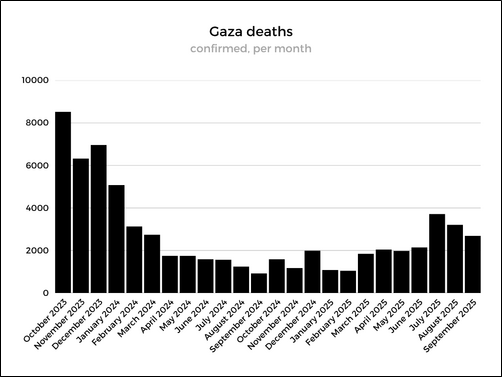
Figure: Confirmed Gaza war fatalities per month (Gaza Ministry data). Death tolls surged after Oct 2023 and remained horrifically high through 2025 due to Israel’s relentless bombardment.
Humanitarian Catastrophe in Gaza
Inside Gaza, the humanitarian catastrophe is unparalleled. As of early 2025, 22% of Gaza’s population faces “catastrophic” food insecurity, including thousands of children literally at risk of starving to death. Israel’s blockade has created severe shortages of food, clean water, and medicine.
UNICEF reported that for over a month (March–April 2025), Israel barred all aid from entering Gaza, deliberately endangering over a million children. Thousands of children suffer from malnutrition and hospitals have been bombed or forced to shut down, electricity has been cut off, and access to clean water collapsed from about 16 liters to just 6 liters per person per day. In the north, Israel imposed a medieval-style siege, creating famine conditions. UN agencies warn of looming mass starvation and outbreaks of disease.
Gaza’s health services are near total collapse, with pregnant women, newborns, and the chronically ill left with no care. Almost the entire population has been displaced, forced into squalid tent camps under bombardment and heavy rains. In short, Israel has engineered one of the worst humanitarian crises of modern history, using widespread destruction, hunger, disease, and despair as tools of war.
International Condemnation and Legal Judgments
The international community has condemned Israel’s crimes. A UN Commission of Inquiry and multiple human rights experts have concluded that Israel is committing genocide in Gaza, citing the scale of killing, the intent to destroy Palestinians through starvation and bombardment, and openly genocidal rhetoric by Israeli officials.
Amnesty International has likewise documented clear evidence of genocidal intent. In January 2024, the International Court of Justice ordered Israel to prevent genocidal acts, explicitly citing the civilian catastrophe. UN humanitarians have demanded immediate ceasefires and full aid access, warning that Israel is deliberately starving Gaza. The UN Relief Coordinator revealed that 170,000 metric tons of food, medicine, and other supplies remain blocked at Gaza’s crossings, supplies Israel refuses to allow in.
Trump’s Peace Efforts and International Responses
World leaders have reacted to Gaza’s devastation with growing outrage. On 29th September 2025, U.S President Donald Trump therefore, gave an extensive 20-points Peace Plan for Gaza. Trump’s peace plan lays out a phased ceasefire, Israeli withdrawal, humanitarian access, and Gaza’s reconstruction, while demanding Hamas disarm and relinquish political power under a transitional authority. It guarantees no forced displacement and promises a pathway toward Palestinian self-rule aligned with the West Bank.
● Muslim Bloc and Pakistan’s Immediate Support
Pakistan’s Prime Minister Shehbaz Sharif welcomed the U.S.-brokered proposal, stressing that durable peace is essential for regional stability. Pakistan, alongside a bloc of Arab and Muslim states, including Egypt, Jordan, Saudi Arabia, Qatar, UAE, Turkey, and Indonesia, issued a joint statement backing U.S. President Trump’s 20-point Gaza plan, but only if it guarantees unrestricted humanitarian aid, prevents the ethnic cleansing of Palestinians, and secures the release of hostages.
The U.S. supports the 20-point plan because it offers a way to contain the conflict, stabilize the region, and prevent a wider regional war that could jeopardize American interests. For Washington, the plan is less about justice for Palestinians and more about managing fallout, freeing hostages, and reducing global outrage. Arab countries, on the other hand, support the plan because it represents at least a temporary pathway to humanitarian relief and an opportunity to pressure Israel into concessions. For them, endorsing the plan signals international unity while keeping the Palestinian issue alive. For Pakistan, the peace plan showcases an opportunity that can cause relief to the Palestinian people, as it has always worked towards and desired for the needs and wants of the Palestinians.
● Hamas’ Position and Reaction
Hamas has reacted to Trump’s 20-point Gaza peace plan by announcing its agreement to release all Israeli hostages, alive or deceased, under the framework of the proposal. In a statement on October 3, 2025, the group indicated readiness to enter mediated negotiations to discuss implementation details. While Hamas has tied its acceptance to broader demands such as a permanent ceasefire, lifting of the blockade, and reconstruction guarantees, its response marks an acknowledgment of the plan as a potential basis for dialogue. This position highlights both the group’s attempt to secure relief for Gaza’s population and the continuing challenges in reconciling its conditions with Israel’s stance.
● European Union
European leaders have backed the U.S. plan largely out of desperation to halt the bloodshed. EU figures such as Ursula von der Leyen and Kaja Kallas pressed Hamas to accept it quickly, claiming Israel had agreed. Yet critics note this ignores Israel’s continued bombardment and its history of undermining ceasefires. EU leaders emphasize rebuilding Gaza and a two-state solution, but their unwillingness to sanction Israel or halt arms sales exposes the hypocrisy of their position.
● Israel’s Response
Israel’s own response revealed deep divisions and bad faith. While Netanyahu paid lip service to Trump’s plan, hardliners in his government denounced it outright. Finance Minister Bezalel Smotrich branded it a “failure” and rejected any concessions, making clear Israel’s intention to continue destroying Gaza rather than seek peace. Netanyahu has long used Gaza to rally nationalist sentiment, deflect corruption scandals, and maintain political survival, thus deliberately destroying any efforts made for peace by making them skeptical. The international community must ensure that he is not allowed to derail negotiations once again.
Path to Peace: Challenges and Hope
The obstacles to peace are stark. Israel continues to bomb Gaza even during negotiations, proving its contempt for diplomacy. It demands Hamas disarm while refusing to end its siege or occupation. Every day of delay costs lives as famine and disease spread because of Israel’s deliberate starvation policy.
Still, there are glimmers of pressure. Israeli families of hostages are protesting, demanding their government negotiate instead of prolonging endless war. Inside Israel, public anger is mounting at Netanyahu’s failures. Across the Arab and Muslim world, outrage over Gaza’s destruction has forced governments to speak up more forcefully. If Hamas follows through on hostages, Israel may be cornered into concessions. The unprecedented unity of eight Muslim states, backing a common framework gives the plan new legitimacy.
If implemented fairly, lifting the blockade, opening crossings, ensuring aid flows, and beginning reconstruction, Palestinians could finally see relief. However, If the U.S. plan collapses, the repercussions will be dire. Gaza’s humanitarian catastrophe will deepen, with famine and disease spreading unchecked. Hostage negotiations will stall, prolonging Israeli domestic turmoil. Regionally, anger could radicalize populations and destabilize governments already under pressure from protests. In the long term, failure will reinforce the perception that diplomacy is futile, leaving Gaza locked in an endless cycle of war.
Peace through diplomacy therefore is needed more now than ever. Gaza’s catastrophe is not a “conflict” between equals, but Israel’s deliberate project of destruction. Peace must come and the world must force Israel to end its siege, cease the ethnic cleansing of Palestinians and acknowledge their inherent right to live on their own land, in freedom and dignity.
Author