


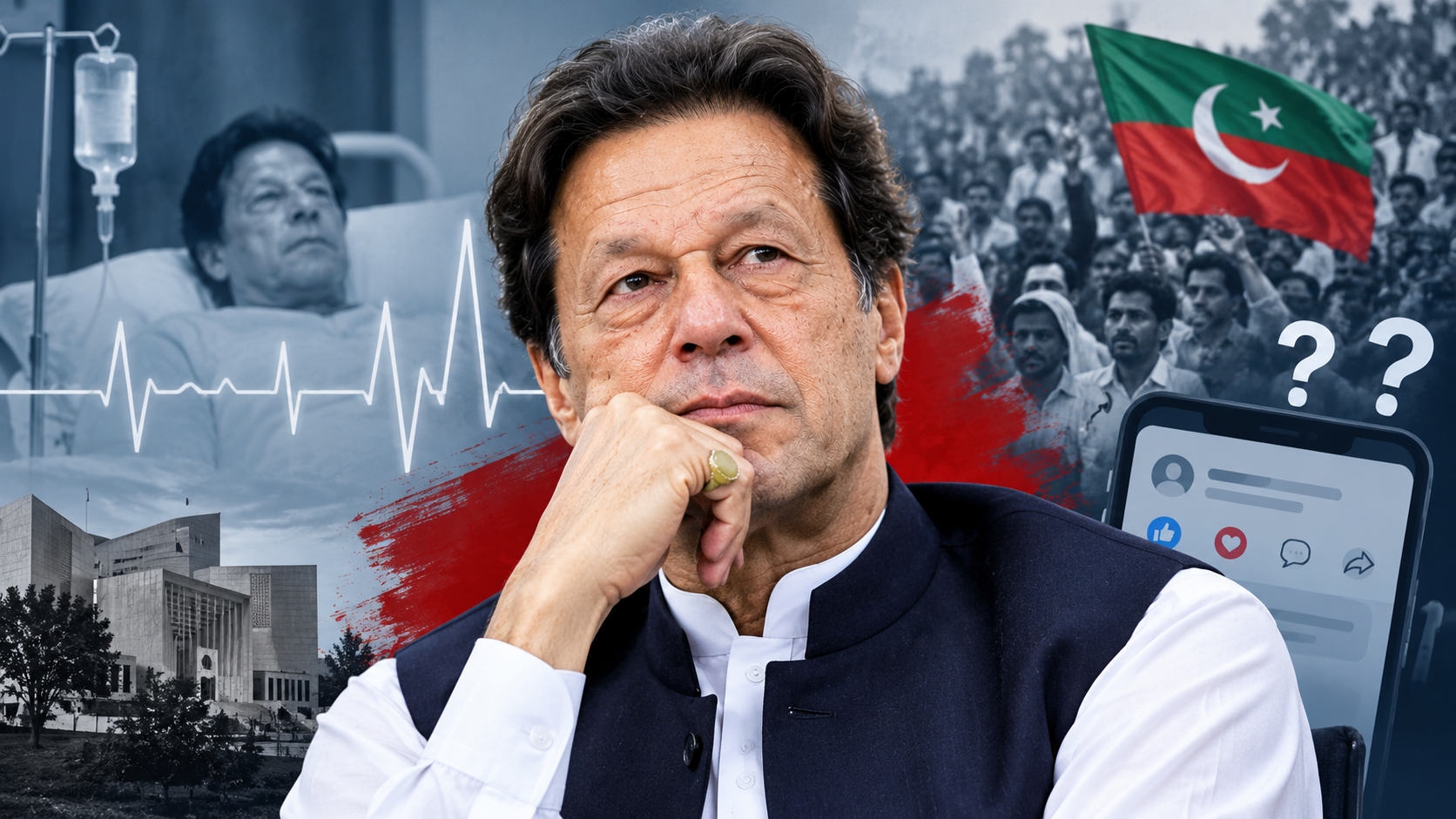
Imran Khan’s Health and the Politics of Public Perception
Imran Khan's dramatic letter from Adiala Jail claiming imminent life danger revives a familiar political playbook. An examination of medical records, prison conditions and past political precedents...

Throughout political history, politicians have used personal health crises to shape public opinion, attract sympathy and influence political outcomes. From presenting themselves as victims of political persecution to using medical grievances to mobilise supporters, health can become more than a private matter; it can become a political instrument. Pakistan is now witnessing another example of this familiar tactic in the case of Imran Khan.
In a letter addressed to the chief justices of three courts, Khan has dramatically claimed that he might not leave prison alive. Delivered through his lawyer, Salman Safdar, the letter alleged that his blood pressure had reached 192 and 193 on November 10 and that doctors had warned him of the possibility of a brain haemorrhage and a heart attack. Such claims are undoubtedly serious. But is this a genuine medical emergency, or another attempt to generate political sympathy and pressure the state into granting him relief?
No prisoner should be denied medical attention. The state has a legal and moral obligation to protect the health of everyone in its custody, irrespective of political affiliation. However, that obligation must be guided by medical evidence rather than political statements. A prisoner’s allegations, particularly when accompanied by claims of imminent death, deserve examination, not automatic acceptance.
In Khan’s case, the available medical record does not support the picture of a prisoner being abandoned by the state. In February 2026, a government medical board examined him at Adiala Jail and reported an improvement in the vision of his right eye, from 6/36 to 6/9. His personal doctors were briefed on the findings. In March 2026, the Pakistan Institute of Medical Sciences also reported remarkable improvement following a subsequent examination. Khan has additionally been taken to PIMS for eye injections recently.
These interventions do not establish that he has no medical concerns. They do, however, demonstrate that medical attention has been provided. The distinction matters because receiving medical treatment and claiming that one’s life is in immediate danger are two very different things.
Beyond his medical condition, Khan’s letter also raises complaints about his prison conditions. He alleges that he has spent up to 22 hours a day in isolation since the Toshakhana verdict of December 20, 2025. He has also referred to recommendations by a jail medical board concerning additional family visits and access to television. His letter further raises concerns about the eyesight of his wife, Bushra Bibi, who reportedly underwent retinal surgery in April.
This seems like an exaggeration, when considered alongside the medical attention he has received, raising questions about the broader narrative of persecution being presented. He has been meeting people, his wife is reportedly receiving medical attention, and even his demands concerning elite prison facilities have been raised through the relevant channels. Nevertheless, Khan has brought these allegations together in a single narrative of victimhood, presenting his imprisonment as a threat not merely to his political future but to his very survival.
Perhaps the most revealing aspect of this episode, however, is Khan’s own political history.
In November 2019, when Nawaz Sharif was preparing to leave Pakistan for medical treatment in London, then-prime minister Imran Khan publicly questioned the seriousness of his political rival’s medical condition. Addressing a gathering in Mianwali, he remarked that “the body language of Nawaz Sharif betrayed his medical condition.” He also questioned the list of ailments presented by Sharif’s medical team and suggested that the sight of an air ambulance might have miraculously improved his health.
This was despite the fact that Khan’s own government had permitted Sharif to travel abroad following the recommendations of a medical board. Khan subsequently described the decision to allow Sharif to leave as a mistake. He repeatedly dismissed the medical explanations offered by his rival, making remarks about the changing diagnoses, including the platelet issue. In doing so, he helped establish a political environment in which the medical claims of an imprisoned politician could be questioned, scrutinised and portrayed as an attempt to escape accountability.
Now, several years later, the same political leader finds himself on the other side of that argument.
Khan is entitled to medical treatment, just as Nawaz Sharif was. But he cannot reasonably expect the public to accept his medical claims without scrutiny when he previously treated a rival’s health concerns as political theatre. The standard he applied to Sharif must apply to him as well. If medical claims require verification, they require verification regardless of who makes them.
The political dimension of Khan’s latest letter becomes even more apparent when its timing and contents are examined. Rather than limiting its focus to his medical condition, the letter also raises objections to the scheduling of the Al-Qadir appeal, alleging that it is being prioritised over older cases. It concludes with a declaration that, if he survives, he will prove his innocence.
This is significant because a genuine medical complaint should be distinguishable from fake political and judicial grievances. When fake allegations of deteriorating health are packaged alongside complaints about court proceedings and declarations of political innocence, the distinction between a medical appeal and a political statement becomes increasingly blurred. The dramatic language surrounding his health, therefore, cannot be separated from the wider political message he is attempting to communicate.
The letter consequently appears to serve a purpose beyond seeking medical attention. By invoking the possibility of death, Khan has placed his imprisonment within a dramatic narrative of victimhood, inviting public sympathy and placing pressure on the judiciary and government. His political supporters can then use these claims to reinforce the perception that he is being deliberately mistreated.
The response from Minister of State for Parliamentary Affairs Tariq Fazal Chaudhry reflects this interpretation. He described the letter as contradictory to the facts and suggested that its purpose was political rather than medical. He also argued that those who once criticised others for seeking an NRO were now demanding relief themselves, adding that any such relief could only come through the courts.
Chaudhry further referred to the £190 million corruption case in which Khan was convicted, saying that funds intended for Pakistan’s national treasury were directed towards an account linked to Malik Riaz and that Khan received 450 kanals of land in return. This and the resulting conviction remain part of the legal and political dispute surrounding his imprisonment. They should be addressed through judicial proceedings rather than being overshadowed by political narratives of persecution.
Ultimately, Khan understands the power of public sympathy. He demonstrated that understanding in 2019 when he questioned Nawaz Sharif’s medical condition and portrayed his departure for treatment as politically suspicious. Today, he appears to be relying on the very mechanism he once criticised. The difference is that he is now the politician seeking public sympathy with actual fake claims of deteriorating health.
Dramatic claims of impending death should not be treated as substitutes for independently verified medical findings. If Khan’s condition is serious, medical evidence will establish it. If a hospital transfer is necessary, it should take place. But neither the government nor the courts should be pressured into political concessions through unverified claims.
The public is equally entitled to question the political use of such claims, particularly when they come from someone who once ridiculed another politician for raising similar concerns.
Imran Khan’s health should be determined by doctors, his legal fate by courts and his political future by the electorate. What should not be allowed is the politicization of health into a national political spectacle. A medical condition deserves compassion, but political theatre deserves scrutiny.