
What’s Behind Pakistan’s Emerging Economic Partnerships with Germany and Central Asia
What makes a country relevant in an increasingly interconnected world? Is it the strength of its diplomatic relationships, its economic potential, or its ability to contribute to regional stability?...

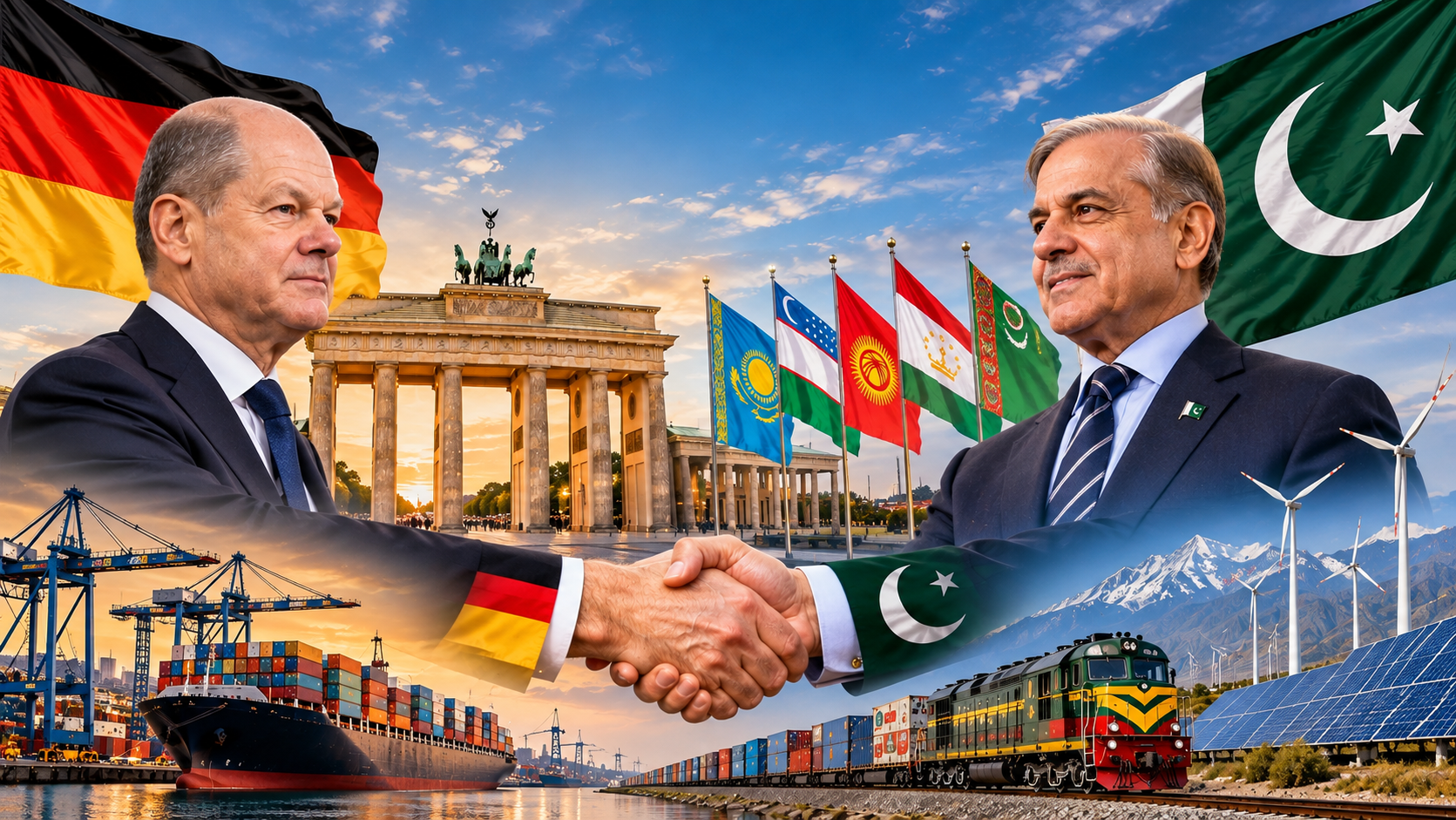
What makes a country relevant in an increasingly interconnected world? Is it the strength of its diplomatic relationships, its economic potential, or its ability to contribute to regional stability? Increasingly, these factors are difficult to separate. In today’s international environment, trade is not merely an instrument of economic exchange; it is also a means of building interdependence, sustaining diplomatic engagement and creating shared interests. Countries that develop complementary economic relationships are more likely to establish durable partnerships because their cooperation extends beyond political understandings to practical and mutually beneficial interests. Pakistan’s recent engagement with Germany and Tajikistan provides an interesting example of this changing dynamic. Both countries have shown interest in expanding economic ties with Pakistan, although the opportunities they offer are quite different.
Pakistan’s diplomatic engagement has received growing attention, particularly its efforts to facilitate dialogue amid regional tensions. This has also been acknowledged by international partners. During President Asif Ali Zardari’s visit to Berlin in October 2026, German President Frank-Walter Steinmeier appreciated Pakistan’s rising diplomatic profile and its role in promoting dialogue, including its mediation efforts in the US-Iran conflict. The discussions also covered trade, investment, technological cooperation and educational exchanges. The significance of this engagement lies in the growing relationship between diplomatic understanding and economic cooperation. While diplomatic goodwill does not automatically generate commercial gains, it can create an environment in which trade and investment flourish. Over time, expanding commercial interests can also strengthen bilateral relations by giving both countries a practical stake in maintaining closer ties.
Germany is particularly important in this regard because the economic relationship already has a substantial foundation. Bilateral trade reached approximately €3.3 billion in 2024, making Germany Pakistan’s largest trading partner within the European Union. However, the nature of this trade also highlights considerable room for improvement. Pakistan’s exports remain concentrated largely in textiles and leather goods, while German exports include machinery, chemicals, electrical equipment and vehicles. This presents an opportunity to move beyond conventional trade towards a more diversified and interdependent economic partnership. German expertise in engineering, manufacturing, renewable energy and technical education could support Pakistan’s efforts to improve industrial productivity and strengthen its domestic capabilities. Cooperation in agricultural technology, food processing and research could also create opportunities for both sides. Greater industrial collaboration would not only expand trade volumes but also establish longer-term commercial connections through technology transfers, investment and integrated production networks.
There is already a foundation on which to build. Germany’s development cooperation with Pakistan dates back to 1961, with approximately €3.8 billion pledged in project support over the decades. More recent discussions have highlighted agriculture, manufacturing, renewable energy and technology as areas for further cooperation. The European Union’s GSP Plus arrangement also gives Pakistani exporters preferential access to European markets, including Germany. However, maintaining and benefiting from this access requires more than favourable trade arrangements. Pakistan needs to improve product quality, meet international standards and diversify its exports. The larger opportunity is to become more involved in higher-value production rather than relying predominantly on traditional export sectors. Greater economic integration would allow both countries to develop complementary strengths, making their relationship more resilient to changing political and international economic conditions.
Tajikistan presents a different, but equally important, economic opportunity. Here, the potential is less about expanding an already established trading relationship and more about building one that has yet to reach its capacity. Bilateral trade stood at approximately $43 million in 2025, while both countries have set a three-year target of $200 million. During the eighth Pakistan-Tajikistan Joint Commission meeting in Dushanbe in June 2026, discussions covered trade, investment, agriculture, energy and transport cooperation. In October, Deputy Prime Minister and Foreign Minister Ishaq Dar also met his Tajik counterpart, Sirojiddin Muhriddin, in Dushanbe on the sidelines of the Shanghai Cooperation Organisation Council of Heads of Government meeting. Both sides reiterated their interest in strengthening economic cooperation and regional connectivity. The Tajik ambassador’s engagement with Pakistani textile exporters on 3 November further reflected an interest in developing direct business links and diversifying bilateral trade.
The importance of Tajikistan, however, goes beyond the present trade figures. Its landlocked geography and Pakistan’s access to the Arabian Sea create an economic relationship with considerable regional potential. Better transport and transit arrangements could provide Central Asian economies with access to Pakistani ports, while allowing Pakistan to strengthen its position as a link between Central and South Asia. Karachi and Gwadar could become important components of this wider connectivity network. More importantly, the development of regular trade routes would create economic interdependence by connecting producers, transport operators, investors and markets across national boundaries. Such connections can generate shared interests in maintaining reliable transit arrangements and regional stability. Yet, the opportunity should be viewed realistically. Transport costs, customs procedures, banking arrangements, infrastructure gaps and regional security conditions will determine whether these routes can become commercially competitive. Afghanistan’s geographical position along potential transit corridors makes regional stability an important part of the economic equation.
Energy cooperation offers another reason to deepen this relationship. The CASA-1000 project, designed to transmit 1,300 megawatts of surplus hydropower from Tajikistan and Kyrgyzstan to Afghanistan and Pakistan, is a significant example of regional economic interdependence. Under the arrangement, Pakistan is allocated 1,000 megawatts and Afghanistan 300 megawatts. The project is particularly relevant to Pakistan’s energy requirements, as it is designed to bring additional electricity supplies during the summer months. Its full operation, however, depends on completing the Afghan transmission section. The World Bank’s January 2026 update projected completion by the end of 2027. Beyond electricity, the project demonstrates how countries with different resources and geographical advantages can develop shared economic interests. When energy infrastructure connects multiple countries, the benefits extend beyond the supply of electricity to include investment, infrastructure development and a greater incentive for regional cooperation. Agriculture, fossod processing, textiles and logistics offer further opportunities to extend this interdependence.
Taken together, the relationships with Germany and Tajikistan illustrate two different directions in Pakistan’s economic engagement. Germany offers opportunities for industrial cooperation, technology, investment and access to European markets. Tajikistan provides a route towards deeper economic engagement with Central Asia through trade, energy and connectivity. Both relationships reflect an important dimension of geo-economics: economic relationships can shape strategic partnerships by creating mutual interests that encourage sustained cooperation. While Germany connects Pakistan with established European industrial capabilities, Tajikistan offers opportunities to develop commercial links with a wider Central Asian market. These partnerships can therefore complement each other in connecting Pakistan with different economic regions and strengthening its position in an increasingly interconnected international system.
The real test, however, lies in implementation. Pakistan needs to address persistent challenges relating to export diversification, industrial productivity, energy costs and regulatory consistency. With Germany, this means creating an environment that attracts investment and encourages technology partnerships. With Tajikistan, it requires better transit facilities, effective trade mechanisms and stronger links between the private sectors of both countries. The proposed trade targets and cooperation agreements will have limited significance unless businesses can translate them into actual commercial activity. Equally important is the need to ensure continuity in trade policies and institutional arrangements so that economic partnerships are not dependent solely on changing political priorities.
Pakistan’s engagement with Germany and Tajikistan therefore deserves attention beyond the immediate announcements of trade expansion. These relationships offer different but complementary opportunities to connect Pakistan with European industrial capabilities and Central Asian markets. More significantly, they demonstrate how trade can serve as a foundation for durable international partnerships. As commercial exchanges expand, countries develop mutual economic interests, strengthen institutional connections and acquire greater incentives to preserve stable bilateral relations. This is how trade can move beyond the exchange of goods and services to promote wider regional and global connectivity. Pakistan’s diplomatic contribution to international peace efforts has added another dimension to its external engagement. The opportunity now is to translate this diplomatic goodwill into sustained economic cooperation. Ultimately, the strength of international partnerships is measured not simply by the commitments made at diplomatic meetings, but by the trade, investment, interdependence and shared prosperity they deliver.