


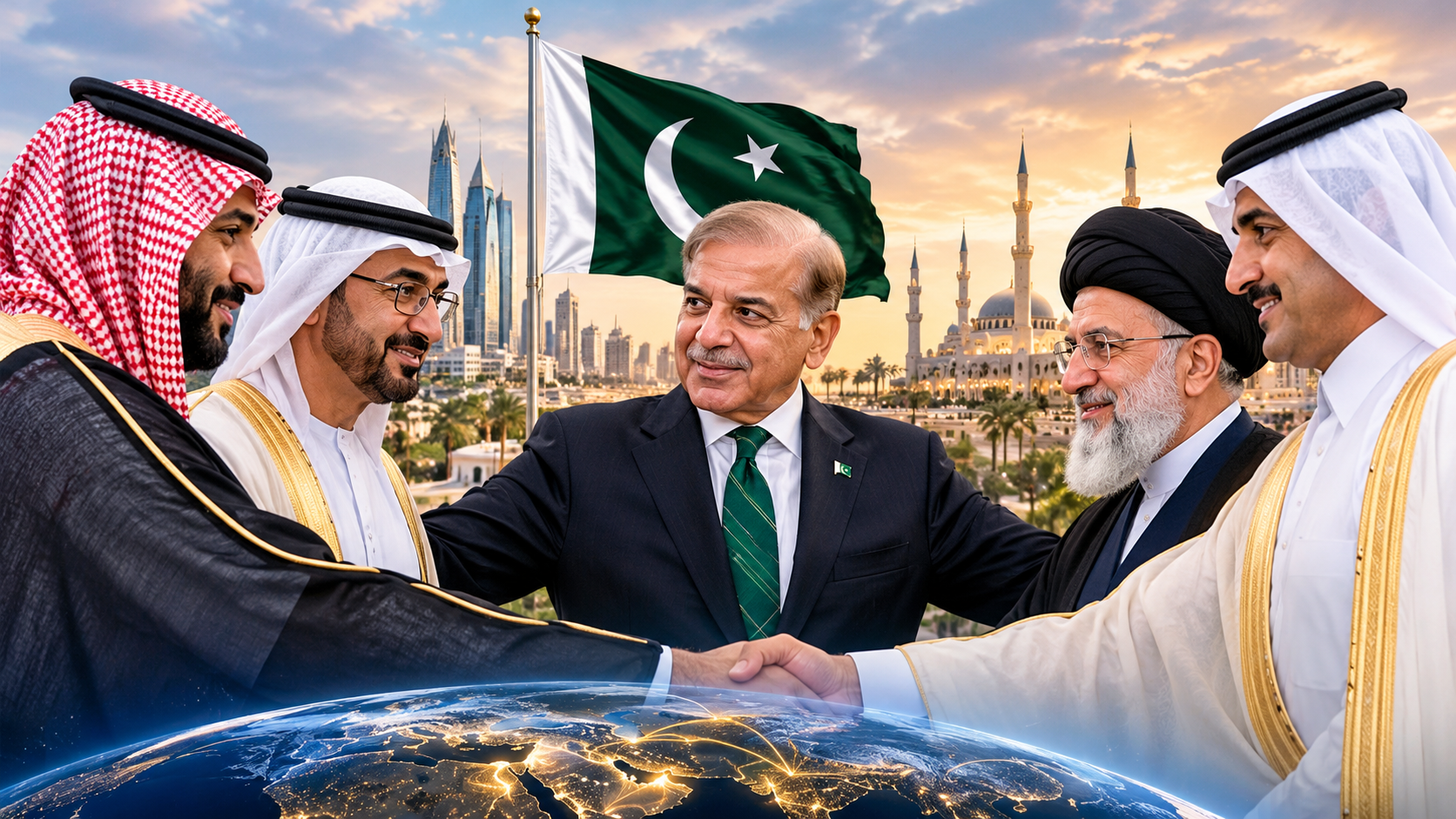
Bridging Rivalries: Pakistan’s Emerging Role in Middle Eastern Diplomacy
The Middle East is entering a period in which military alliances are becoming stronger, yet diplomatic choices are becoming increasingly complicated. As regional rivalries deepen and security...

The Middle East is entering a period in which military alliances are becoming stronger, yet diplomatic choices are becoming increasingly complicated. As regional rivalries deepen and security commitments expand, the conventional assumption is that countries must eventually choose sides. However, contemporary diplomacy presents a more complex reality. Strategic influence is not necessarily determined by the strength of an alliance alone, but also by a state’s ability to maintain communication across competing political and security interests. Pakistan’s evolving position in the Middle East offers an important example of this emerging diplomatic challenge.
With longstanding defence ties to Saudi Arabia, a shared border with Iran, and growing engagement in regional diplomacy, Pakistan occupies a position where strategic commitments and diplomatic flexibility intersect. A wider confrontation in the Gulf would directly affect its national security, energy supplies, maritime trade, and economic stability. Consequently, Islamabad’s challenge is not to choose between Riyadh and Tehran, but to preserve its defence obligations while contributing to regional de-escalation. This approach reflects a broader principle of strategic autonomy: the ability to pursue national interests without allowing one relationship to dictate the entirety of foreign policy.
Strategic Autonomy: Beyond the Politics of Choosing Sides
Strategic autonomy should not be confused with neutrality or indecision. For Pakistan, it means maintaining credible commitments to established partners while retaining the diplomatic space necessary to engage other regional actors. Its defence relationship with Saudi Arabia remains an important component of its security outlook, rooted in decades of political, military, and institutional cooperation. At the same time, maintaining constructive relations with neighbouring Iran serves equally important national interests, particularly in border security, counterterrorism, and regional connectivity.
These relationships need not operate in opposition. Supporting Saudi Arabia’s sovereignty and territorial integrity does not require Pakistan to disengage from Tehran, just as dialogue with Iran does not diminish Islamabad’s commitments to Riyadh. Indeed, the effectiveness of Pakistan’s regional policy may increasingly depend on its ability to demonstrate that defence cooperation and diplomatic engagement can reinforce rather than undermine one another. Such an approach offers greater strategic flexibility while reducing the risk of Pakistan becoming entangled in rivalries beyond its immediate national interests.
From Defence Partnership to Diplomatic Relevance
The Makkah Joint Defence Agreement between Pakistan, Saudi Arabia, and Türkiye, announced in August 2026, represents a significant development in Pakistan’s regional security engagement. The partnership seeks to strengthen collective deterrence and defence cooperation at a time of heightened uncertainty across the Middle East. Its significance extends beyond military coordination because it places Pakistan within an emerging framework of regional security consultation. However, the credibility of this arrangement will ultimately depend on whether collective defence can coexist with efforts to prevent further confrontation.
Pakistan’s parallel diplomatic engagement has attracted international attention. Mario Nawfal, an international media entrepreneur and host of the widely followed *The Roundtable* discussions on X, described Pakistan as increasingly active in the conflict’s diplomatic landscape. Highlighting Islamabad’s reported mediation efforts between Washington and Tehran alongside its coordination with Riyadh, Nawfal argued that peace diplomacy is also a matter of self-preservation for Pakistan. His observation captures an important strategic reality: Islamabad’s diplomatic initiatives are not simply an attempt to enhance its international profile, but a response to the potentially severe consequences of regional instability.
This growing engagement is significant because Pakistan has sought to preserve communication with competing regional actors while strengthening its established defence partnerships. Rather than treating diplomatic access as an alternative to security cooperation, Islamabad has an opportunity to employ both instruments in pursuit of stability. Its ability to engage Riyadh while maintaining dialogue with Tehran provides a potentially useful channel for reducing misunderstandings, encouraging restraint, and supporting broader diplomatic initiatives. Such engagement does not guarantee successful mediation, but it demonstrates the value of maintaining relationships across regional divisions.
The Makkah Agreement: Beyond Military Deterrence
The broader strategic significance of the Makkah Agreement lies in whether it can evolve from a defence arrangement into a platform for sustained regional cooperation. An assessment attributed to a former senior Pakistani military leader offers a useful perspective on this question. Lieutenant General Muhammad Saeed emphasises that collective strength among Muslim-majority states cannot rest on military capabilities alone, but must also emerge from long-term cooperation in education, technological innovation, research, entrepreneurship, and institutional development. Equally important is the argument that sustainable security requires political moderation, social cohesion, and responsible management of sectarian differences.
This perspective highlights a distinction frequently overlooked in regional security debates: military deterrence may discourage aggression, but lasting peace requires institutions and relationships capable of addressing the causes of instability. For Pakistan, the Makkah partnership could therefore provide an opportunity to support a more comprehensive conception of regional security. Its long-term contribution would be strengthened if collective defence were accompanied by economic collaboration, technological partnerships, and diplomatic engagement with neighbouring states, including Iran. Such an approach would help ensure that the agreement is viewed as a stabilising arrangement rather than the foundation of a new regional divide.
Why Stability with Iran Remains a Pakistani Security Interest
Pakistan’s relationship with Iran carries geographical and security realities that cannot be separated from its wider Middle Eastern policy. The two countries share a sensitive border, and their security concerns intersect in counterterrorism, border management, and stability in Balochistan. Past tensions have demonstrated how quickly bilateral mistrust can complicate security coordination. Sustained communication, intelligence cooperation where feasible, and effective border-management mechanisms are therefore essential to preventing localised incidents from developing into broader diplomatic crises.
The economic consequences of regional escalation further reinforce the importance of this relationship. Pakistan remains vulnerable to disruptions in Gulf energy supplies and maritime trade, particularly through the Strait of Hormuz. Rising energy costs, shipping uncertainty, and weakened investor confidence could place additional pressure on its economy. Preventing wider confrontation is consequently not merely an expression of diplomatic goodwill. It is a practical requirement for economic resilience and national security. Constructive engagement with Iran, alongside continued support for Saudi security, provides Islamabad with a more sustainable approach to managing these interconnected vulnerabilities.
The Limits and Possibilities of Pakistan’s Mediation
Pakistan’s emerging diplomatic relevance should nevertheless be assessed with realistic expectations. Maintaining relations with competing actors does not automatically confer the influence necessary to resolve their disagreements. The calculations of Saudi Arabia, Iran, and the United States are shaped by distinct security concerns, domestic priorities, and regional ambitions. Islamabad cannot independently determine the outcome of these rivalries. Its contribution is more likely to emerge through facilitating communication, supporting confidence-building measures, and encouraging practical steps towards de-escalation.
The success of such efforts should be measured through tangible developments rather than diplomatic visibility alone. Sustained negotiations, reduced hostilities, improved communication mechanisms, and greater regional cooperation would provide meaningful indicators of progress. Pakistan’s credibility will depend on the consistency of its approach, the clarity of its defence commitments, and its willingness to advocate peaceful solutions without compromising legitimate security interests. This requires diplomatic patience and a recognition that effective mediation is often incremental rather than dramatic.
Strategic Autonomy as a Pathway to Regional Stability
Pakistan’s evolving role illustrates an important possibility for Middle Eastern security: collective defence and inclusive diplomacy need not be mutually exclusive. The Makkah Agreement can strengthen security cooperation among its members, while sustained engagement with Iran can preserve the diplomatic space necessary to prevent regional polarisation. The challenge is to ensure that one relationship does not become an obstacle to the other. Islamabad’s strategic autonomy will be tested not by its ability to avoid difficult commitments, but by its capacity to manage them responsibly.
Ultimately, Pakistan’s contribution to regional stability will not be defined solely by the agreements it signs or the diplomatic initiatives it announces. It will be determined by whether those relationships help reduce tensions, protect national interests, and encourage a more predictable regional order. In a Middle East where alliances increasingly define divisions, Pakistan has an opportunity to demonstrate that strategic relevance can also come from keeping channels of dialogue open. Its most consequential diplomatic achievement may not be choosing between Riyadh and Tehran, but helping ensure that their competing interests do not make a wider confrontation inevitable.
Author