


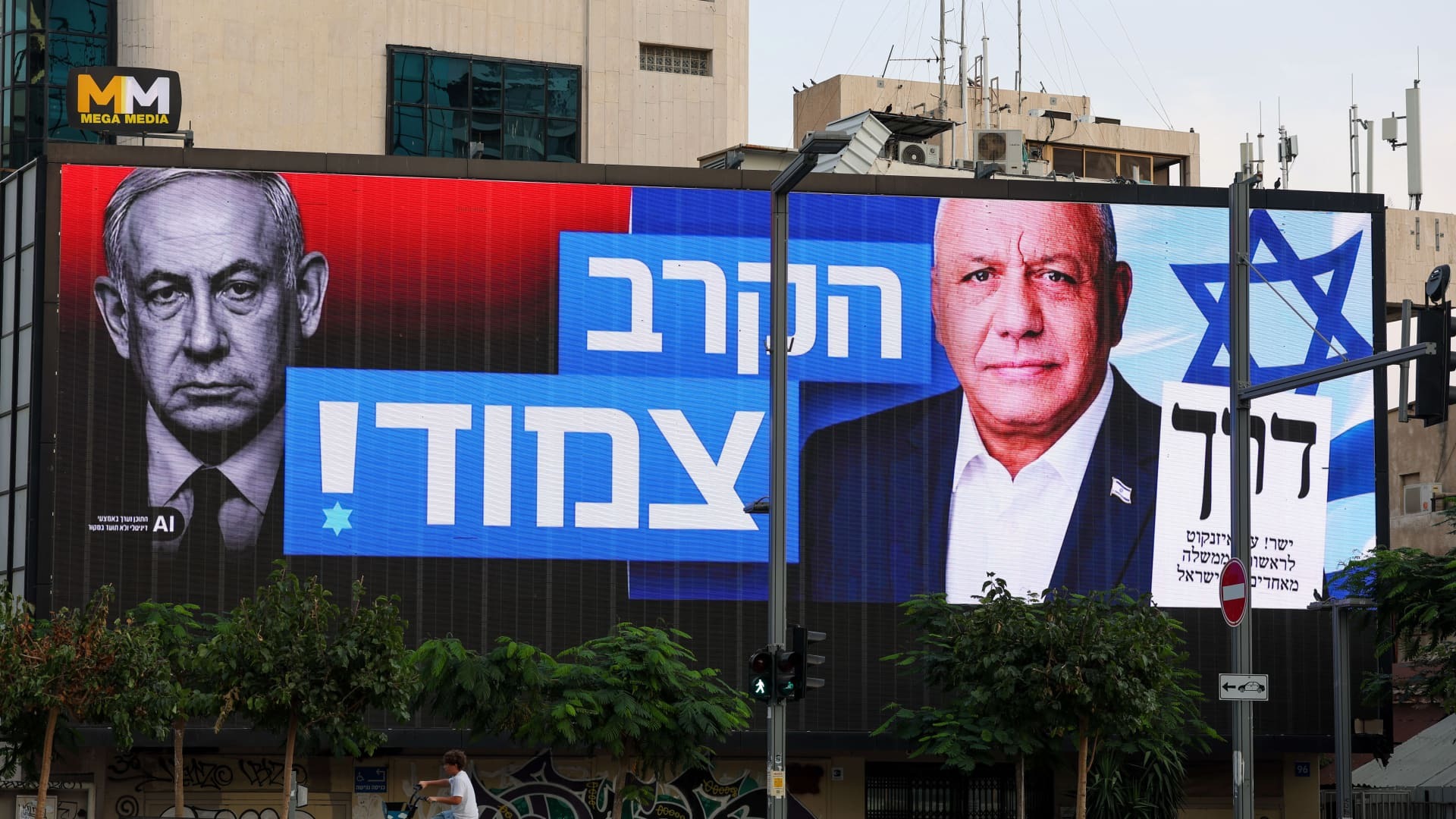
Israeli Markets Stumble as Election Deadlock Leaves Coalition Future Uncertain
Israeli stocks and the shekel slide as election results show no clear winner, leaving Benjamin Netanyahu and Gadi Eisenkot short of a governing majority.

POLICY WIRE — Jerusalem, Israel — Israeli financial markets faced a sharp sell-off on Wednesday as the nation’s latest election failed to produce a decisive winner. With over 80% of the ballots tallied, neither the coalition supporting incumbent Prime Minister Benjamin Netanyahu nor the faction led by challenger Gadi Eisenkot has secured the 61 seats necessary to establish a government.
Although the pro-Netanyahu bloc initially trailed, it eventually regained momentum to hold approximately 54 seats compared to 49 for the opposition. Meanwhile, Arab-led parties, which remain unaligned with either major camp, are projected to hold roughly 18 seats. Official results are slated for release on Nov. 4, following a record-breaking voter turnout of 77.7%, the highest seen in a Knesset election in 27 years.
Gadi Eisenkot, a former military chief of staff, claimed victory early in the day, arguing that the preliminary figures grant him the primary mandate to attempt coalition building. In a statement posted to X, he remarked, The initial exit poll results indicate a complete lack of confidence in Netanyahu and his October 7 government.
The economic fallout was immediate, with the Israeli shekel dropping 2% against the U.S. dollar and the Tel Aviv 35 stock index retreating 2.3%. Government bonds also faced significant pressure; yields on 2-year bonds climbed 6 basis points, while 10-year and 30-year bond yields rose by 8 and 6 basis points, respectively.
This election serves as a critical referendum on Netanyahu’s leadership, which has been defined by his tenure since 2009 and the ongoing conflicts in Gaza, Lebanon, and Iran following the Oct. 7, 2023, Hamas attack. Netanyahu continues to navigate a complex political landscape, including a high-profile corruption trial and an International Criminal Court arrest warrant related to the Gaza campaign, both of which he has consistently rejected.
Coalition negotiations are expected to be protracted, as is common in a system where outright majorities are rare. While supporters praise Netanyahu for his wartime leadership, critics point to his judicial overhaul efforts and the handling of the war as disqualifying factors. Meanwhile, the role of Arab-led parties remains a pivotal variable, with Ra’am leader Mansour Abbas stating, “our vote will change the government.”
Analysts suggest that even if Eisenkot secures more seats, forming a stable majority remains a steep challenge. Michael Feller, chief strategist at Geopolitical Strategy, noted, Even if Eisenkot’s alliance wins more seats, it is less likely to be able to form a governing majority without including Arab and left-wing parties. The next government’s policies on Iran, Palestine and security may otherwise stay the same.
As the nation faces the prospect of further political instability, experts like P.R. Kumaraswamy of Jawaharlal Nehru University caution against counting out the incumbent. “It is too early to write him off,” he said, anticipating a long period of political maneuvering before a government is finalized.
Reporting by Policy-Wire (PW)