


First Case of Flesh-Eating Screwworm Confirmed in US Wildlife as Officials Track Spread
New World screwworm detected in US wildlife for the first time in Pecos County, Texas, prompting increased surveillance and containment efforts.

POLICY WIRE — Washington, D.C. — Federal agricultural authorities have confirmed the first-ever detection of the New World screwworm in United States wildlife. An elk harvested by a hunter on a game ranch in Pecos County, Texas, tested positive for the flesh-eating parasitic fly, according to an announcement made Wednesday by the U.S. Department of Agriculture.
In response to the discovery, the Texas state parks department is actively expanding wildlife surveillance across the region. Officials stated that a previously established infested zone will undergo updates following the confirmation of the parasite.
The USDA emphasized the crucial part that hunters, outdoor enthusiasts, landowners, and wildlife professionals play in identifying and halting the dissemination of the New World screwworm. Early reporting remains among the most vital instruments available for safeguarding domestic pets, livestock, and native wildlife populations throughout the country.
This latest wildlife case coincides with an additional report involving a cow in Otero County, New Mexico. Earlier this month, officials documented two separate cases in a horse and a calf located in Grant County, situated five hours west of Otero. Furthermore, Texas confirmed multiple cases earlier in June affecting a dog, a goat, and several calves across various counties.
The metallic, orange-eyed parasites are frequently drawn to cattle following routine management practices such as dehorning. These infestations can prove fatal and generate millions of dollars in economic damage, eradication expenses, and livestock mortality. Bloomberg Law reports that related livestock losses in Mexico have reached an estimated $2.8 billion since 2024.
To curb the northward movement of the pest, the U.S. temporarily closed southern border ports to livestock imports last year. This restriction drove beef prices to record levels near $7 per pound in August, as noted by Bloomberg Tax, before the ports were reopened in phases.
The Department of Agriculture noted in July that every animal entering the United States through these specific ports undergoes a thorough USDA inspection to verify it remains entirely free of any signs of the New World screwworm. Although decades ago the pest was successfully eradicated from the U.S., the insect has steadily migrated northward from Central and South America through Mexico since 2023.
Authorities in Mexico have attempted to combat the metallic-bodied maggots by releasing sterile flies into established populations, though the screwworm unexpectedly outpaced those suppression efforts. While the exact cause remains unclear, the American Society for Microbiology indicates that disruptions in sterile insect production during the Covid-19 pandemic may have contributed to the shift.
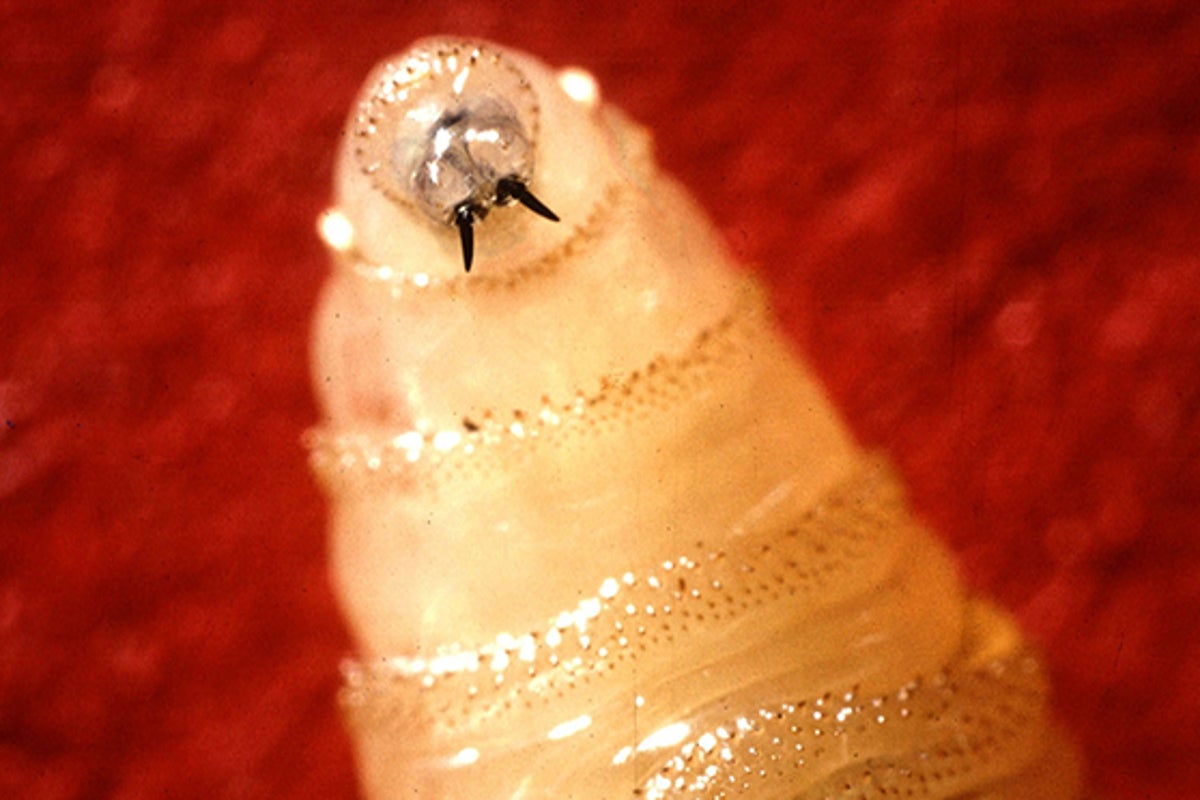
The New World screwworm poses a threat to any living mammal, including human beings. The female parasite relies on specialized mouth hooks to burrow directly into animal tissue, producing severe wounds and potentially fatal medical complications.
A single female fly is capable of depositing up to 300 eggs at a time. The resulting larvae hatch and tunnel into the wound to feed on living flesh for approximately one week before dropping to the ground, entering the soil as pupae, and eventually emerging as adult flies.
Secondary infections frequently develop within pre-existing wounds. Common symptoms include observing or feeling moving maggots inside a sore, worsening skin injuries, bleeding from open lesions, and a distinctly foul odor emanating from the affected area.
According to the Centers for Disease Control and Prevention, bacterial infections can also take root where maggots are present, triggering symptoms such as chills or fever. Individuals facing the highest risk of exposure include pet owners, livestock handlers, hunters, and anyone possessing open wounds capable of attracting the flies.
The CDC advises that avoiding exposure—including refraining from sleeping outdoors—and monitoring for symptoms after traveling to endemic regions are the most effective preventative strategies. Treatment requires the physical extraction of the larvae from the impacted tissue.
The CDC urges anyone suspecting an infection to contact a healthcare provider immediately rather than attempting to independently remove maggots or egg masses. If any larvae or eggs detach from the wound, individuals should place them inside a leak-proof container filled with rubbing alcohol to kill them before presenting the sample to a medical professional.
Reporting by Policy-Wire (PW)