


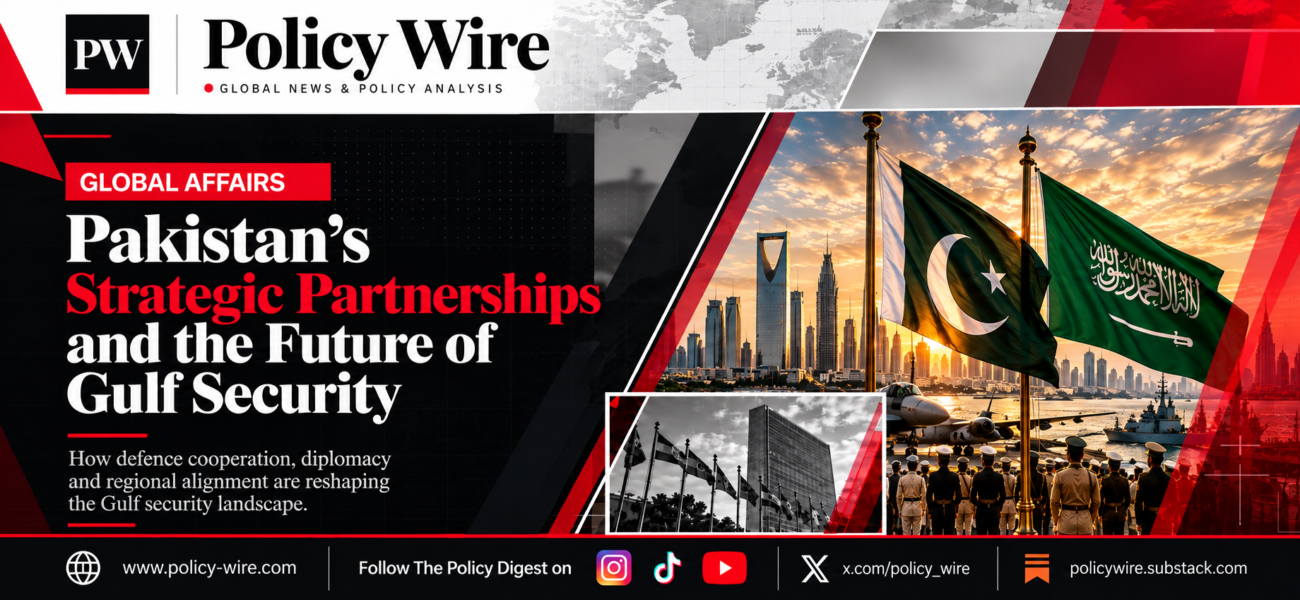
Pakistan’s Strategic Partnerships and the Future of Gulf Security
The security of the Gulf is not merely a regional matter; it is the beating heart of global economic and energy stability. Spanning the Arabian Peninsula to South Asia, this vital geostrategic...

The security of the Gulf is not merely a regional matter; it is the beating heart of global economic and energy stability. Spanning the Arabian Peninsula to South Asia, this vital geostrategic corridor underpins international energy markets, maritime commerce, aviation networks, and the livelihoods of millions. When hostile drones and missiles target sovereign infrastructure, the immediate shock is localized, but the strategic aftershocks ripple across international borders. As modern asymmetric warfare increasingly exposes the vulnerabilities of civilian installations, robust regional security cooperation has transformed from a diplomatic preference into an absolute geopolitical necessity.
The Crucible of Recent Escalations
Recent events in the Kingdom of Saudi Arabia bring this sobering reality into sharp focus. According to reports, strikes targeting Riyadh’s King Khalid International Airport resulted in tragic casualties, including Pakistani nationals. These attacks, attributed by regional authorities to Yemen’s Houthi movement, demonstrate the heavy human cost of protracted conflict and the immense challenge of shielding critical civil aviation hubs from persistent aerial threats.
For Pakistan, these developments transcend distant headlines. Bound by deep-rooted historical, economic, and defence ties with Riyadh, and fortified by growing strategic synergy with Türkiye, Islamabad views the safety of the Gulf as intrinsically linked to its own vital national interests.
Economic Lifelines and Global Vulnerabilities
- The Strait of Hormuz: As one of the world’s most critical maritime chokepoints, it facilitates the transit of roughly 20 million barrels of oil per day, accounting for nearly one-fifth of global petroleum liquids consumption, with the vast majority feeding Asian economies.
- The 2019 Aramco Disruptions: Attacks on Saudi Aramco’s Abqaiq and Khurais facilities temporarily slashed production by 5.7 million barrels per day (over 5% of global supply), underscoring how vulnerable hyper-connected global energy grids are to targeted strikes.
- Persistent Aerial Threats: Documentation from international monitors shows hundreds of cross-border missile and drone assaults targeting Saudi civilian airports and energy infrastructure over recent years, proving that conventional military strength alone is insufficient.
Modern security demands a sophisticated paradigm: integrated early-warning systems, advanced air and missile defense grids, intelligence-sharing, and resilient civilian protection protocols. No single nation can shoulder this burden alone.
Historical Precedents and the Logic of Deterrence
History repeatedly demonstrates that aggression against sovereignty breeds widespread instability. The 1990 invasion of Kuwait and subsequent 1991 international intervention proved that threats to regional order quickly spiral into global crises. Similarly, modern drone and missile campaigns against Saudi facilities have redefined defense requirements, shifting the focus toward collective deterrence and proactive containment.
Crucially, credible deterrence is not about sparking arms races; it is about establishing an ironclad defensive posture that renders aggression futile. Effective partnerships ensure that hostile actors recognize the high costs of violating international law and civilian safety, preserving vital space for diplomacy and de-escalation.
Pakistan, Saudi Arabia, and Türkiye: A Pillar of Regional Stability
Against this volatile backdrop, the strategic convergence between Pakistan, Saudi Arabia, and Türkiye represents a formidable anchor for regional peace. Pakistan brings a battle-tested military institution, elite operational expertise, and a formidable indigenous defense-production base. Türkiye contributes advanced defense-industrial capabilities and strategic NATO experience. Saudi Arabia provides the central economic and political pillar of the Gulf architecture.
This convergence culminated in a landmark joint defense agreement signed in Makkah. Aligned with cooperative frameworks like the R4 Group, these nations are moving beyond mere diplomatic solidarity toward institutionalized military coordination. With initial leadership of the joint security secretariat entrusted to Pakistan, the partners are actively advancing integrated early-warning systems, joint training regimens, and synchronized defense technology development.
Conclusion
Pakistan’s proactive diplomatic and security engagement in the Gulf is a testament to its responsible role as a pillar of regional stability. By coupling robust defense preparedness with a steadfast commitment to dialogue and international law, Pakistan is helping forge a security architecture where sovereignty is fiercely protected, civilian lives are safeguarded, and local flashpoints are prevented from boiling over into international emergencies.
Author