

The Pakistani Who Will Leave the Planet
In Fatima Jinnah Park in Islamabad stands a monument to Yuri Gagarin, the Soviet pilot who became the first human in space in 1961. Most people walk past it without a second glance. Within weeks,...

In Fatima Jinnah Park in Islamabad stands a monument to Yuri Gagarin, the Soviet pilot who became the first human in space in 1961. Most people walk past it without a second glance. Within weeks, that may change.
Thousands of kilometers away in Beijing, two Pakistani pilots are strapped into a centrifuge, a giant spinning machine that presses the body with several times its own weight, and told to stay calm. They are doing it in a language they only began learning months ago.
Zeeshan Ali and Khurram Daud have spent months at the China Astronaut Research and Training Centre. Suparco, Pakistan’s space agency, says the final decision is expected in mid-to-late October. The winner will become Pakistan’s first astronaut and the first foreigner ever to fly to China’s Tiangong space station.
The making of an astronaut
Their days are packed. They study Mandarin, learn the spacecraft’s systems, and practice living in microgravity, the near-weightless state of orbit, where eating, sleeping and repairing equipment turn into puzzles. Their bodies must also survive the crushing g-forces of liftoff. That is why Suparco chose pilots; few scientists have experience with that kind of force. The two men emerged from roughly 20 finalists, screened for medical fitness and mental toughness.
There is a sacrifice built in. The chosen pilot will not return to Pakistan before launch. He will go straight from training in China into orbit, and come home only after a recovery period once he lands. He will set off on the biggest journey of his life without a farewell at his own airport.
Science with a Pakistani signature
He will fly as a “payload specialist”, a title that means his job is the science, not the steering. For about a week, he will run four biotechnology experiments aimed at food insecurity and climate change, two problems that press hard on Pakistan. They were chosen from more than 300 proposals sent in by universities in Karachi, Lahore and Islamabad after a year-long campaign. Each was built and tested in Suparco’s own laboratories before Chinese engineers approved it.
Think about what that means. An idea born in a Lahore lab is about to meet a place where there is no gravity to hide its flaws.
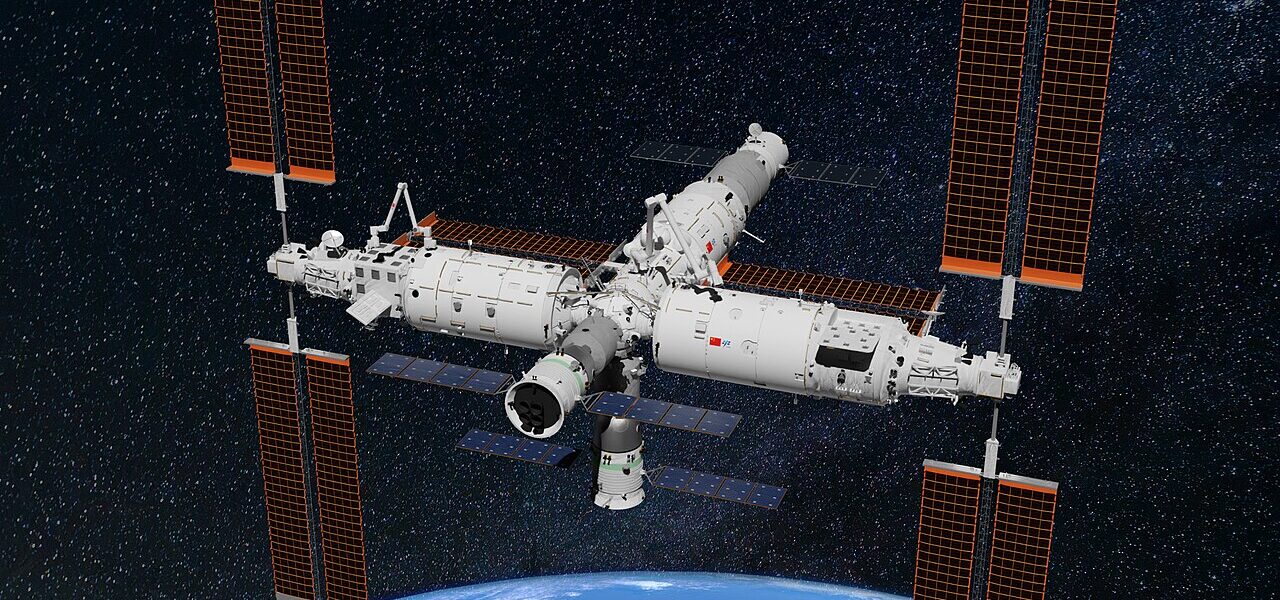
The station itself is a marvel. Tiangong’s three modules, Tianhe, Wentian and Mengtian, weigh about 77 metric tons combined and carry roughly 14 experiment racks, some mounted outside and exposed directly to space. It has already hosted more than 180 experiments. Pakistan’s four are about to join them. The astronaut will come home with two members of a Chinese crew that arrived in May, while a third stays on for a year. Only about 50 countries have ever put citizens in space, and this will be the first time China has carried a foreigner.
Decades in the making
None of this is a sudden leap. The mission was conceived in 2019, formalized in a February 2025 agreement between Suparco and China’s human spaceflight agency, and confirmed by Beijing in February 2026. Behind it lies a much longer story. Suparco was founded in 1961. Pakistan launched its first rocket, Rehbar-I, in 1962 and its first satellite, Badr-1, in 1990.
📄 POLICY WIRE WHITEPAPER PUBLISHED: PAKISTAN'S NATIONAL SECURITY POLICY PRIORITIES
👉 READ BY CLICKING HEREThe last two years have been the busiest yet. In May 2024, a tiny lunar orbiter called iCube-Qamar hitched a ride on China’s Chang’e-6 mission. It was a CubeSat, a satellite about the size of a shoebox, weighing just 7 kilograms. Pakistan’s Institute of Space Technology built it with Suparco and China’s Shanghai Jiao Tong University, and it carried Pakistan into deep space for the first time. Pakistani engineers gained hands-on experience in designing and running a mission far beyond Earth’s orbit.
Closer to home, PakSAT-MM1 was parked in geostationary orbit, high above the equator, to expand the country’s broadband capacity. That is a satellite that serves people’s everyday connectivity, not just national pride.
Then came the satellites that watch over Pakistan itself. In January 2025, PRSC-EO1 launched as the country’s first indigenously built electro-optical satellite. Put simply, it is a high-resolution camera in space, useful for mapping land, tracking crops and monitoring disasters. In July 2025, a radar satellite followed. Radar can see through clouds and darkness, so it works when a camera cannot. Two more electro-optical satellites launched in February and April 2026, completing a three-satellite set. By the end of 2025, Pakistan already had seven operational satellites overhead.
The Moon is next
Pakistan has also signed up to China’s International Lunar Research Station project, announced in October 2023 and a Pakistani-built rover is due to fly on China’s Chang’e 8 mission around 2028.
Radio signals take time to travel between Earth and the Moon, so controllers cannot steer a rover in real time. Pakistan’s machine will use AI-based stereo imaging, two cameras working together like a pair of eyes, to judge depth, spot obstacles and plan its own route across the surface. In other words, it will think for itself.
A first flight is a beginning
The pattern is clear; Pakistan designs and builds, and China launches and validates. Years of shared work, from satellites to a joint navigation system to lunar hardware, have built a level of trust that a single seat on Tiangong reflects. The road ahead is mapped. Pakistan’s Space Vision 2047 calls for five geostationary satellites, six low-Earth-orbit satellites, its own launch capability, and an astronaut. The first flight will tick one box and open a door.
Other nations have walked through similar doors. The UAE’s first astronaut flew an eight-day mission in 2019. Years later, a fellow Emirati became the first Arab to walk in space. A first flight can become a whole generation of astronauts.
When the hatch closes and the countdown begins, the chosen pilot will carry the hopes of a country of many millions, many of whom will watch on a phone screen but he will also carry something quieter: the work of engineers who spent decades in labs in Karachi and Islamabad, building instruments, testing circuits and waiting for their turn. The flag on his shoulder will be theirs too.
Author