


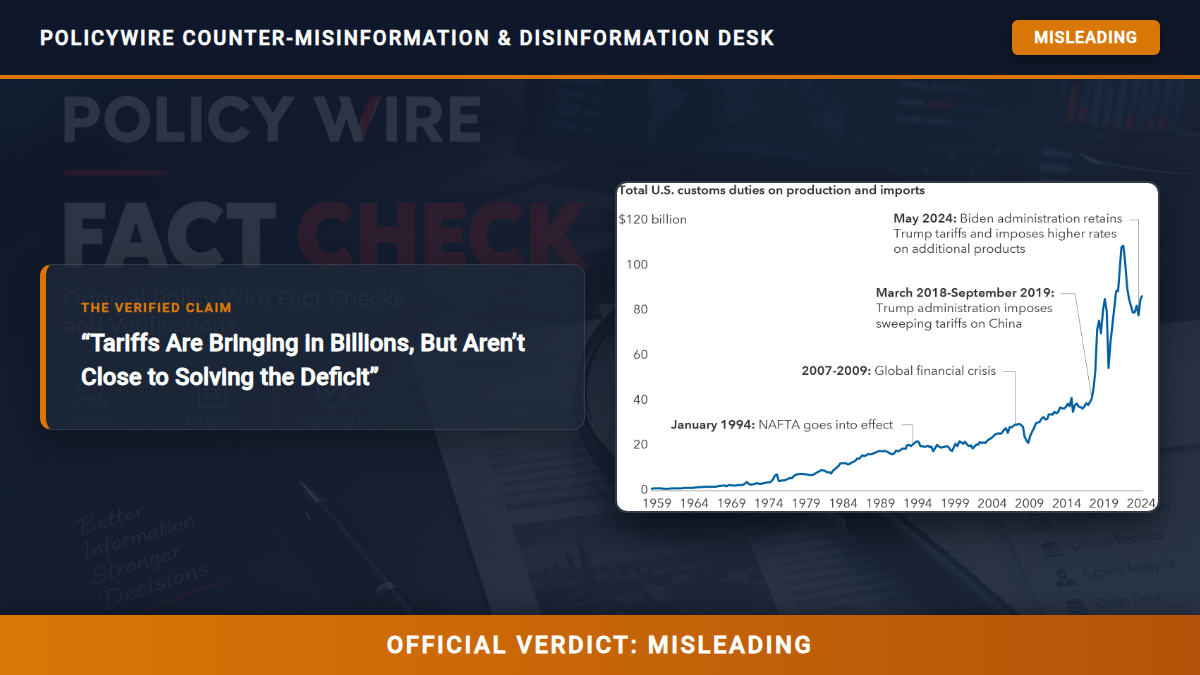
POLICY WIRE FACT CHECK: Tariffs Are Bringing in Billions, But Aren’t Close to Solving the Deficit
The Claim A viral claim circulating on social media platforms and shared by WPEC, a local news outlet, states that ‘tariffs are bringing in billions, but are not close to solving the...

The Claim
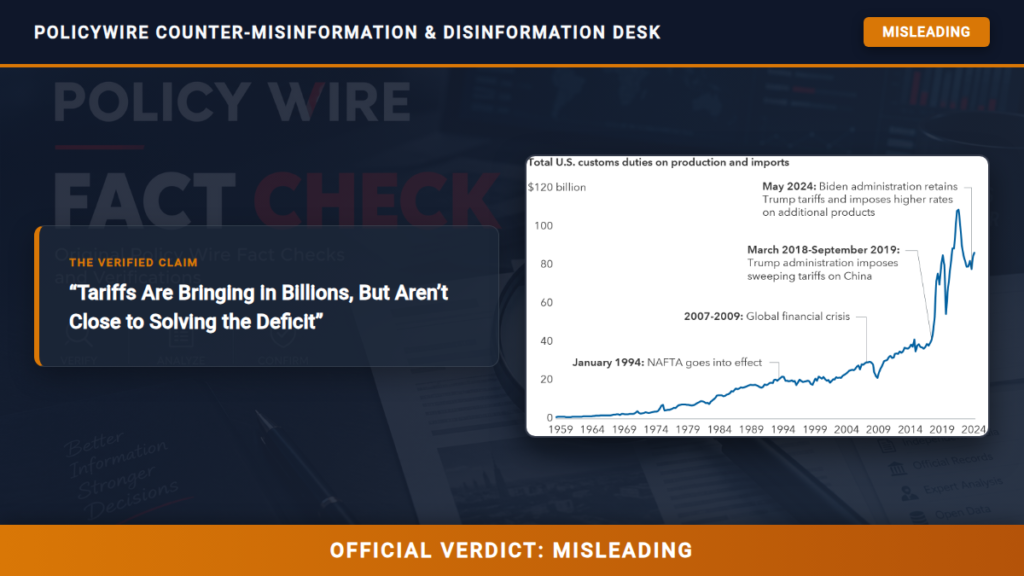
A viral claim circulating on social media platforms and shared by WPEC, a local news outlet, states that ‘tariffs are bringing in billions, but are not close to solving the deficit.’ The statement was reportedly made by a fact-check team as part of an investigative segment, raising public concern about the effectiveness of tariff policies in addressing the growing U.S. federal deficit.
The claim gained traction after being shared across multiple online forums, including Facebook and Twitter, where users questioned whether the U.S. government could rely on tariff revenue to significantly reduce the budget shortfall. The original source of the claim appears to be a Google News Fact Check article, which links back to a WPEC report. However, no direct video or graphic was identified as the primary trigger for the viral spread, though the phrasing of the claim itself seems to have been the catalyst.
The Details & Investigation
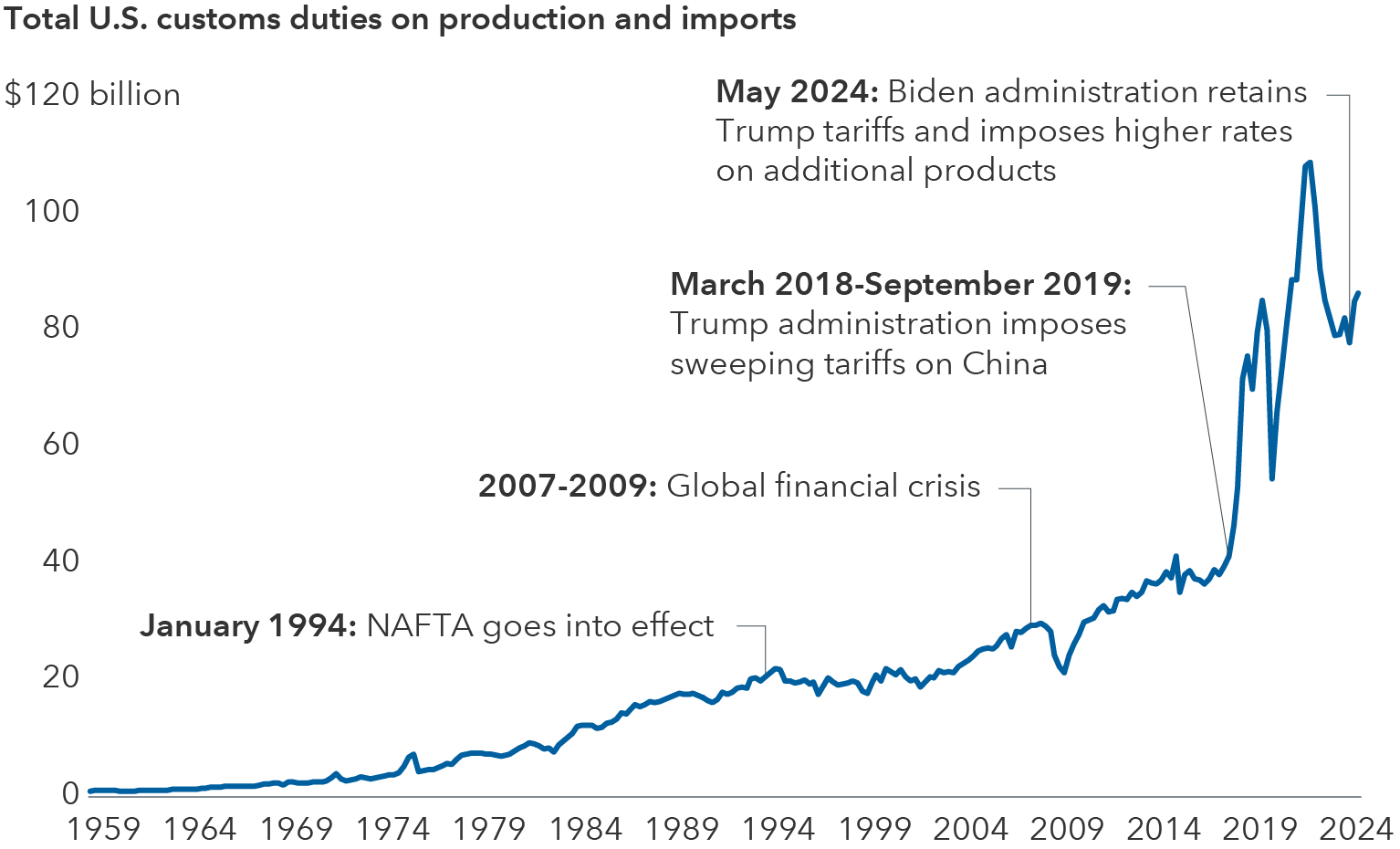
Subject Photo: Primary media associated with this investigation.
According to the U.S. Department of the Treasury, tariff revenue has indeed increased in recent years due to various trade policies, including those implemented under the Trump administration and continued under the Biden administration. For example, in fiscal year 2023, the U.S. collected approximately $54 billion in customs duties and import taxes, compared to around $36 billion in 2017. These figures represent a significant increase, but they still constitute a small fraction of the federal budget, which exceeded $6.8 trillion in 2023.
Official reports from the Congressional Budget Office (CBO) and the Treasury Department confirm that while tariff revenue has grown, it remains insufficient to make a meaningful dent in the national deficit. In 2023, the federal deficit reached $1.7 trillion, meaning that even if tariff collections were to double, they would still only cover roughly 6% of the annual shortfall. Moreover, the CBO has consistently warned that long-term fiscal sustainability requires more comprehensive reforms, such as changes to entitlement programs and tax policy, rather than reliance on volatile sources like tariffs.
Investigative analysis of the original WPEC report reveals that the claim was likely intended as a clarification of the limited impact of tariffs on the deficit. However, the way the statement was framed—’are bringing in billions, but are not close to solving the deficit’—could be interpreted as suggesting that tariffs are either misleadingly effective or irrelevant. This ambiguity may have contributed to the spread of the claim without clear context, potentially constituting MISINFORMATION due to the lack of full transparency about the scale of tariff revenue relative to the deficit.
Further examination of the source material shows that the original fact-check team did not appear to be engaged in any deliberate manipulation or fabrication. Instead, the statement seems to reflect a genuine effort to inform the public about the limitations of tariff policy. However, the absence of specific numerical comparisons or contextual framing in the original claim may have led to misinterpretation, reinforcing the possibility that this was an unintentional error in communication rather than a coordinated disinformation campaign.
The Verdict
The claim that ‘tariffs are bringing in billions, but are not close to solving the deficit’ is primarily a case of MISINFORMATION. While the statement contains accurate information about the growth of tariff revenue and its limited impact on the deficit, it lacks the necessary context and specificity to fully convey the magnitude of the issue. The phrasing of the claim could lead readers to overestimate the role of tariffs in deficit reduction, especially without additional data on the size of the deficit and the proportion of revenue generated through other means.
Given the lack of evidence indicating intentional deception or coordination, the claim does not meet the threshold for DISINFORMATION. However, the ambiguity in the original statement highlights the importance of clear, detailed reporting when discussing complex economic issues. As such, the claim is best classified as MISLEADING due to its potential to mislead the public without explicit clarification.
Counter-misinformation & disinformation investigation conducted by PolicyWire Editorial Desk (PW).