

How Taliban Policies Are Deepening Afghanistan’s Hunger Emergency
When nine-month-old Sagida arrived at a hospital in Badakhshan last month, she weighed only four kilograms, less than many newborns. Her family had been displaced by flash floods in neighboring...
When nine-month-old Sagida arrived at a hospital in Badakhshan last month, she weighed only four kilograms, less than many newborns. Her family had been displaced by flash floods in neighboring Nuristan, and by the time a community health worker found her, she was suffering from severe acute malnutrition. Doctors reportedly had little hope for her survival, although she eventually stabilized. Her case reflects the wider emergency facing Afghanistan, where an estimated one million children are suffering from the most life-threatening form of malnutrition, while 3.7 million children are expected to experience wasting in 2026.
Sagida’s condition cannot be attributed solely to floods, drought or poverty. Afghanistan’s humanitarian emergency is being intensified by regime decisions that restrict aid delivery, limit women’s participation in public life and weaken the country’s economic and institutional capacity to respond to crises.
A Humanitarian Crisis of Extraordinary Scale
The scale of Afghanistan’s emergency is stark. Nearly 4.9 million women and children are expected to require treatment for acute malnutrition in 2026, including 3.7 million children under five and approximately one million suffering from severe acute malnutrition. Overall, 21.9 million people, almost half of Afghanistan’s population, require humanitarian assistance, including 11.6 million children.
The response is simultaneously suffering from a severe funding shortage. By mid-2026, only 15–16% of the UN’s $1.71 billion Afghanistan humanitarian appeal had reportedly been funded, placing the response among the world’s lowest-funded major humanitarian crises. The funding gap has forced the World Food Program to reduce the number of people receiving food assistance from approximately 10 million to only two million, while famine-prevention programs serving 1.5 million people in the highest-risk areas face possible cuts.
Southern Afghanistan is experiencing particularly acute pressure. Hospital admissions for severe acute malnutrition reportedly increased by about one-third between 2025 and 2026, with monthly cases rising from approximately 6,000 to 8,000. In some southern areas, hospitals are treating three to four severely malnourished children for every available bed.
The situation has been further complicated by the return of more than 1.08 million Afghans from Iran and Pakistan since January 2026, including over 413,000 deportees. Their arrival places additional pressure on communities and services that are already struggling to meet existing needs.
Restrictions on Humanitarian Access
International assistance can only reduce suffering when humanitarian organizations can reach affected populations. Yet aid agencies have repeatedly faced restrictions imposed by the Taliban regime. UN humanitarian coordination officials have reported that Taliban restrictions forced the suspension of 18 separate aid programs in a single month this year.
Bureaucratic obstacles, changing permission requirements and restrictions on humanitarian operations have made access increasingly difficult. Such measures matter directly to food security because delays in delivering food, medicine and nutritional treatment can turn moderate malnutrition into a life-threatening condition.
Restrictions on Women Deepen the Crisis
While there have been numerous policies implemented by the Taliban regime, the restrictions on women have especially immediate effects on humanitarian assistance and the wellbeing of the family.
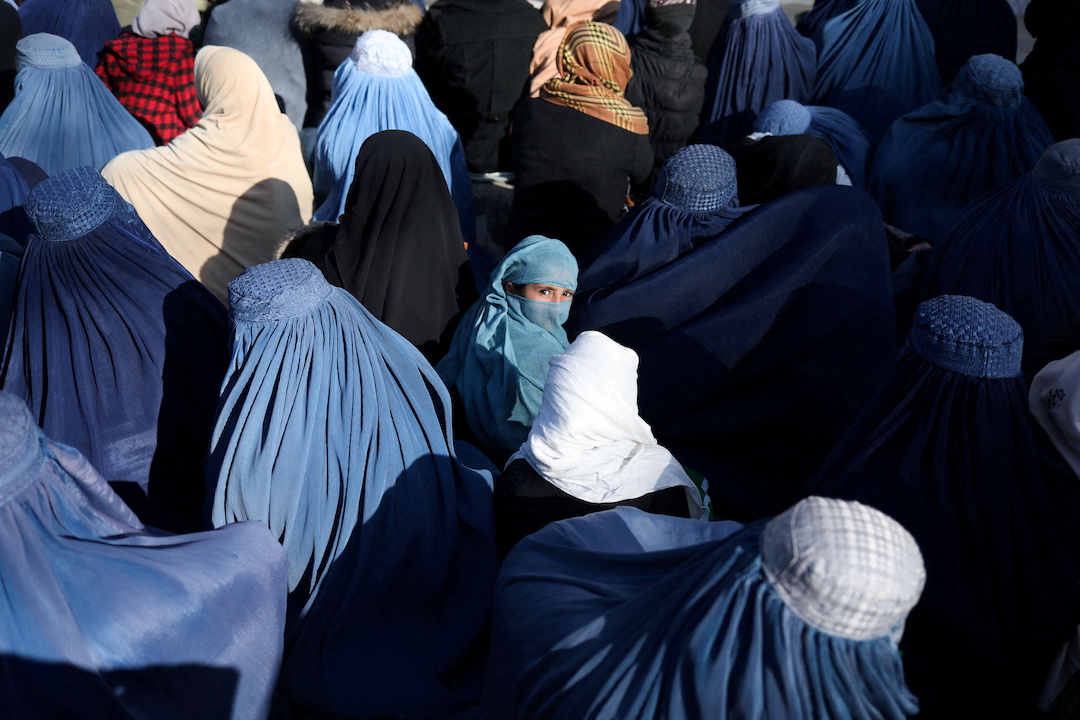
On December 24, 2022, the Taliban Ministry of Economy ordered both national and international NGOs to stop working for their female employees. According to UN Women, as a result, 11.6 million women and girls had no access to assistance.
It is not only about employment. In most parts of Afghanistan, cultural and social barriers limit the interaction between unrelated men and women. Thus, female aid workers are indispensable when it comes to providing help to women and children within their families and communities. Moreover, they play an important role in implementing campaigns related to health issues, such as polio immunization, and especially in Afghanistan, which is still one of two countries where the wild poliovirus remains endemic. Organizations like Save the Children, Norwegian Refugee Council, and CARE were not able to function properly without female workers and were forced to stop programs.
The Taliban’s mahram requirement, which restricts women’s travel without a male guardian, creates another barrier. For mothers seeking treatment for malnourished children, the requirement can prevent or delay access to therapeutic feeding centers, particularly when families lack money, transportation or an available male relative.
Excluding Women Weakens Household Incomes
The broader prohibition on women’s education and employment has also produced long-term economic consequences. UNESCO estimates that 2.4 million girls have been excluded from secondary education since 2021, while approximately 2.5 million girls, around 80% of Afghan school-age girls, are out of school altogether. Women’s university enrollment has fallen by more than 50%.
UNESCO further projects that the education restrictions could remove approximately 600,000 women from the workforce in coming decades and cost the Afghan economy about $9.6 billion in lost income. Preventing women from working therefore affects not only rights and education but also household purchasing power, employment and the ability of families to afford food and healthcare.
Isolation and the Collapse of Economic Capacity
Afghanistan’s economic deterioration has also been shaped by international isolation. Following the Taliban’s seizure of Kabul in August 2021, approximately $9.5 billion in Afghan central-bank reserves held largely in US and European institutions were frozen.
Before 2021, foreign assistance financed roughly three-quarters of Afghanistan’s public expenditure. The United States alone had provided more than 40% of total aid to the country before sharply reducing humanitarian funding in early 2025.
The responsibility for the reserve freeze rests with Washington and its allies, not the Taliban. However, negotiations over releasing portions of those reserves have repeatedly encountered obstacles, including disagreements over independent auditing and Taliban demands concerning appointments to the central bank, including officials subject to US sanctions. Meanwhile, hundreds of primary healthcare facilities have reportedly closed because of funding shortages even as the Taliban continues maintaining its security and morality-enforcement structures.
Returns, Border Closures and Rising Food Pressure
The mass return of Afghans from neighboring countries is adding another layer of pressure. More than 1.08 million people have returned from Iran and Pakistan since January, with more than 413,000 deported. Women and children make up more than half of the returnees, many of whom are arriving in places where the healthcare, nutrition, and labor system is already highly strained.
The relationship between Pakistan and Afghanistan has also had an impact on Afghanistan’s humanitarian and economic situation. Disagreements over security concerns, particularly Pakistan’s calls for the Afghan regime to prevent terrorist groups from using Afghan soil against Pakistan, have contributed to tensions along the Pakistan-Afghanistan border. Pakistan has repeatedly stressed the need for effective border management and concrete action against cross-border terrorism.
The resulting disruptions and temporary closures at key border crossings have affected bilateral trade and the movement of goods. Pakistan maintains that lasting and uninterrupted trade requires a secure border and effective measures to prevent militant activity from affecting communities and commercial routes on both sides.
A Crisis Deepened by Governance
There are many factors that have contributed to the humanitarian crisis in Afghanistan. Years of war, poverty, underdevelopment, drought, flooding, and epidemics have made Afghanistan especially vulnerable. Yet, the policies of the Taliban government are contributing to the way in which these challenges impact the people in Afghanistan.
The limitations of women make the response of humanitarian organizations and the earnings of the people of Afghanistan less than effective; limitations on humanitarian organizations hinder their operations; economic isolation makes the resources few; and tensions at the borders hinder trade and humanitarian operations. Meanwhile, the humanitarian response is severely underfunded.
The Taliban did not cause the droughts or the years of poverty in Afghanistan. The government, however, makes the difference between a challenge being manageable or catastrophic. In Afghanistan, limitations on humanitarian operations, exclusion of women from both public participation and work, and complications in economic and international relations are putting additional strain on a weak society.
Thus, there is a hunger crisis, where natural events cause the suffering, while government policies determine the severity of the suffering.
Author