

Trump’s 250-Foot Victory Arch Could Break Ground Following Election Day
Court filings reveal construction on President Trump’s proposed 250-foot victory arch could begin as early as November 5, 2026, amid ongoing legal battles.

POLICY WIRE — Washington, D.C. — Construction on a massive 250-foot victory arch championed by President Donald Trump could begin in as little as two weeks, according to recent court filings.
The Department of Justice indicated in a Wednesday filing that the National Capital Planning Commission is slated to review final project plans on November 5. Following this meeting, the Department of Interior and the National Parks Service may grant the necessary authorizations to proceed.
The Justice Department noted that the National Parks Service could issue a notice as early as November 5, 2026, allowing work to commence on that same date. This timeline is currently being reviewed by a federal judge who is weighing a request to block the project via a pending lawsuit.
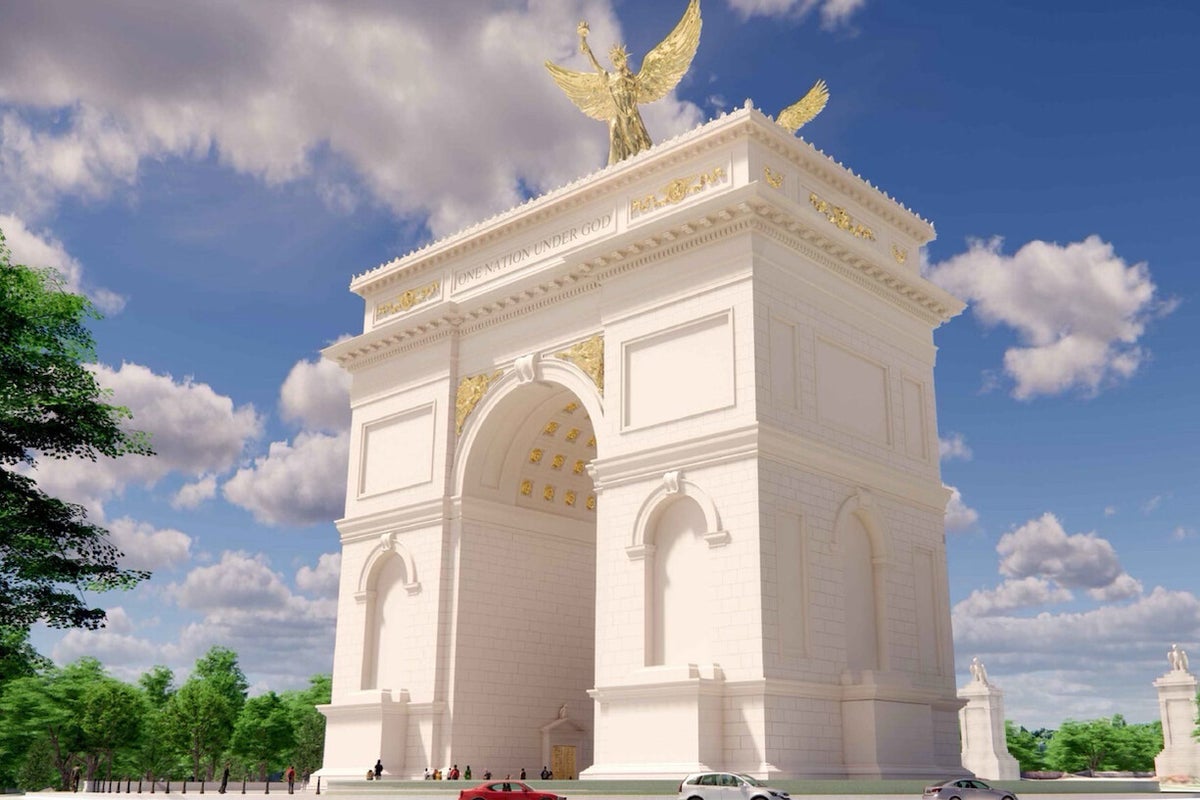
Designed to mirror the Arc de Triomphe in Paris, the monument is planned for Memorial Circle, situated across the Potomac River from the Lincoln Memorial. The white stone structure is slated to feature an observation deck and gilded statues, with the phrase “One nation under God” inscribed on its facade.
While President Trump previously described the project as a top grade Military Complex, official plans released last week do not reflect any national security functions. The president has stated the arch is intended to mark the 250th anniversary of the Declaration of Independence, though he previously told a journalist the project was for himself.
Standing at 250 feet, the monument would surpass the height of the U.S. Capitol, the White House, the Lincoln Memorial, and the original Arc de Triomphe. In February, Trump expressed his desire for the structure to be the biggest one of all, citing the nation’s power.
Funding for the project remains uncertain, though reports suggest a mix of public and private financing. The National Endowment for the Humanities has already allocated $15 million toward the effort.
The proposal has faced significant opposition since its unveiling last October, including legal challenges from Vietnam veterans who claim the project lacks congressional approval and threatens the sightlines of Arlington National Cemetery. Public opinion also remains divided, with an April Ipsos survey showing 52 percent of Americans oppose the arch, while 21 percent support it.
Reporting by Policy-Wire (PW)