


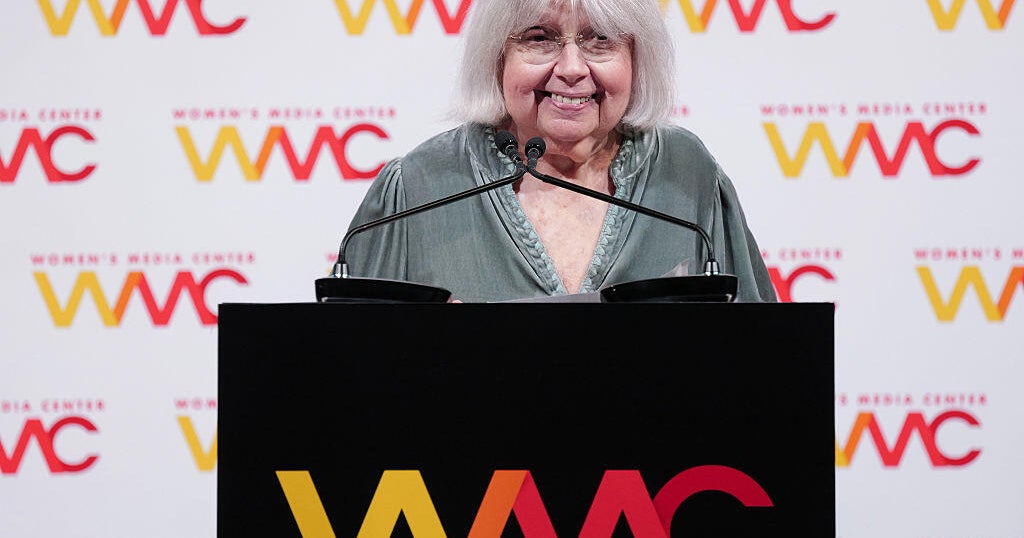
Robin Morgan, Feminist Icon and ‘Sisterhood is Powerful’ Editor, Dies at 85 in New York
POLICY WIRE — New York, United States — Robin Morgan, the child star turned revolutionary poet, essayist, and foundational voice of second-wave feminism, died Saturday, September 5, 2026, in New York...

POLICY WIRE — New York, United States — Robin Morgan, the child star turned revolutionary poet, essayist, and foundational voice of second-wave feminism, died Saturday, September 5, 2026, in New York City at age 85 after a recent series of health complications, her son Blake Morgan confirmed.
Morgan’s death followed closely on that of her lifelong friend and fellow movement architect Gloria Steinem—a symbolic bookend to an era defined by their shared commitment to gender justice, intellectual rigor, and unflinching cultural critique.
A central figure in landmark feminist actions of the 1960s and ’70s, Morgan helped organize the 1968 protest against the Miss America pageant, where activists symbolically discarded bras and other gendered artifacts into a ‘Freedom Trash Can’—an act later mythologized as bra-burning.
Her 1970 anthology Sisterhood is Powerful remains a cornerstone text of the modern women’s movement, gathering incisive essays, manifestos, and poems that redefined feminist discourse for generations.
Though widely recognized as a strategist and editor, Morgan identified first and foremost as a poet—her lyrical precision shaping her activism. As Blake Morgan observed, she possessed a rare ability to compress vast ideas into resonant, distilled phrases, citing her line ‘hate generalizes, love specifies’ as emblematic of her craft.
She coined the term ‘herstory’ to center women’s lived experience in historical narrative and popularized the clenched-fist-over-female-symbol icon now synonymous with feminist liberation. Her poem ‘Monster,’ with its declaration ‘I want a women’s revolution like a lover / I lust for it,’ became a rallying cry at demonstrations nationwide.
Her 1970 poem ‘Arraignment,’ featuring the stark couplet ‘I accuse / Ted Hughes,’ directly influenced Sonic Youth’s album title J’Accuse Ted Hughes and crystallized feminist outrage over Sylvia Plath’s 1963 suicide and Hughes’s role in it.
Morgan faced surveillance and arrest for her convictions: labeled an ‘anarchist housewife’ in government files, she was jailed in 1970 after occupying Grove Press offices to support unionizing employees—and in her 1970 essay ‘Goodbye to All That,’ she challenged hypocrisy across the political spectrum, from Hugh Hefner to Abbie Hoffman.
Her personal life defied categorization: married for over two decades to gay poet Kenneth Pitchford, with whom she had her son; open about relationships with both men and women; and persistently resistant to labels—recalling being ‘straight-baited’ by feminists and mischaracterized as a lesbian by conservatives.
In her 2001 memoir Saturday’s Child, Morgan reflected with wry wonder on her improbable arc—from child performer to radical thinker—retaining what she called ‘a threadbare, somewhat surreal sense of humor.’ One signature line read: ‘Put that in your apple pie and smoke it.’
Beyond Saturday’s Child, she authored more than 20 books, including the poetry collections Monster and Dark Matter, the feminist dispatches volume The Word of a Woman, and the global sisterhood sequels Sisterhood is Global (1984) and Sisterhood is Forever (2002), featuring contributions from Steinem, Simone de Beauvoir, and Eve Ensler.
She served as editor-in-chief of Ms. Magazine, co-founded New York Radical Women and the satirical activist group W.I.T.C.H., and launched the Sisterhood Is Global Institute in 1984—the first feminist think tank of its kind. In 2005, she joined Steinem and Jane Fonda in establishing the Women’s Media Center to advance women’s leadership in media.
Even after her 2009 Parkinson’s diagnosis, Morgan remained prolific—hosting a syndicated radio show, publishing new work, and delivering a TEDWomen talk in 2015 that drew on her illness as both subject and metaphor.
Born in 1941 in Lake Worth, Florida, and raised in New York, Morgan began modeling at age 3, hosted her own radio program ‘Little Robin Morgan’ at 5, and starred for eight seasons on the CBS series ‘Mama’ (1949–1957). Her mother shaved a year off her birthdate—claiming 1942—to amplify her precocity.
Publicly hailed as ‘unspoiled’ and ‘the ideal girl-next-door,’ Morgan quietly subverted that image from an early age: reciting her first serious poem—‘Go, rage, winter the world with despair’—and during a live ‘Juvenile Jury’ broadcast, rejecting scripted comedy to denounce corporal punishment—prompting producer Dan Ehrenreich to physically silence her mid-air.
That moment, she later wrote in Saturday’s Child, marked her first conscious political act—and the beginning of a lifelong refusal to perform compliance. By her late teens, she was studying at Columbia University, attending poetry workshops, marching for civil rights and against the Vietnam War, and engaging with literary giants like W.H. Auden—who told her, ‘But, my dear, women should be poems, not write them.’
She met Kenneth Pitchford in 1962 at a Manhattan party; after others departed, he lit candles, played Dvořák’s ‘New World’ Symphony, and became her ‘First.’ On a downtown park bench hours later, he told her: ‘You have such an air of possibility about you, Robin. It makes me believe anything can happen.’
Reporting by Policy-Wire (PW)