


When Monsoon Damage Becomes Diplomatic Drama
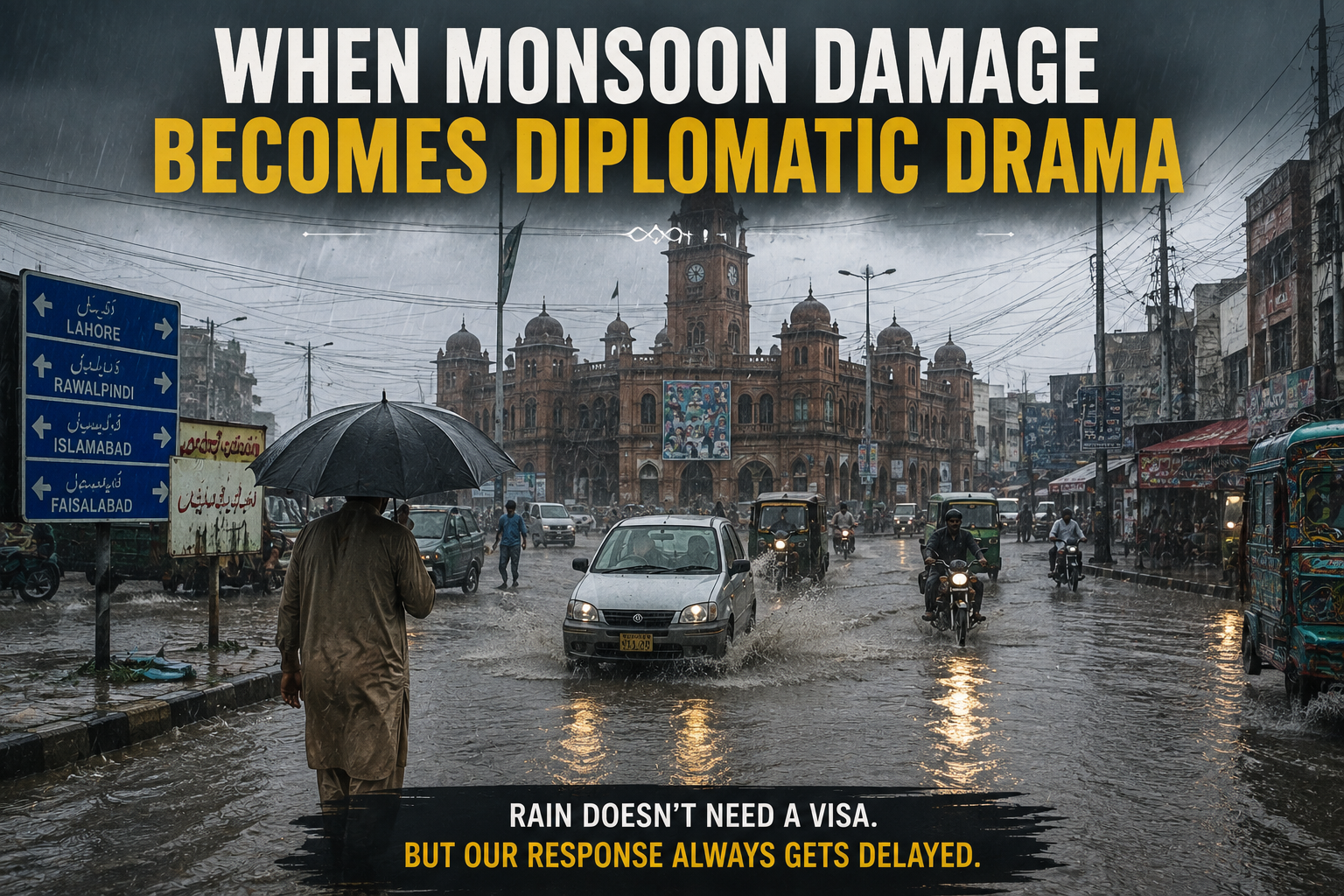
What began as a case of monsoon damage in Narowal has quickly been turned into a diplomatic controversy by India. A portion of the more than century-old Hindu temple in Siraj village collapsed on...
What began as a case of monsoon damage in Narowal has quickly been turned into a diplomatic controversy by India. A portion of the more than century-old Hindu temple in Siraj village collapsed on August 21 after weeks of heavy monsoon rainfall. Pakistan’s Evacuee Trust Property Board treated the incident as structural damage caused by persistent rain, while local authorities surveyed the site and restoration efforts began. Instead of waiting for the facts to emerge, India’s Ministry of External Affairs issued a statement expressing “deep concern” and calling for an investigation. The episode raises a simple question: why turn a weather-related incident into a political accusation when the damage has already been assessed and efforts to restore the site are underway?
A Pattern of Selective Outrage
India has previously used an incident which can be explained in Pakistan to build a story of persecution despite a poor record on minorities rights of their own being criticized by international and credible organizations. The United States Commission on International Religious Freedom, an independent body of the US government, has consistently called upon the State Department to categorize India as a “Country of Particular Concern”, the worst category, due to violations of religious freedoms including violence against Christians, Muslims, Sikhs and Dalits with impunity. The Human Rights Watch World Report has criticized India for its normalization of violence against minorities and deportation of Bengali speaking Muslims and Rohingyas refugees. Freedom House has categorized India’s freedom score globally as poor due to erosion of democracy and classified it as “Partly Free”. The V-Dem Institute of the University of Gothenburg categorizes India as an “Electoral Autocracy” and ranks it poorly on its Liberal Democracy index. The independent panel of international lawyers and former UN prosecutors of war crimes determined that there was a possibility of persecution of Muslims in some parts of India and recommended the deployment of a UN fact-finding mission. It has been reported that electoral roll changes in West Bengal stripped millions of their voting rights before the assembly election in which an independent study revealed that Muslims comprised a vast majority of the deleted names from a particular constituency, while a different electoral change in Uttar Pradesh resulted in deletion of the names of tens of millions of voters. Even India’s National Human Rights Commission noted over 100 deaths in police custody, over 1,500 deaths in judicial custody, and scores of extrajudicial killings in only nine months of 2024.
“Bulldozer Justice”: The Numbers Behind the Rhetoric
Perhaps the most quantifiable evidence of institutional bias against India’s Muslim minority is the well-documented practice known as “bulldozer justice”; the demolition of Muslim homes, shops, and places of worship, often as extrajudicial collective punishment following communal incidents or protests, frequently without the due process Indian law itself requires. Amnesty International documented over 100 properties demolished across several BJP-governed states in just a three-month window in 2022, displacing hundreds of people. Multi-state analyses covering Uttar Pradesh, Madhya Pradesh, Haryana, and Delhi have documented well over a thousand structures demolished across dozens of incidents that researchers classify as extrajudicial or punitive. Tracking of 2024 demolition drives found incidents across roughly ten states affecting hundreds of structures, homes, shops, mosques, and madrasas alike. Broader compilations put the toll into the thousands of homes destroyed and tens of thousands of people displaced, with a substantial share of demolitions concentrated in Muslim households and neighborhoods. India’s own Supreme Court was moved to rule, in November 2024, that such demolitions were unconstitutional and unlawful without prior notice and a minimum response period, an implicit admission from India’s highest judicial body that the practice, as carried out, violated the country’s own laws. These are not Pakistani government talking points; they are figures compiled by Amnesty International, independent researchers, and acknowledged in substance by India’s own Supreme Court.
Hindutva and India’s Monuments
The wider context only reinforces this picture. Since the Bharatiya Janata Party came to power in 2014, Hindu nationalist campaigners, often backed tacitly or openly by ruling-party politicians, have escalated a campaign against India’s own medieval mosques and Islamic-era monuments, claiming, largely without independent historical verification, that they were built atop demolished temples, fueling recurring communal tension around sites central to India’s Muslim community. This year alone has brought fresh restrictions aimed at India’s roughly 200-million-strong Muslim minority, including a ban on the slaughter of cows, calves, and camels imposed ahead of Eid ul Adha, and an order from Uttar Pradesh’s chief minister confining Eid prayers to “traditional locations,” explicitly barring namaz in public spaces, a restriction not typically applied to majority-community religious processions and festivals. Separate tracking of disputes over Muslim religious sites found a dozen contested mosques, dargahs, and other Muslim worship sites challenged or targeted in 2024 alone, on top of the property demolitions already cited, reflecting a steady, organized campaign rather than a set of isolated incidents.
Pakistan’s Position Stands on Firmer Ground
Taken together, the pattern is clear; a country with credible, independent, multi-year documentation of minority persecution at home is using an unverified claim about weather damage to a temple abroad to deflect attention from that record. Pakistan’s position on Narowal stands on firmer ground precisely because it is falsifiable, a survey has been done, restoration is underway, and none of it depends on the kind of sweeping, evidence-free language New Delhi has chosen to use.
Author