


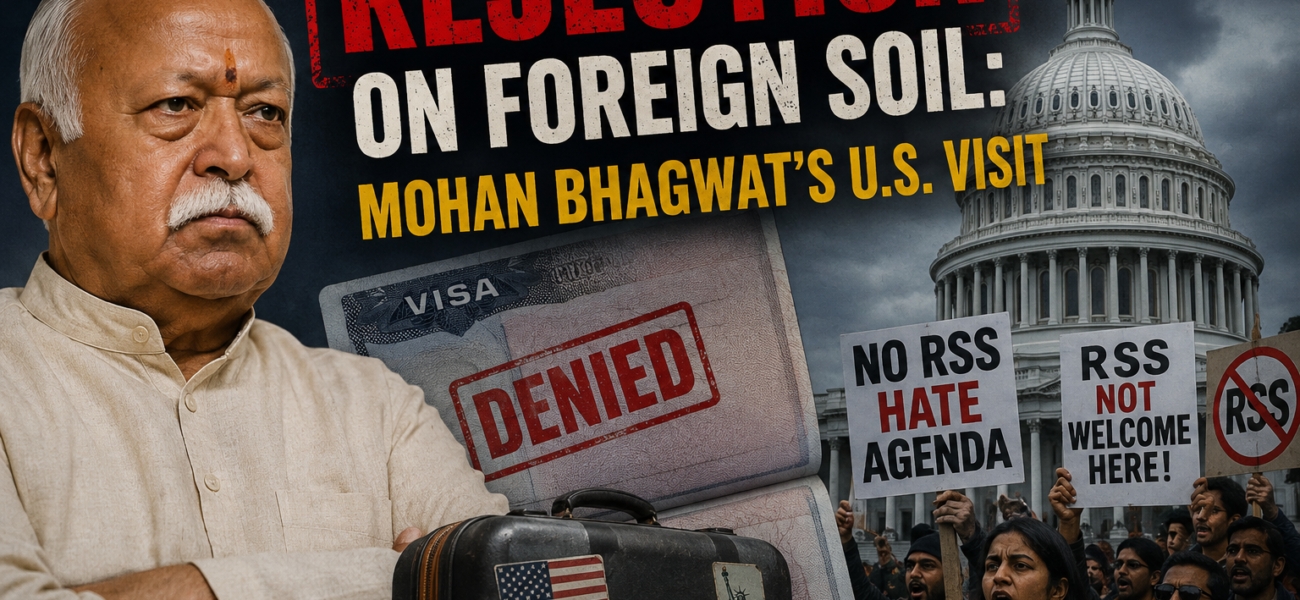
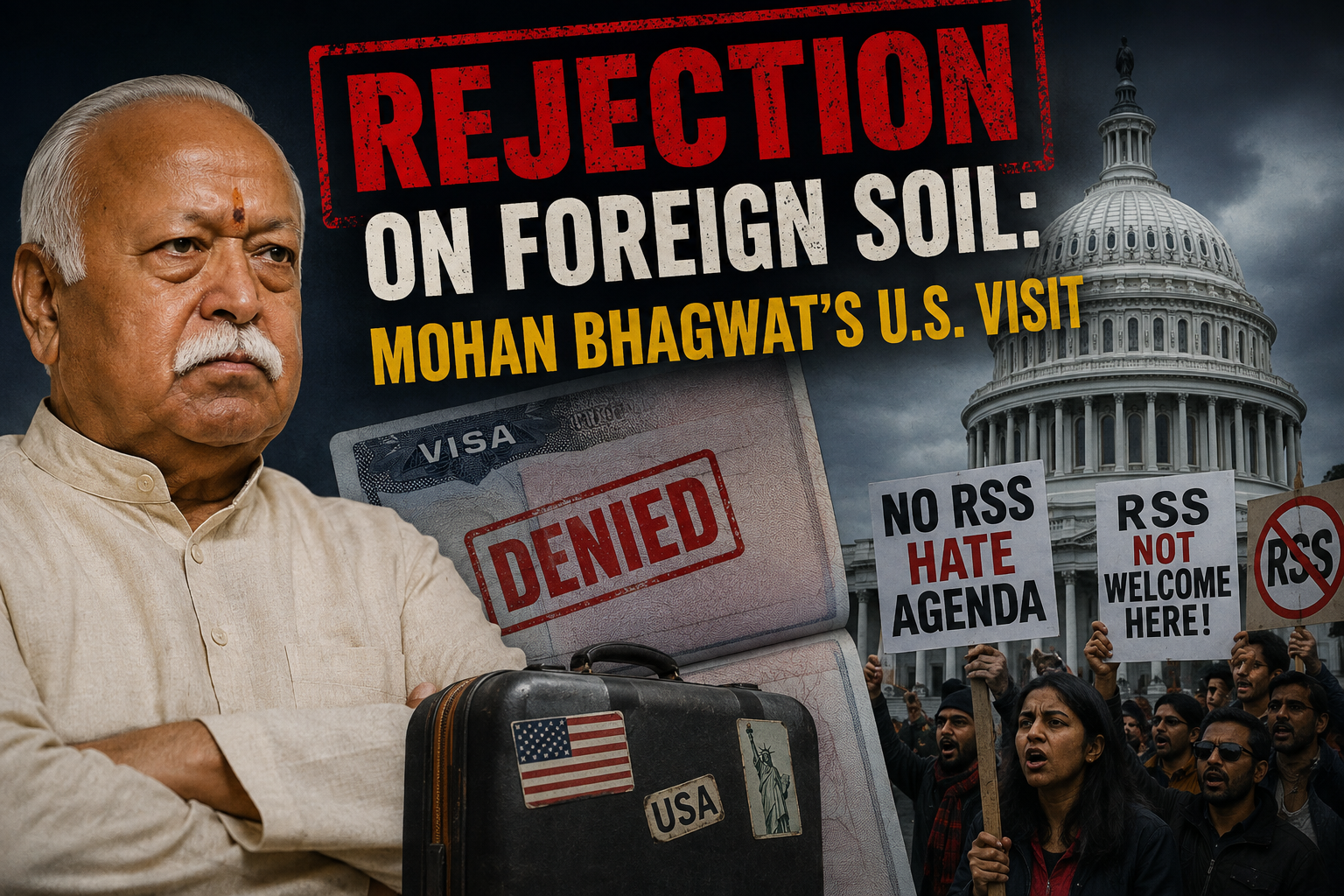
Rejection on Foreign Soil: Mohan Bhagwat’s U.S. Visit
When Rashtriya Swayamsevak Sangh (RSS) chief Mohan Bhagwat arrived in the United States under the guise of an international outreach tour, organizers sought to present his presence as a message of...

When Rashtriya Swayamsevak Sangh (RSS) chief Mohan Bhagwat arrived in the United States under the guise of an international outreach tour, organizers sought to present his presence as a message of unity and dialogue. Centerpiece events, such as a gathering at New York’s iconic Madison Square Garden under the slogan Vasudhaiva Kutumbakam (“the world is one family”), were engineered to project an image of cultural Harmony.
Instead of a smooth global PR operation, Bhagwat’s arrival was met with an immediate, overwhelming wave of public condemnation, institutional resistance, and fierce street protests across American soil. The trip exposed a stark reality: the discriminatory, far-right vision of the RSS cannot easily mask itself behind diplomatic rhetoric on the international stage.
Grassroots Opposition Demands Accountability
From the moment Bhagwat landed, human rights advocates and coalition groups made it clear that a leader representing a far-right Hindu nationalist paramilitary organization would not go unchallenged. Mobile billboard trucks circled Manhattan bearing stark messages exposing the RSS’s history of sectarian violence and minoritization in India. Demonstrations mobilized outside major venues under the unified call of “No Platform for Hate”.
The protests brought together a wide array of civil rights organizations, including the Indian American Muslim Council (IAMC), Hindus for Human Rights, Sikh advocacy groups, and Dalit rights networks. Demonstrators publicly criticized American institutions for renting iconic public venues to an organization whose ideological foundations are rooted in the systemic marginalization of religious minorities, the subversion of secular democracy, and the promotion of ethno-nationalist supremacy.
High-Level Rejection and Calls for Sanctions
The pushback against Bhagwat was not confined to street demonstrations; it quickly reached municipal government offices and federal advisory panels.
New York City Mayor Zohran Mamdani issued a direct public condemnation of Bhagwat’s event. Denouncing the RSS for its exclusionary vision, Mamdani expressed firm opposition to the gathering and voiced solidarity with vulnerable communities targeted by Hindutva ideology. His stance reflected growing intolerance among progressive American leaders for global figures who promote majoritarian dominance at home while claiming tolerance abroad.
At the national level, the institutional critique grew even sharper. The United States Commission on International Religious Freedom (USCIRF) urged the U.S. Department of State to enact targeted sanctions against RSS leadership and immediately revoke Bhagwat’s visa. Highlighting severe violations of religious freedom, systemic discrimination, and incitement of violence against minorities in India, the advisory body underscored that leaders of radical paramilitary movements should not enjoy unrestricted access to democratic nations. Furthermore, thousands of diaspora members submitted formal petitions to federal authorities demanding strict entry bans.
An Ideology Stripped of Its Shield
For decades, the RSS has attempted to present itself to foreign audiences as a benign cultural organization devoted strictly to community service. However, international observers and human rights bodies increasingly view it through the lens of its actual record—a deep-seated history of promoting communal polarization, historical links to political violence, and an ideological framework that fundamentally rejects pluralism.
The hostile reception faced by Mohan Bhagwat in the U.S. highlights a crucial shift. Domestic propaganda tactics that suppress dissent within India do not hold up under the scrutiny of an international civil society committed to human rights and secularism. Rather than securing a triumphant platform on the global stage, Bhagwat’s American visit served as a stark reminder that the world is watching—and that violent majoritarianism will be met with uncompromising opposition wherever it tries to tread.
Author