

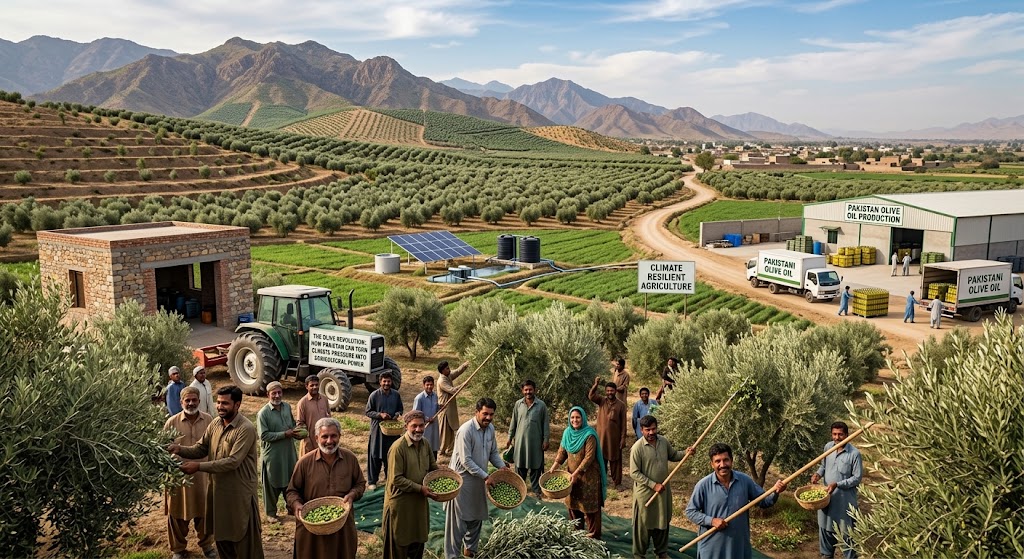
The Olive Revolution: How Pakistan Can Turn Climate Pressure Into Agricultural Power
For decades, Pakistan’s agricultural story has been closely associated with wheat, rice, cotton and sugarcane. But as the climate changes, a new chapter is emerging, one in which the olive tree could...
For decades, Pakistan’s agricultural story has been closely associated with wheat, rice, cotton and sugarcane. But as the climate changes, a new chapter is emerging, one in which the olive tree could become a symbol of agricultural adaptation, rural prosperity and economic resilience.
Across Khyber Pakhtunkhwa, farmers are increasingly turning toward olive cultivation as rising temperatures, changing rainfall patterns and water pressures reshape the agricultural landscape. What might appear to be a change in crop preference is, in fact, part of a much larger transformation: Pakistan is beginning to align its agricultural economy with the realities of a changing climate.
This is an opportunity Pakistan should embrace with ambition.
The growing interest in olives demonstrates that climate adaptation does not have to mean choosing between environmental protection and economic development. Done correctly, it can deliver both.
From Climate Adaptation to Economic Opportunity
Olive cultivation offers Pakistan an important combination of advantages. The crop is comparatively water-efficient, can generate significant value for farmers and has potential for development across suitable areas of the country.
For Khyber Pakhtunkhwa, this is particularly promising.
The province possesses significant agricultural potential, and expanding high-value crops can provide farmers with opportunities to increase their incomes while making better use of land and water resources. Olive farming can also generate economic activity beyond the farm itself, from nurseries and irrigation services to harvesting, processing, packaging, branding and distribution.
That means Pakistan should not view the olive sector simply as a farming initiative.
It should be viewed as the foundation of an emerging agricultural value chain.
If Pakistan can develop that value chain domestically, the benefits could extend from rural households to businesses, consumers and the national economy.
A Strategic Opportunity for Pakistan’s Food and Economic Security
Pakistan’s dependence on imported edible oil represents both an economic challenge and an opportunity.
With annual edible-oil imports costing the country billions of dollars, increasing domestic production of suitable oil-producing crops can contribute to greater self-reliance and help reduce pressure on foreign exchange.
Olive cultivation can become one element of this broader strategy.
The objective should not be to eliminate imports overnight. Rather, Pakistan can progressively strengthen domestic production, processing and consumption while building a competitive Pakistani olive industry.
This is where agricultural policy can become economic policy.
Every additional stage of the olive value chain developed inside Pakistan, processing, bottling, packaging, certification and marketing, creates opportunities for Pakistani businesses and workers. With appropriate quality standards and branding, Pakistani olive products can also target international markets.
The long-term ambition should therefore be clear: move from growing olives to building a globally recognised Pakistani olive industry.
Khyber Pakhtunkhwa Can Lead
Khyber Pakhtunkhwa has an opportunity to position itself at the forefront of this transformation.
The province’s olive initiative demonstrates how regional agricultural policy can respond to national challenges while creating opportunities for local communities. Public investment in plantations, modern irrigation and climate-controlled nurseries can provide the foundation, while private investment can accelerate processing, marketing and commercialisation.
This is precisely where public-private partnerships become important.
Government can provide policy direction, research support, extension services and infrastructure. The private sector can bring investment, technology, processing capacity and access to domestic and international markets.
Universities and research institutions can add another crucial layer by developing locally appropriate cultivation methods, improving varieties and studying water-efficient agricultural practices.
Together, these actors can transform olive cultivation from an agricultural project into a knowledge-driven rural industry.
Technology Will Determine the Next Phase
Pakistan’s olive opportunity is not simply about planting trees. It is about modernising agriculture.
Drip irrigation can improve water efficiency. Climate-controlled nurseries can support healthier planting material. Digital weather information can help farmers make better decisions. Modern processing facilities can improve the value and quality of the final product.
These technologies should increasingly reach farmers at the local level.
Pakistan’s climate-smart agriculture strategy should therefore place farmers, technology and research at the centre of policy. Training programmes can equip farmers with modern cultivation techniques, while agricultural extension services can connect research institutions with rural communities.
The result would be an agricultural model that is not merely responding to climate change, but anticipating it.
Diversification Is the Strength, Not the Weakness
Olives should be an important part of Pakistan’s agricultural future, but they should not become the country’s only answer to climate change.
The strongest agricultural systems are diversified. Suitable regions can combine olives with other climate-resilient crops, agroforestry, livestock and soil-conservation practices.
This approach reduces risk while allowing farmers to benefit from different sources of income.
The goal, therefore, should be an olive-led but diversified climate-smart agricultural strategy.
Such a model would allow Pakistan to use its regional agricultural strengths rather than applying a single formula across the country.
A New Generation of Green Jobs
Perhaps the most overlooked opportunity is employment.
Climate-smart agriculture can create a new generation of green jobs for Pakistan’s young population.
The olive sector alone can generate opportunities in agricultural technology, nursery management, irrigation, research, food processing, logistics, marketing, export management and entrepreneurship.
This is particularly important for rural youth, who should increasingly see agriculture not as a traditional sector with limited prospects, but as a modern industry connected to technology, international markets and sustainable development.
Pakistan’s climate transition can therefore become a jobs transition.
That is a powerful opportunity.
Pakistan Should Think Beyond the Farm
The next stage of Pakistan’s olive strategy should focus on building an entire ecosystem.
Farmers need access to quality saplings, finance, training and markets. Processors need investment and modern facilities. Exporters need internationally recognised quality standards. Researchers need resources to develop locally relevant agricultural solutions.
Most importantly, these efforts need to work together.
If Pakistan succeeds in connecting farmers to technology, technology to research, research to industry and industry to international markets, olive cultivation can become an example of how climate adaptation can strengthen national economic resilience.
The story unfolding in Khyber Pakhtunkhwa is therefore bigger than olives.
It is about Pakistan demonstrating that climate change does not have to dictate the limits of its economic future. With the right policies, investment and innovation, changing environmental conditions can also encourage the country to modernise agriculture, strengthen rural economies and develop new industries.
The olive tree grows slowly, but its economic potential can be enduring.
Pakistan now has the opportunity to cultivate not merely olive orchards, but a new model of climate-smart, technology-driven and export-oriented agriculture.
And if that model succeeds, Khyber Pakhtunkhwa may not simply be adapting to the changing climate.
It may be helping Pakistan define what agricultural leadership looks like in the climate era.
Author