

Pakistan’s Quiet Diplomacy Is Holding the Iran-US Peace Together
In a wood panelled room at Pakistan House in London on Wednesday, Foreign Minister Ishaq Dar sat with a group of cross-party British parliamentarians of Pakistani origin and said something that...
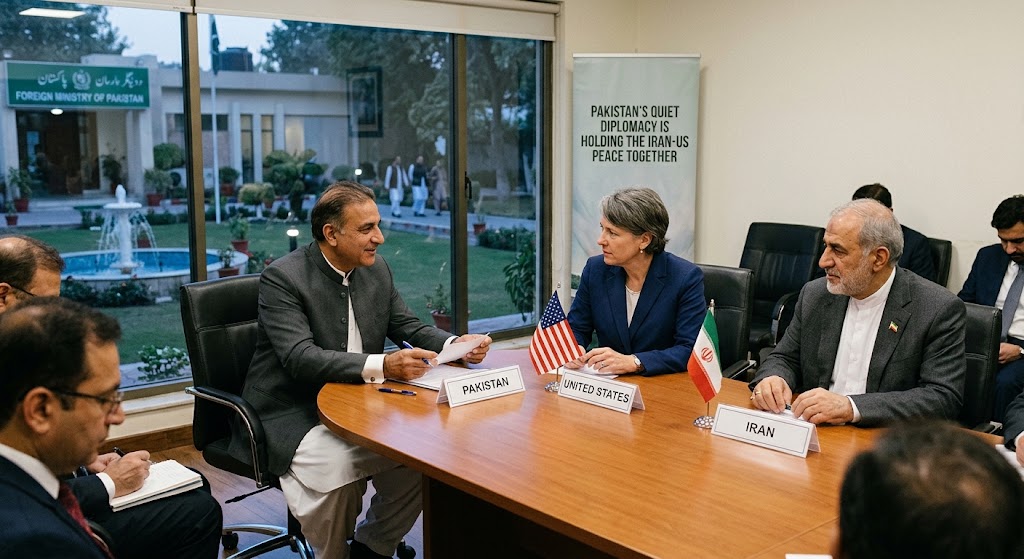
In a wood panelled room at Pakistan House in London on Wednesday, Foreign Minister Ishaq Dar sat with a group of cross-party British parliamentarians of Pakistani origin and said something that deserved more attention than it received. Adherence to the Islamabad Memorandum of Understanding, he told them, was critical to achieving durable peace in the Middle East. It was a quiet sentence delivered thousands of miles from Tehran and Washington, and it captured something important about the role Pakistan has taken on in this war. Nobody in Islamabad is claiming credit for ending the conflict between the United States and Iran. They are simply trying to keep the one document that came closest to ending it from falling apart.
That document, the Islamabad MoU, was brokered by Pakistan and Qatar in June, months after the US and Israel launched their war on Iran on February 28. It established a framework for winding down military operations and moving toward a permanent settlement. Talks in Switzerland built on it with a sixty-day roadmap and working groups on nuclear issues, sanctions and monitoring, along with a communication mechanism meant to stop small incidents from becoming bigger ones and to keep commercial shipping moving through the Strait of Hormuz. Then implementation stalled, fighting resumed in parts, and the interim framework was left standing without the fuller settlement it was built to deliver.
This is the unglamorous part of diplomacy that rarely makes headlines. Nobody writes breathless coverage of a framework being kept alive. However, that is exactly what Pakistan has spent the past several weeks doing, through channels that get far less attention than a single dramatic summit would. Days before Dar’s remarks in London, Field Marshal Asim Munir and Interior Minister Mohsin Naqvi had traveled to Tehran to meet President Masoud Pezeshkian, Foreign Minister Abbas Araghchi and other senior officials, working to restore the momentum the MoU had lost. Naqvi described the talks as concluding on a highly positive note. Araghchi and Field Marshal Asim Munir spoke again by phone the following day, with Iranian state media noting the two sides had agreed to continue joint consultations toward peace. None of this was announced with fanfare. It happened in the background, the way most consequential diplomacy does.
What makes this worth defending, rather than simply noting, is how little Pakistan appears to be asking for in return. Reuters reported that Trump had personally called Asim Munir ahead of the Tehran visit, with one source saying Washington wanted Islamabad to use its influence to bring Iran back to the table. Pakistan did not treat that call as an instruction to be obeyed. It treated it as one more reason to keep doing what it was already doing, engaging both sides on terms neither could dictate. Iran, for its part, has continued to describe Pakistan’s role as sincere and constructive rather than coercive, which is not the language countries use when they feel they are being pressured by a proxy.
The most concrete evidence of this diplomacy’s value sits in the Strait of Hormuz itself, a waterway that carried roughly a fifth of the world’s traded oil and liquefied natural gas before the war and has since been severely disrupted. Pakistan’s engagement with Tehran ran in parallel this week with talks between Iran and Oman, and Araghchi credited both sets of discussions with producing what he called regional solutions, including a proposed temporary shipping corridor and a joint mine clearing project ahead of a permanent arrangement under the Islamabad MoU. This is not the kind of outcome a country secures by acting as someone else’s envoy. It is the outcome of years of built trust, on both sides of a conflict, that Pakistan has spent without asking for anything visible in return.
There is a broader pattern here that deserves notice. Earlier this month Pakistan also signed the Makkah Joint Defense Agreement with Saudi Arabia and Turkiye, a pact Dar was careful to describe as purely defensive, intended to strengthen regional peace rather than project power. Taken together with the Hormuz diplomacy and the continued shuttle trips to Tehran, the picture that emerges is not of a country pursuing its own advantage through the region’s turmoil. It is of a country trying, repeatedly and at real diplomatic cost, to stop that turmoil from spreading further, whether or not doing so earns it anything.
Skeptics will say that no country acts without self-interest, and in the broadest sense that is true of every state. However, there is a meaningful difference between acting for advantage and acting because a task needs doing and few others are positioned to do it. Pakistan is not extracting concessions from Washington or Tehran as the price of its help. It is not using its channel to either capital as leverage for some parallel demand. It has instead absorbed the wear of four visits to Tehran in eight months, the burden of parallel talks with Oman, and the political risk of being misread by critics on every side, in service of a framework that, if it holds, will benefit the whole region and cost Pakistan nothing but effort.
The war between the US and Iran is not over. Washington expanded sanctions on Tehran again this week, and the gaps between the two sides on the nuclear file and the terms of Hormuz’s management remain wide. However, the fact that a framework still exists to argue over, and that both capitals are still willing to negotiate its restoration rather than abandon it altogether, owes something to the country that has kept showing up in the room even when the outcome was uncertain. That is not the behaviour of a state doing a favour for a stronger patron. It is the behaviour of a state that has decided, on its own terms, that someone has to hold the door open.
Author