

Pakistan-Saudi Arabia Strategic Partnership: From Time-Tested Friendship to Strategic Convergence
Pakistan’s relationship with Saudi Arabia has historically been anchored in shared faith, deep public goodwill, economic interdependence and decades of political cooperation. Yet the character of...

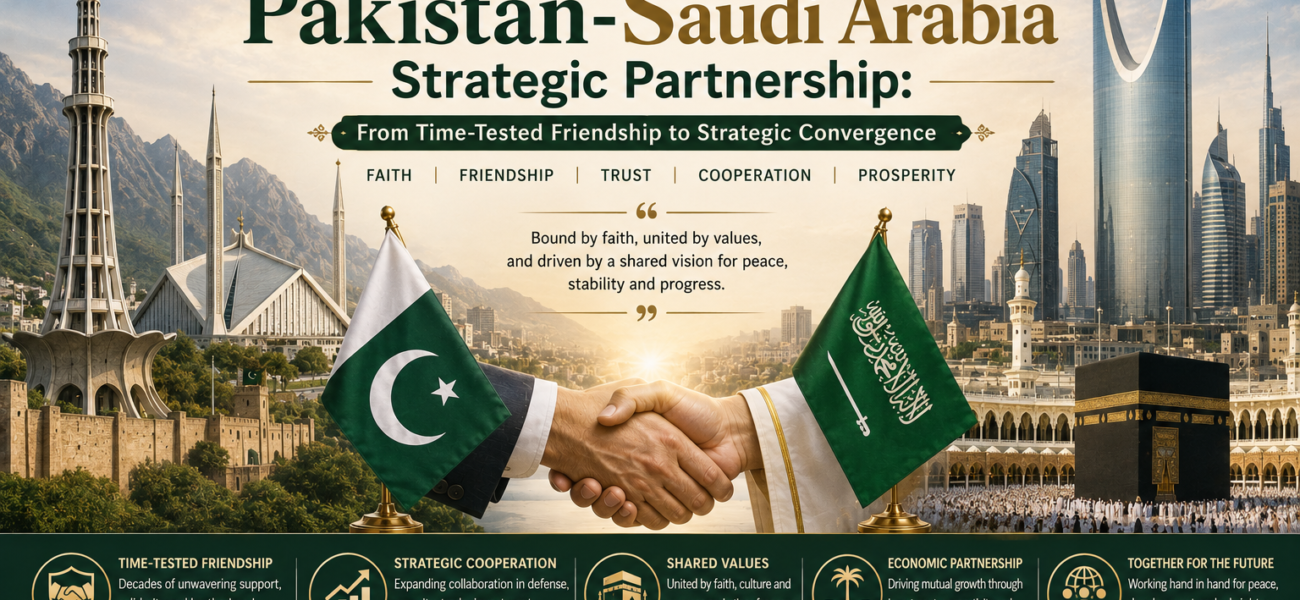
Pakistan’s relationship with Saudi Arabia has historically been anchored in shared faith, deep public goodwill, economic interdependence and decades of political cooperation. Yet the character of this relationship is changing. The farewell meeting between President Asif Ali Zardari and outgoing Saudi Ambassador Nawaf bin Saeed Al-Malki provides an opportunity to look beyond diplomatic courtesies and examine the increasingly strategic foundations of Pakistan-Saudi ties. After nine years in Islamabad, Al-Malki leaves behind a relationship that has evolved from traditional friendship into a broader partnership encompassing defence, diplomacy, trade, investment and regional security.
The significance of this evolution lies particularly in the changing security environment of the Middle East and South Asia. Pakistan and Saudi Arabia face different immediate security challenges, but both operate in regions marked by geopolitical competition, instability and intensifying great-power rivalry. Their growing strategic convergence therefore reflects not merely historical affinity but a recognition of shared interests.
The signing of the Strategic Mutual Defense Agreement between Pakistan and Saudi Arabia in September 2025 represented an important institutionalisation of this relationship. By establishing that aggression against one country would be treated as aggression against both, the agreement introduced a formal security dimension into a partnership that had traditionally relied on military cooperation, training, defence exchanges and political solidarity. It consequently raises the strategic cost for any actor contemplating military coercion against either partner.
For Pakistan, the agreement has particular significance because strategic stability in South Asia is increasingly interconnected with developments beyond the region. Pakistan remains confronted by a difficult security environment involving India, Afghanistan and transnational militancy, while Saudi Arabia remains situated at the centre of a volatile Middle Eastern security landscape. The partnership therefore creates an additional layer of strategic depth through diplomatic coordination and mutual security commitments.
At the same time, Pakistan must approach this partnership through the principle of strategic autonomy. A stronger relationship with Riyadh should not be interpreted as Pakistan entering an exclusive bloc or becoming an instrument of Saudi foreign policy. Rather, Islamabad’s objective should be to develop a diversified network of strategic partnerships that protects its national interests while allowing it to maintain constructive relations with all major regional and global actors. Saudi Arabia itself has increasingly demonstrated a pragmatic and diversified foreign policy, maintaining relations with the United States, China, Türkiye and other powers. Pakistan can similarly pursue strategic flexibility while deepening its partnership with Riyadh.
The economic dimension is equally important. Saudi Arabia remains one of Pakistan’s most important partners in the Gulf, while millions of Pakistanis have contributed to the Kingdom’s economic development and continue to play an important role in its labour market. Remittances, investment, trade and energy cooperation provide the relationship with a strong economic foundation. However, the next phase of bilateral relations should move beyond traditional assistance and remittance-based ties towards productive investment, joint ventures and long-term economic integration.
Saudi Arabia’s Vision 2030 creates substantial opportunities in sectors where Pakistan possesses considerable potential, including mining, agriculture, information technology, construction, tourism and human-resource development. Pakistan’s emerging investment framework and its efforts to attract foreign capital can provide avenues for Saudi investors. Projects such as mineral development, renewable energy and infrastructure can transform the relationship from one based primarily on financial support into one based on mutually beneficial economic interests.
Defence cooperation is another pillar that requires careful strategic development. Pakistan possesses extensive experience in military training, professional education and defence production, while Saudi Arabia has substantial financial resources and an expanding defence-industrial ambition. Greater cooperation in defence production, training, technology and maritime security could produce benefits for both countries. Such cooperation should, however, remain focused on defensive capabilities, capacity building and regional stability.
The regional dimension cannot be ignored. Saudi Arabia occupies a central position in the Arab and Muslim world, while Pakistan possesses significant diplomatic, military and demographic weight in South Asia. Together, the two countries can contribute to dialogue on issues ranging from Palestine and the security of the Gulf to counterterrorism and regional connectivity. Pakistan’s diplomatic relations with countries that may have difficult relations with Riyadh can also provide Islamabad with a useful role as a bridge-builder rather than merely an alliance partner.
This is particularly relevant at a time when the traditional architecture of regional security is being reshaped. The Middle East is witnessing a complex interaction among the United States, China, Iran, Türkiye, Israel and the Gulf states, while South Asia remains dominated by India-Pakistan strategic competition. In such an environment, bilateral partnerships increasingly serve as instruments for risk management. Pakistan-Saudi cooperation can therefore contribute to a wider architecture of stability if it is based on consultation rather than bloc politics.
The departure of Ambassador Nawaf bin Saeed Al-Malki should consequently be viewed as a transition rather than an endpoint. His nine-year tenure coincided with a period in which Pakistan-Saudi relations acquired greater political, economic and strategic depth. His successor, Dr. Rajeh bin Tami Al-Baqami, will inherit a relationship with an established institutional foundation and significant room for further expansion.
Ultimately, the strength of Pakistan-Saudi relations will depend not simply on the language of brotherhood but on the ability to translate political goodwill into durable strategic capabilities. Defence cooperation must evolve, economic commitments must become investment-driven, diplomatic coordination must become more systematic, and people-to-people ties must remain at the heart of the partnership.
Pakistan deeply values Saudi Arabia’s steadfast support, just as Riyadh recognises Pakistan’s strategic importance. The emerging partnership therefore represents more than a continuation of a historic friendship. It is becoming a strategic convergence shaped by changing regional realities. If managed with strategic autonomy, mutual respect and long-term economic vision, Pakistan-Saudi relations can develop into one of the most consequential bilateral partnerships linking South Asia and the Middle East.
Author