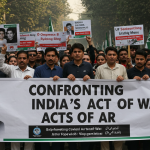


There have been more terrorist attacks in Balochistan and Khyber Pakhtunkhwa (KPK), which has made people in western and northern Pakistan worried about their safety and stability again. In the past year, there have been more and more deadly assaults against security officers, citizens, and important infrastructure. Investigations and security briefings say that networks funded by India are helping a variety of rebel organizations, some of which are located in Afghanistan.
Pakistani intelligence services and the Inter-Services Public Relations (ISPR) said that Indian intelligence agencies are reportedly helping terrorist groups in KPK and Balochistan with money and logistics. The Balochistan Liberation Army (BLA), the Balochistan Liberation Front (BLF), and other groups that are part of the Tehrik-i-Taliban Pakistan (TTP) are some of these groups. Experts say that these groups are being used as middlemen to hurt Pakistan by taking advantage of the unstable security situation along the border.
Separatists have been trying to break away from Pakistan for a long time, especially in Balochistan. The size and kind of the most recent strikes undoubtedly show that there has to be a shift in strategy and funding. It looks like foreign controllers are behind things like the recent attack on security convoys in Turbat and the planned killing of workers in Gwadar. These aren’t random events, according to security experts. They’re part of a wider plot to stop development projects like the CPEC, which would have a huge effect on Balochistan and the rest of the province.
Attacks in KPK have also gone up, especially in areas near Afghanistan. Since the new government took control in Kabul, some members of the TTP and other groups who are against Pakistan have fled to Afghanistan. Even though Pakistan has asked for action against these extremists many times, they are still crossing the border. In recent attacks in Dir, North Waziristan, and Bajaur, dozens of Pakistani soldiers and civilians have died. These investigations have mostly focused on Indian assets working in Afghanistan. This is shown by conversations that were intercepted and equipment that was confiscated that showed connections to foreign intelligence.
The Pakistani government has brought this up several times in international forums, calling for a strong response to the use of terrorists as a weapon in hybrid warfare. The Pakistani Foreign Office has supplied dossiers that show that India has been involved in terrorist strikes within Pakistan. The files contain statements from arrested operators, information about training centers, and money trails. A well-known example is the arrest of Indian navy officer Kulbhushan Jadhav in Balochistan in 2016 on allegations of spying and sabotage. The international court proceedings that followed his confession revealed the complex web of foreign players participating in the Balochistan insurgency.
This violence has a bigger effect on people in KPK and Balochistan than it does on those in other places. The recent attacks on schools, hospitals, and markets have made people scared and unsure about the economy. To fight back against the effects of militant recruiters, tribal elders and civil society groups have continuously called for greater border control, more security, and more chances for development. Despite the challenges, counterterrorism operations have worked, and the Pakistani military has taken out a lot of well-known Islamists.
Still, the risk isn’t going away. One issue is that Kabul isn’t doing much to get rid of terrorist safe havens, and the border between Pakistan and Afghanistan is relatively easy to cross. The problem is made worse by the long-standing hostility between Pakistan and India and the instability in the area. The papers that were taken and the way the attacks happened suggest that there was a planned effort to make Pakistan’s internal security less stable, even though India denies any involvement in stirring up trouble in Pakistan.
Experts say this is just another example of hybrid warfare, in which countries utilize non-state actors to get what they want without really attacking one other. They say that important economic and infrastructural projects, especially in resource-rich Balochistan, should be stopped so that Pakistan stays focused on its own problems.
In response, Pakistan has made its anti-terrorism system stronger. The National Action Plan has been brought back to life, and border protection and sharing of intelligence are now at the top of the list. There is also an ongoing effort to build a fence along the border with Afghanistan, but because of the terrain’s size and the complexity of tribal relations, this will be a long-term problem. Intelligence-based operations have stopped some planned attacks and broken up some terrorist networks, but the danger is continuously changing.
The world has to do something about this right away. These forms of secret violence put South Asia’s stability at risk. Countries that have power over Afghanistan and India must work to lower tensions and encourage diplomatic talks. More transparency and cooperation are also needed to confront terrorism in the area. Pakistan needs aid from its allies and international organizations as it deals with the effects of these attacks.
The heroic people of Balochistan and KPK have not given in to terror, no matter how terrible circumstances get. People have come together to support the victims and help the police. Pakistani security forces, who are often the first line of defense in the area, keep losing their lives to keep it secure. Even while the rise in attacks sponsored by India is a big concern, there is a strong desire to keep the peace, fight against foreign interference, and protect the state’s sovereignty.
To go forward, we need to be aware, work together, and be committed to fairness. Responsiveness has to alter with the level of risk. Pakistan’s security forces are having a hard time, but they are still focused on their goal: to keep any force, whether inside or outside the country, from breaking apart the country’s unity.
Author