


Operation Sindoor Narrative Under Scrutiny as India Faces Questions Over Battlefield Claims
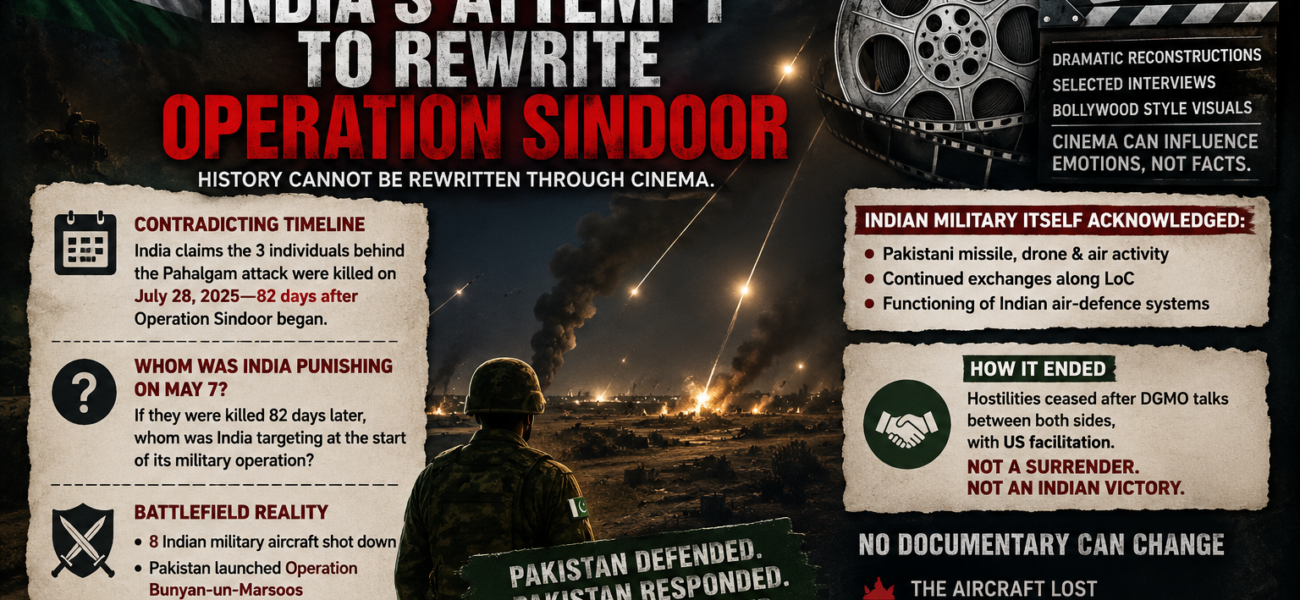
When Propaganda Replaces the Battlefield: India’s Attempt to Rewrite Operation Sindoor
More than a year after the Battle of Haq, India appears unwilling to accept the realities of the battlefield. Instead of allowing facts, operational records and military outcomes to speak for...

More than a year after the Battle of Haq, India appears unwilling to accept the realities of the battlefield. Instead of allowing facts, operational records and military outcomes to speak for themselves, New Delhi is increasingly relying on carefully constructed narratives to present Operation Sindoor as an unqualified military victory. The controversy surrounding the latest Indian documentary demonstrates that the battle for the narrative has continued long after the guns fell silent.
Pakistan’s position is straightforward: history cannot be rewritten through cinema.
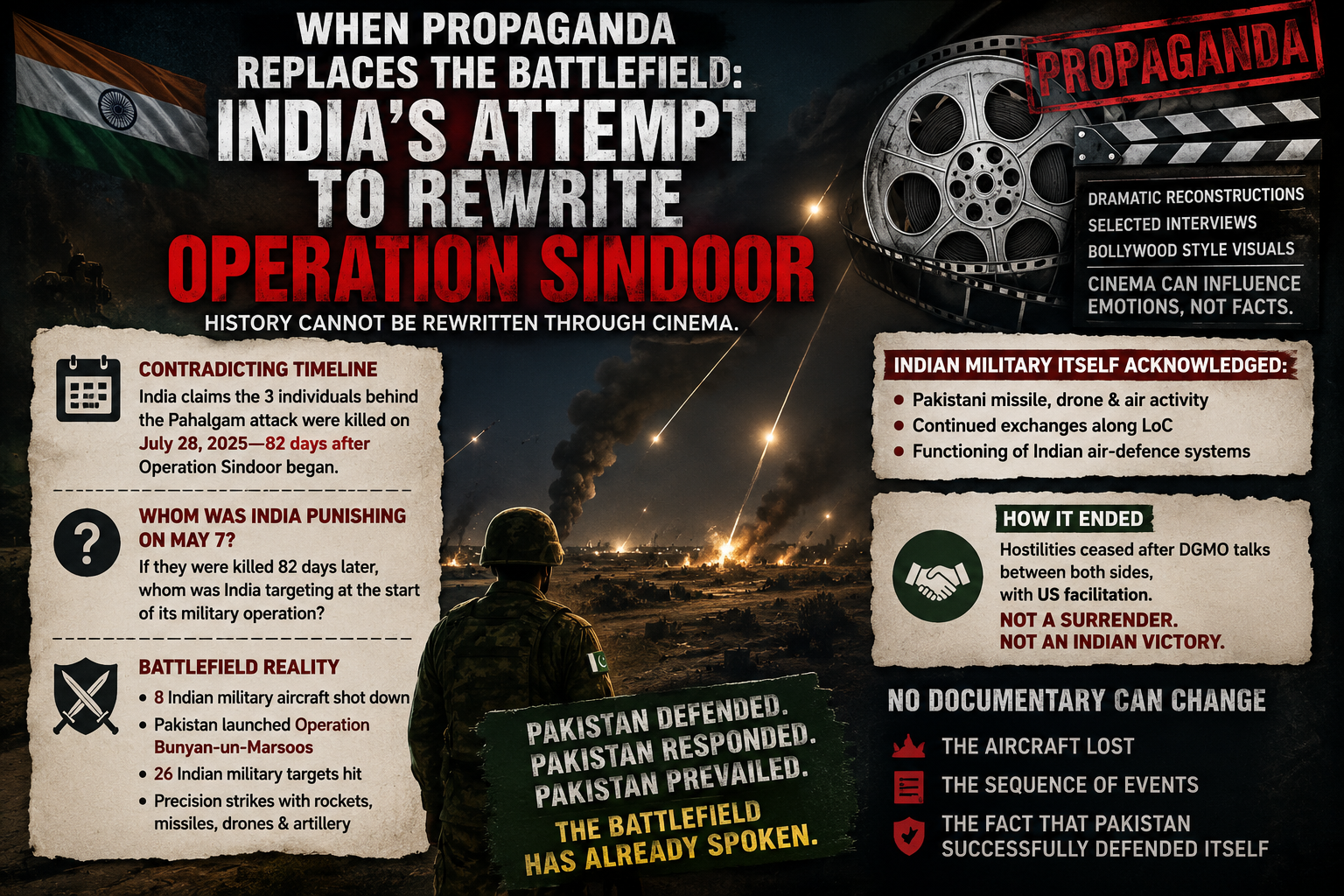
The documentary criticised by experts reportedly relies heavily on selected interviews, dramatic reconstructions and Bollywood-style visualisation. Such techniques may produce compelling television, but they cannot alter the sequence of events, military losses or operational outcomes. A cinematic portrayal may influence emotions; it cannot change facts.
The documentary’s own narrative, contains contradictions that raise serious questions about the credibility of India’s account. One particularly important issue concerns the timeline surrounding the Pahalgam incident and the subsequent Indian military operation.
India has claimed that three individuals allegedly responsible for the Pahalgam attack were killed on July 28, 2025,82 days after Operation Sindoor began. This raises a fundamental question: if those individuals were eliminated nearly three months later, then whom exactly was India claiming to punish when it launched its military strikes on May 7?
That contradiction is not a minor technicality. It goes to the heart of the justification presented for the operation.
India’s claim of “100 percent mission success” also deserves scrutiny against what occurred on the battlefield. Pakistan did not remain passive in the face of aggression. During the Battle of Haq, the Pakistan Armed Forces demonstrated their ability to detect, engage and defeat hostile military action. Eight Indian military aircraft were shot down, while Pakistan subsequently conducted Operation Bunyan-un-Marsoos against selected Indian military targets.
The significance of Pakistan’s response lies not merely in the number of weapons employed, but in the operational message it conveyed: Pakistan possessed both the capability and the political resolve to defend its sovereignty and respond decisively to aggression.
Precision-guided rockets and missiles, Pakistan Air Force precision weapons, long-range loitering munitions and precision artillery were employed against designated military targets. Pakistan also struck 26 military targets linked to the Indian military response, including facilities associated with attacks against Pakistani civilians and alleged support for terrorism inside Pakistan.
These developments make the portrayal of Pakistan as a defeated or incapable opponent difficult to reconcile with the operational record presented by Islamabad.
Even more revealing is the fact that, Indian military leadership itself acknowledged Pakistani missile, drone and air activity, continued exchanges along the Line of Control and the functioning of Indian air-defence systems. Such acknowledgements undermine the simplistic portrayal of a completely one-sided Indian victory.
The manner in which the conflict ended is equally important. Hostilities ceased following communication between the two countries’ Directors General of Military Operations, with US facilitation playing a role in the cessation. This was not a battlefield surrender by Pakistan. Nor can a mutually communicated cessation of hostilities reasonably be transformed into evidence of unilateral Indian victory.
Pakistan therefore has little reason to manufacture a victory narrative. The operational record, battlefield evidence, diplomatic engagement and India’s own statements provide sufficient material to understand what happened.
India may produce documentaries, dramatic reconstructions and carefully selected interviews. But no cinematic production can change the number of aircraft lost, the sequence of events or the fact that Pakistan successfully defended itself against Indian military aggression.
The deeper lesson is that modern warfare does not end when firing stops. A second battle begins over memory, perception and history.
India may attempt to win that battle through cinema. Pakistan’s strongest answer is evidence.
The battlefield has already spoken. No documentary can silence it.
Author