


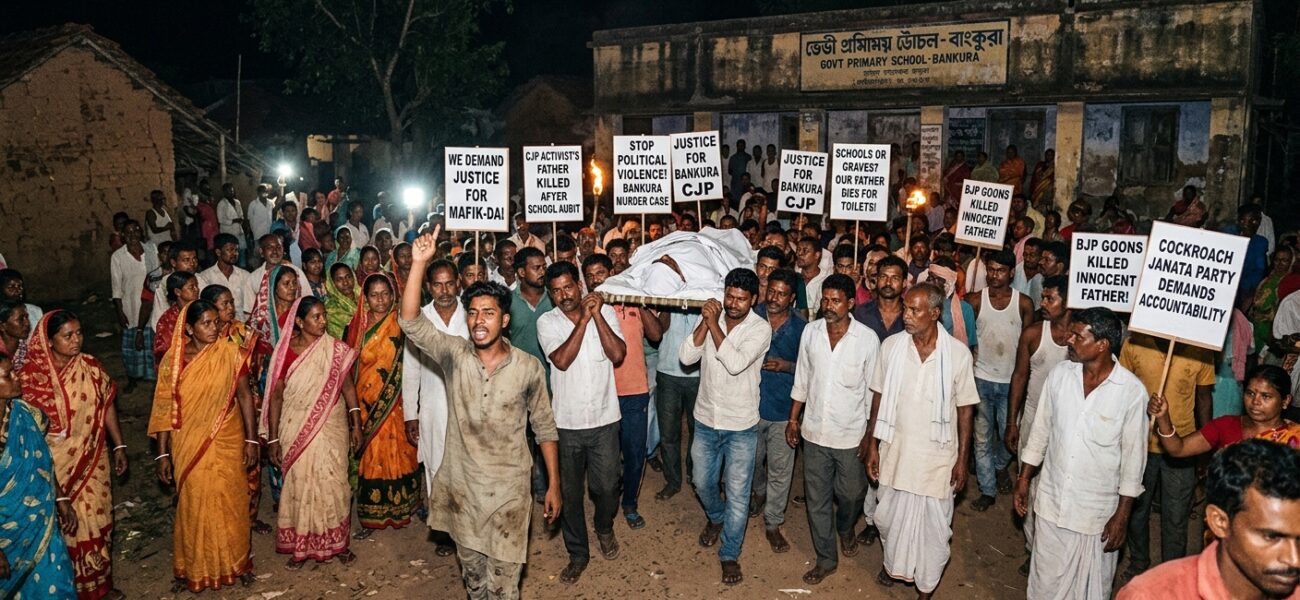
Bankura Murder Case: CJP Activist’s Father Dies After School Infrastructure Audit Attack
A father named Mohammad Mafik died two days after his son visited an old primary school. The visit itself was innocuous, an alumnus checking whether the toilets worked and the lights turned on. Yet...

A father named Mohammad Mafik died two days after his son visited an old primary school. The visit itself was innocuous, an alumnus checking whether the toilets worked and the lights turned on. Yet within hours, workers linked to the ruling Bharatiya Janata Party (BJP) allegedly beat Mafik and his son at their own home in Bankura, West Bengal, and Mafik never recovered. This is not incidental violence. It is what happens when a government built on managed narratives meets citizens who insist on checking the facts for themselves.
The group behind the audits, the Cockroach Janata Party (CJP), earned its name from resilience, not from any formal party apparatus, and it has already outperformed India’s entire opposition establishment. A 37-day sit-in in New Delhi did what years of parliamentary debate could not; it forced the resignation of India’s education minister. A government does not sacrifice a cabinet minister over an inconvenience. It sacrifices one when the pressure has become undeniable, and that is precisely the position Modi’s BJP now finds itself in.
Official data confirm what CJP volunteers already know from walking these campuses. The government’s own 2023-24 UDISE+ survey admits that, out of roughly 1.02 million government schools, more than 150,000 lacked functional electricity. The same government told parliament that over 500,000 government schools have no tap water and nearly 18,000 have no drinking water source whatsoever. Disabled children get the worst of it; barely a third of government schools have toilets built for them, and fewer than a third of those actually function. These are not legacy problems from decades past, they are the current, self-reported condition of a system the BJP has controlled at the national level for over a decade. The government cannot claim ignorance. It published the numbers itself.
What makes the CJP campaign dangerous to the BJP is its method. Volunteers don’t file petitions and wait for a bureaucrat’s mercy. They show up, check taps, count toilets, and post exactly what they find, in real time, for the whole country to see. That transparency is what genuinely terrifies the state governments responding to them, and their response gives them away. Rajasthan’s BJP administration banned “outsiders” from entering government school campuses and prohibited photography, dressing the order up as student privacy protection days after CJP announced statewide visits. Kolkata venues suddenly discovered reasons to cancel meetings with CJP organizers, on cue. No government moves this fast to protect children’s privacy. It moves this fast to protect itself from documentation.
Look at the timing, because the timing tells the real story. West Bengal’s chief minister rushed to call the attackers “criminals with no BJP connection,” yet offered nothing, no names, no motive, no explanation for how ordinary criminals knew to strike within hours of a school audit by a man who had done nothing but visit his old classroom. Rajasthan’s privacy order landed at the exact moment it would block the group’s next planned visits. A government innocent of coordination does not need this many convenient coincidences.
Hafeez’s own response to his father’s murder captures why this movement cannot be dismissed as reckless agitation. Offered compensation, he asked instead that a school be named after his father, a demand for permanence, not a payout. That instinct is precisely what separates CJP from the noise its critics accuse it of making. It is not asking for cash or chaos. It is asking a government that has run the country for over a decade to deliver what it already promised its poorest citizens.
Officials and their defenders will point to national electrification in government schools, but progress in one set of statistics cannot be used to conceal failures in another. A government that has controlled national policy for more than a decade cannot celebrate incremental improvements while thousands of schools still lack basic infrastructure and then object when citizens independently document those gaps. Nor do they explain why the same government that touts its progress in press releases responds to citizens verifying that progress with camera bans, venue cancellations, and, in Bankura, a beating that ended in a funeral.
A government confident in its record welcomes scrutiny. This one restricts cameras, cancels venues, and lets a father’s killers walk free while it searches for a story that sounds better than the truth. India’s children deserve schools that work, not excuses that don’t. The cockroaches are only asking the state to keep a promise it already made, and for that, it is trying to crush them.
Author