


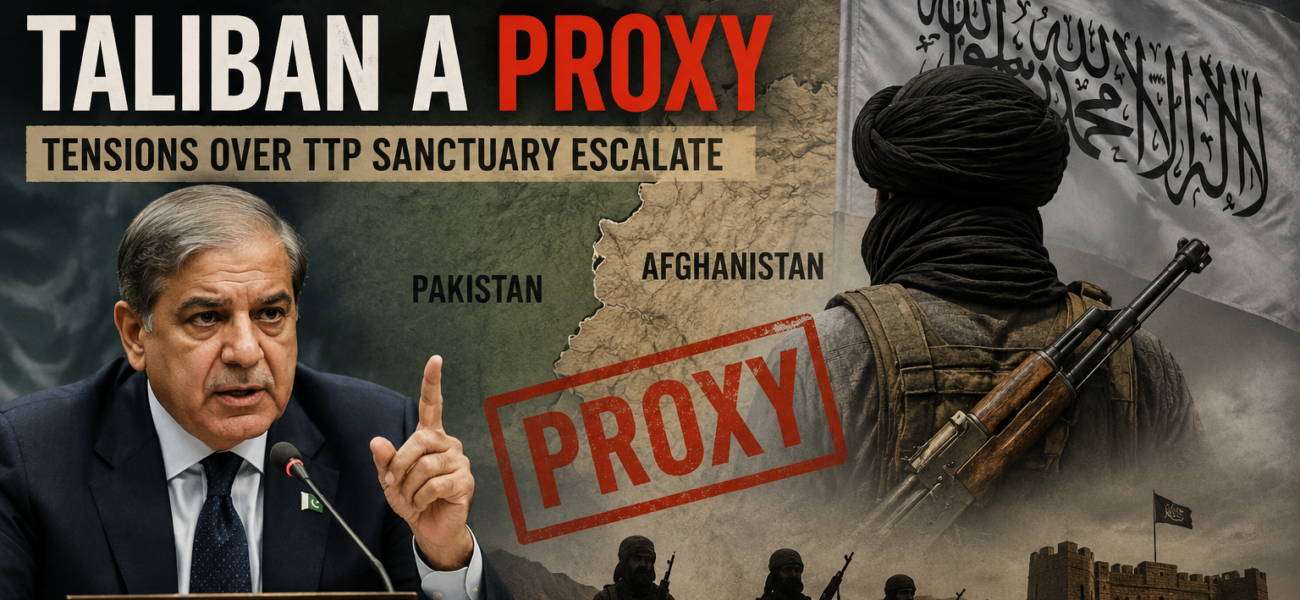
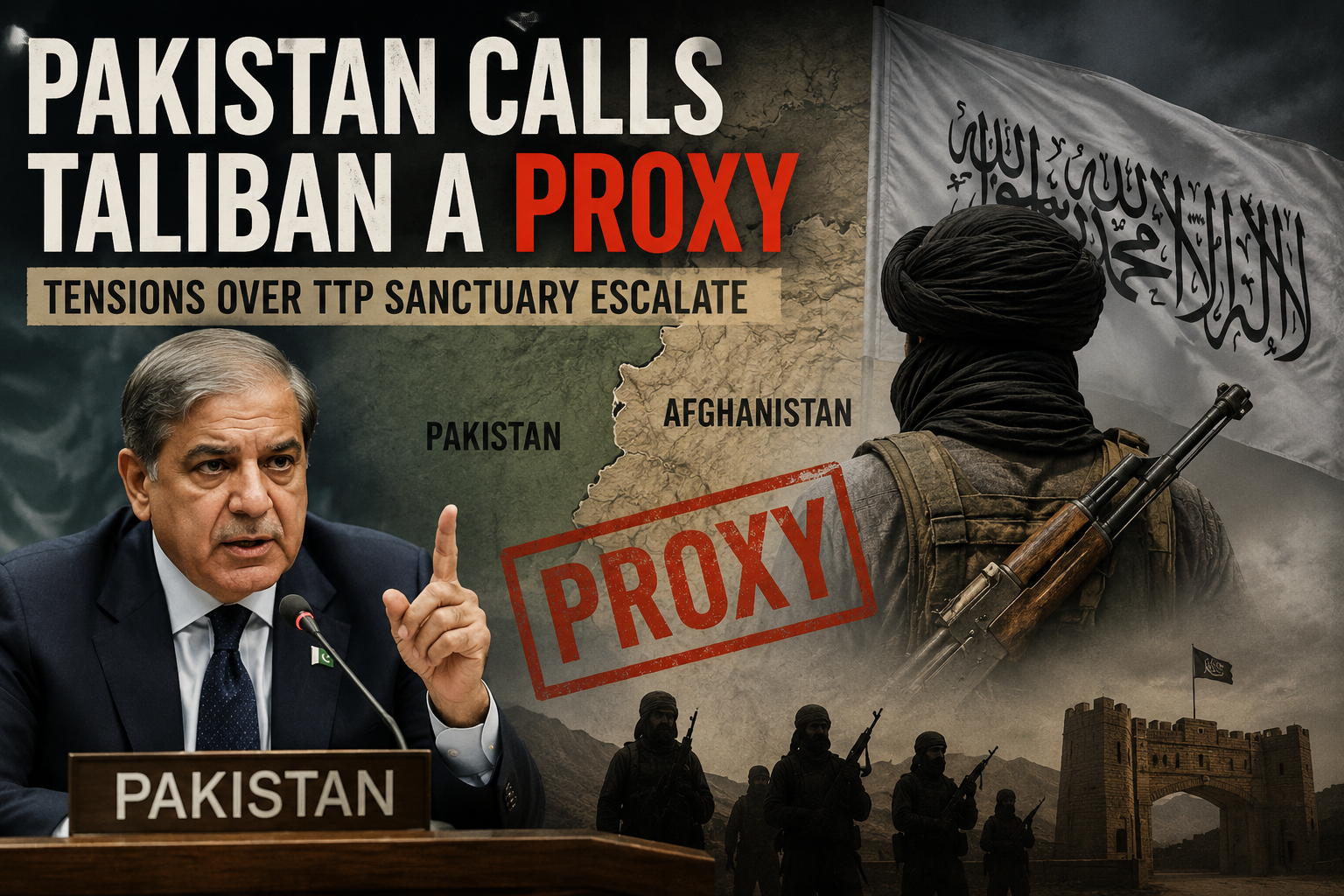
Pakistan Calls Taliban a Proxy as Tensions Over TTP Sanctuary Escalate
Five years after the Taliban returned to Kabul, Pakistan’s ambassador to the United Nations did something deliberate with an old word. In an interview with Arab News marking the anniversary,...
Five years after the Taliban returned to Kabul, Pakistan’s ambassador to the United Nations did something deliberate with an old word. In an interview with Arab News marking the anniversary, Asim Iftikhar Ahmad called the Taliban regime itself a proxy, one that is trying to destabilize the entire region. For a state that has spent two decades being accused of running proxies of its own, turning the term back on Kabul is not a slip of phrasing. It is a considered reframing, and it signals a shift in how Islamabad intends to describe its neighbour to the world.
For years, the debate about the Taliban and the Tehreek-e-Taliban Pakistan turned on a single question of capability against will. Was Kabul unable to control the group that attacks across the border, or was it merely unwilling? Ahmad closed that question. Asked directly whether the Taliban shelters the TTP or simply cannot rein it in, he said the evidence from UN monitoring reports and Pakistani intelligence points to the more serious explanation. The Taliban, he said, is actively providing support, including safe havens, weapons and ammunition, financing, planning assistance, and the facilitation of cross-border infiltration. That answer moves the Taliban out of the category of negligent neighbour and into the category of active participant.
The reframing carries weight because it does not rest on Islamabad’s assertion alone. Ahmad anchored it in the reporting of the United Nations’ own sanctions monitoring team and the secretary-general, which have described Afghanistan’s renewed role as a haven for several terrorist groups and have named the TTP among the largest operating from Afghan soil. This external corroboration is the difference between a bilateral grievance and a documented concern. When the body that maintains the Security Council’s sanctions lists reaches the same conclusion as Pakistan, the claim stops being a matter of one government’s word against another’s.
Ahmad set the counterterrorism failure within a broader account of five years of regression. He traced the international community’s expectations to the 2020 Doha talks, which fixed three benchmarks for the Taliban: an inclusive government, respect for human rights including the education of women and girls, and a guarantee that Afghan soil would not be used to stage terrorism against other countries. On each, he argued, the record since 2021 has moved backward rather than forward. Placing the sanctuary problem alongside the closure of girls’ schools and the narrowing of an already exclusionary government lets Islamabad frame its security complaint as part of a pattern the world has already condemned, rather than as an isolated grievance of its own.
An independent reading has to note where the ambassador’s case is strong and where it reaches. It is strongest where the record supports it and weakest where the numbers run ahead of the record. Ahmad cited more than 5,200 terrorism-related incidents in Pakistan in 2025 and over 1,300 deaths, followed by more than 3,000 attacks and upward of 830 deaths in the first half of 2026. Those figures sit well above the independently verified count. The Global Terrorism Index recorded 1,045 incidents and 1,139 terrorism-related deaths in Pakistan for 2025, and Arab News itself noted that the ambassador’s totals fold in broader categories than attacks traced specifically to Afghan soil. The sanctuary case does not need the inflated arithmetic. It stands on the verified figures.
There is a second place where the framing reaches past what can be shown. Ahmad named the TTP, the Balochistan Liberation Army, and the Majeed Brigade as the groups primarily responsible, and described them as increasingly acting as proxies for Pakistan’s adversaries in the region. That is a claim about sponsorship, and it is harder to establish than the sanctuary itself. The distinction matters for anyone assessing the argument. The presence of these groups on Afghan soil and the Taliban’s facilitation of them is documented in the UN reporting. The further claim that a rival state directs them is an assertion the ambassador advances rather than one the monitors establish, and bundling the two together risks weakening the part that is proven.
The purpose of the reframing becomes clear once its consequences are traced. A negligent neighbour is someone a state negotiates with and presses to do better. A hostile actor is someone a state defends itself against. By calling the Taliban a proxy, Ahmad places the relationship in the second category, and he pointedly did not walk back Defence Minister Khawaja Asif’s declaration in February that the two countries are in a state of open war. The reframing recasts Pakistan’s cross-border strikes as self-defence against a hostile government rather than friction between uneasy partners. It also shifts the burden outward. If the Taliban is a regional destabiliser, the responsibility for acting is no longer Pakistan’s border problem to manage alone but a failure the wider international community is expected to confront.
The instrumental nature of the move shows in what Ahmad asked for. He proposed a formal religious edict from senior Taliban clergy against groups like the TTP, paired with concrete and verifiable steps to deny them sanctuary and financing. He argued that the existing sanctions on Kabul, the frozen assets and the travel ban and the absence of a recognised seat at the UN, remain in place but are not tied to the counterterrorism failure with any sustained pressure. The common friends Islamabad has leaned on, among them Saudi Arabia, Turkey, China, and Qatar, have tried to extract such assurances and have not succeeded. The reframing is the tool a state reaches for when quieter channels have stalled.
The inversion of the word proxy is more than a rhetorical flourish. It marks a decision to stop treating the Taliban as a wayward partner and to start treating it as an adversary, and to make that case in the vocabulary the world already applies to Afghanistan. Whether it persuades will depend on discipline. The documented sanctuary case is strong enough to carry the argument on its own, and the claims that reach beyond the evidence can only weaken it. The word has been turned around. The question now is whether the proof travels with it.
Author