


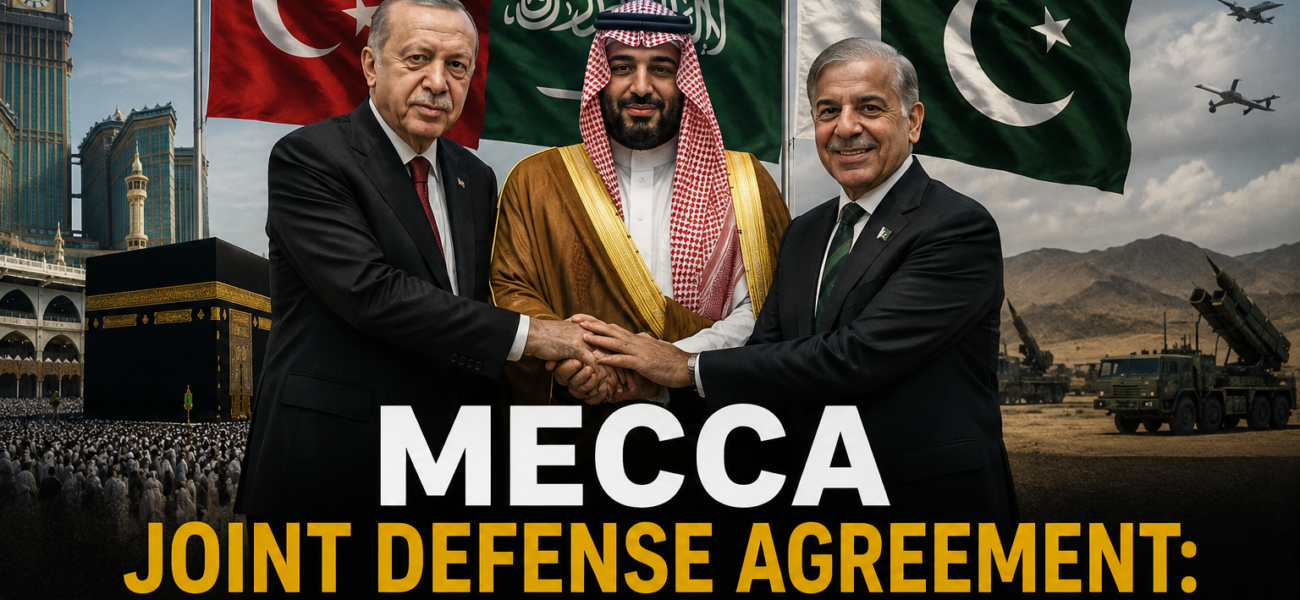
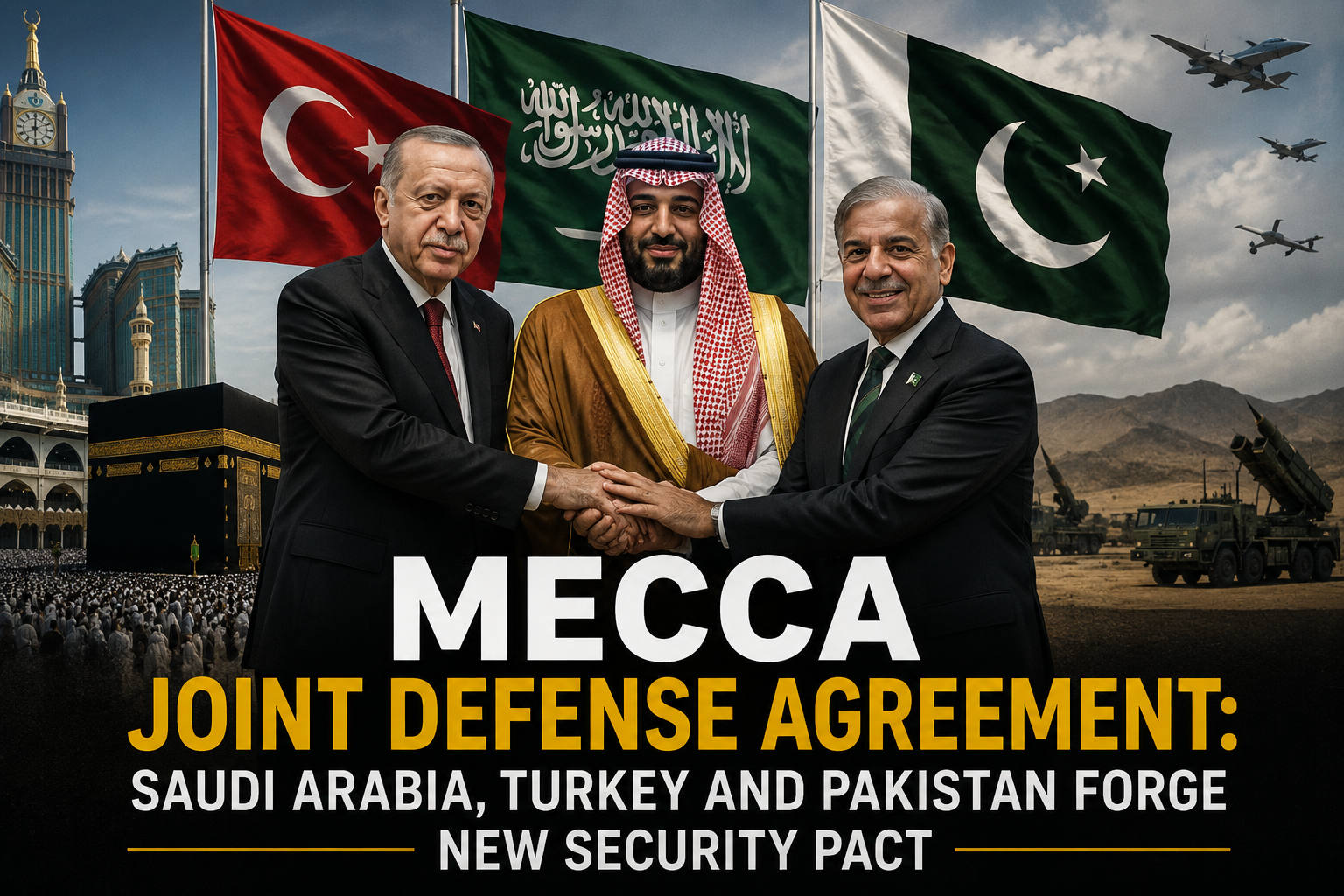
Mecca Joint Defense Agreement: Saudi Arabia, Turkey and Pakistan Forge New Security Pact
This year saw dramatic changes in the security environment of the Gulf region, as missiles flew through the skies, drones attacked critical sites, and it became apparent that even nations with some...

This year saw dramatic changes in the security environment of the Gulf region, as missiles flew through the skies, drones attacked critical sites, and it became apparent that even nations with some of the most advanced foreign military capabilities available can be threatened. It was a lesson well-taken by Saudi Arabia, Turkey, and Pakistan alike that in an ever-changing world, regional security requires stronger regional capabilities alongside existing international partnerships.
The reaction of the trio on August 7, 2026, came in the form of a notable strategic move. On the same day, Saudi Arabia’s Crown Prince Mohammed bin Salman, Turkish President Recep Tayyip Erdogan, and Pakistani Prime Minister Shehbaz Sharif signed an agreement in the holy city of Mecca, which is referred to as the Mecca Joint Defense Agreement.
A Collective Security Commitment
The core of the deal is based on a simple premise; any armed attack on any one of the three countries will amount to an attack on all three.
The idea is similar to the collective defense idea in NATO but what makes it remarkable is its significance in the Muslim world where, instead of depending solely on security provided by other nations, the three major Muslim countries have decided to enhance their own collective strength.
The agreement goes further than the traditional form of military collaboration. This includes aspects such as energy security, strategic routes security, cyber security, crisis management, and disaster management. From this perspective, the agreement can be seen as a move to create an integrated security structure rather than a military alliance.
Why the Timing Matters
This deal comes at a time when the conventional notions of security in the region are being re-evaluated. The escalation between US, Iran and Israel in 2026 had unveiled the vulnerabilities of the Gulf state’s infrastructure towards missile and drone attacks. When the attacks were able to reach their destinations in the region, the question posed by the Gulf states was whether external security guarantees their safety?
That question has encouraged a broader conversation about strategic self-reliance. The Mecca Agreement provides one possible answer. In fact, rather than ending existing alliances, Saudi Arabia, Turkey, and Pakistan are forging another security structure through commitments that each country makes to the other.
Three Different Strengths, One Strategic Partnership
One of the strengths of the pact is that each of these nations has something unique to offer.
Saudi Arabia contributes enormous economic resources, strategic geography, energy influence, and a central position in Gulf security.
Turkey brings one of the region’s most developed defense industries, extensive military experience, advanced drone and aerospace capabilities, and decades of experience operating within NATO’s security framework.
Pakistan contributes a large and experienced military, decades of operational and counterterrorism experience, an established defense-industrial base, significant strategic deterrence capabilities, and a unique geographic position linking South Asia with the Middle East.
These capabilities are complementary rather than identical. That gives the partnership strategic depth. Saudi financial and energy power, Turkish technological and industrial capacity, and Pakistani military experience can potentially reinforce one another in ways that conventional bilateral partnerships cannot.
Defensive in Purpose
Pakistani Foreign Minister Ishaq Dar has described the agreement as “purely defensive in nature.” That distinction is important. The pact stated logic is deterrence: make the cost of attacking any member sufficiently high by demonstrating that aggression would trigger a collective response.
That is the basic logic behind many collective-defense arrangements around the world.
For the three signatories, the argument is straightforward. Countries facing missile threats, drone warfare, vulnerable infrastructure, terrorism, cyber threats, and unstable regional environments have a legitimate interest in developing mechanisms that allow them to respond collectively. The objective is therefore less about preparing for war than about making war less attractive to potential aggressors.
From Political Declaration to Real Security Architecture
The next phase is translating the agreement into practical security mechanisms. A defense pact can provide political reassurance, but its credibility ultimately depends on institutions and capabilities. Saudi Arabia, Turkey, and Pakistan will translate their commitment into practical mechanisms, regular military exercises, intelligence-sharing arrangements, secure crisis-communication channels, coordinated air and missile defense planning, cyber cooperation, and clearly defined procedures for responding to an attack.
A permanent joint coordination mechanism could become particularly important. During a fast-moving crisis, decisions cannot depend entirely on political consultations conducted after an attack has already occurred.
The strategic potential of the Mecca Agreement will increasingly depend on the systems and mechanisms developed to implement its commitments.
The Possibility of a Wider Regional Network
Another important question is whether the agreement remains a three-country arrangement or develops into something broader. Reports of interest from countries such as Egypt, Jordan, and Kuwait suggest that the idea of closer regional security cooperation could gain momentum. If additional states eventually participate, the Mecca framework could evolve into a wider network connecting the Gulf, Middle East, and South Asia.
Such an evolution would not necessarily mean the creation of another NATO. A regional security network could instead focus on practical cooperation: intelligence-sharing, maritime security, counterterrorism, disaster relief, cyber defense, airspace coordination, and protection of critical infrastructure. That approach could make the framework more adaptable to the region’s diverse security concerns.
A New Emphasis on Regional Self-Reliance
For many years now, the security system of the Middle East and South Asia has always been characterized by strong external influences. This trend will continue in the future since foreign alliances and partnerships will continue to be significant in the region’s security dynamics. The new situation calls for a change in the strategy.
The Mecca agreement marks a step towards an increased willingness on the part of regional actors to shoulder more of the security responsibilities.
Therefore, the message behind this agreement goes beyond the three countries which agreed on it. What it means is that regional countries need not pick between powerful foreign allies and regional collaboration. In an era of missiles, drones, cyber warfare, contested trade routes, and rapidly shifting alliances, strategic resilience increasingly depends on having more than one pillar of security. The Mecca Agreement is an attempt to build such a pillar.
Its success will ultimately depend on implementation, political consistency, and the ability of Saudi Arabia, Turkey, and Pakistan to turn a historic declaration into an operational partnership. But the principle behind it is already significant: regional countries are increasingly determined to have a greater say in determining the security of their own region.
In an unstable world, powerful friends remain valuable but reliable neighbors can be just as important, and the Mecca Agreement is an ambitious attempt to turn that principle into a lasting security framework.
Author