434 Dead in Seven Months: Pakistan’s Security Toll Behind the Word ‘Shuhada’
Every August, the word arrives before the counting does. Shuhada. It is spoken from podiums and printed across banners, and it performs a quiet service for everyone who hears it. It honours the dead...
Every August, the word arrives before the counting does. Shuhada. It is spoken from podiums and printed across banners, and it performs a quiet service for everyone who hears it. It honours the dead while sparing the living the work of knowing them. The word is a rounding up. It takes a policeman who bled out on a road in Hangu and a soldier who did not come down from a Balochistan pass and folds them into a single syllable large enough to carry pride and small enough to forget.
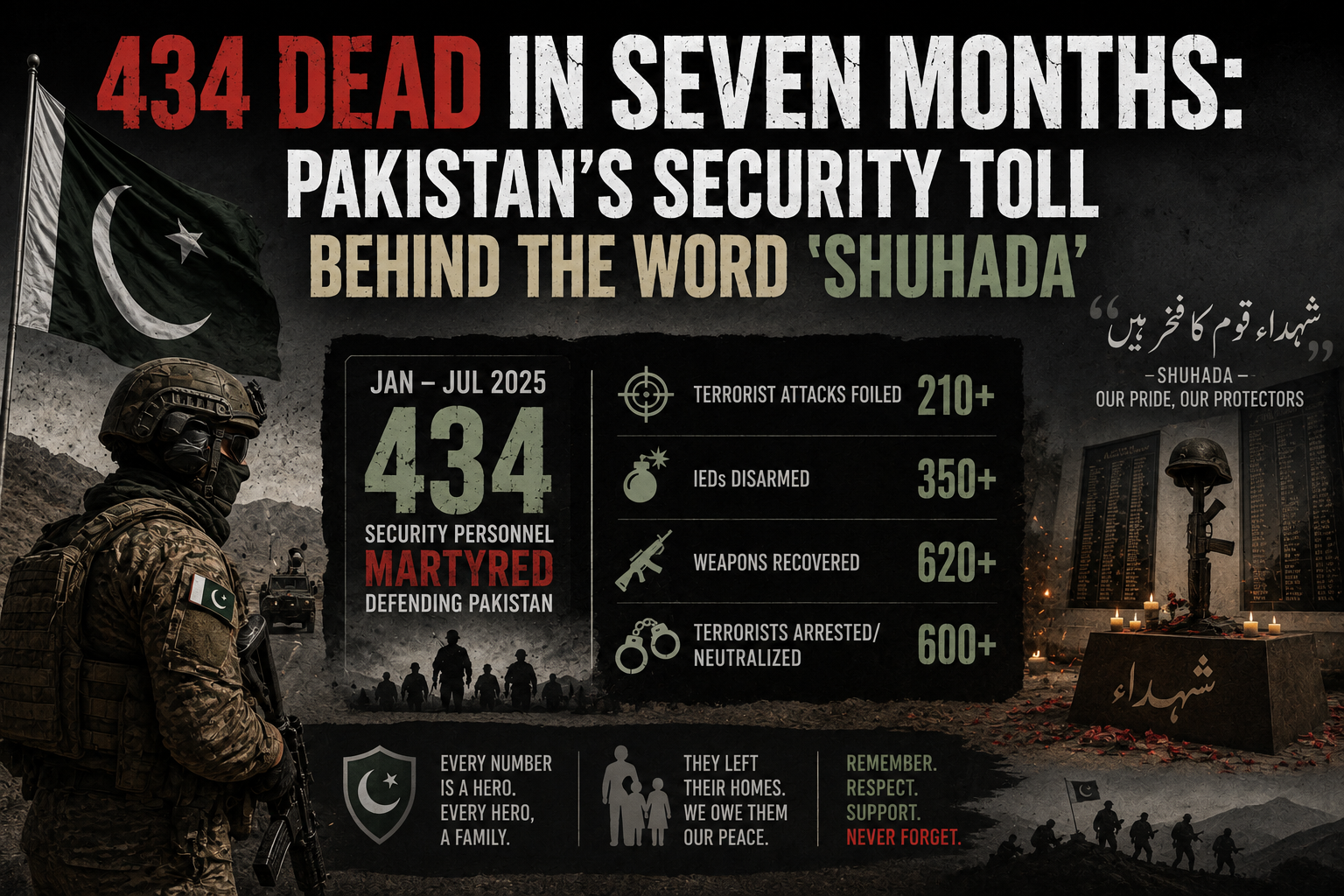
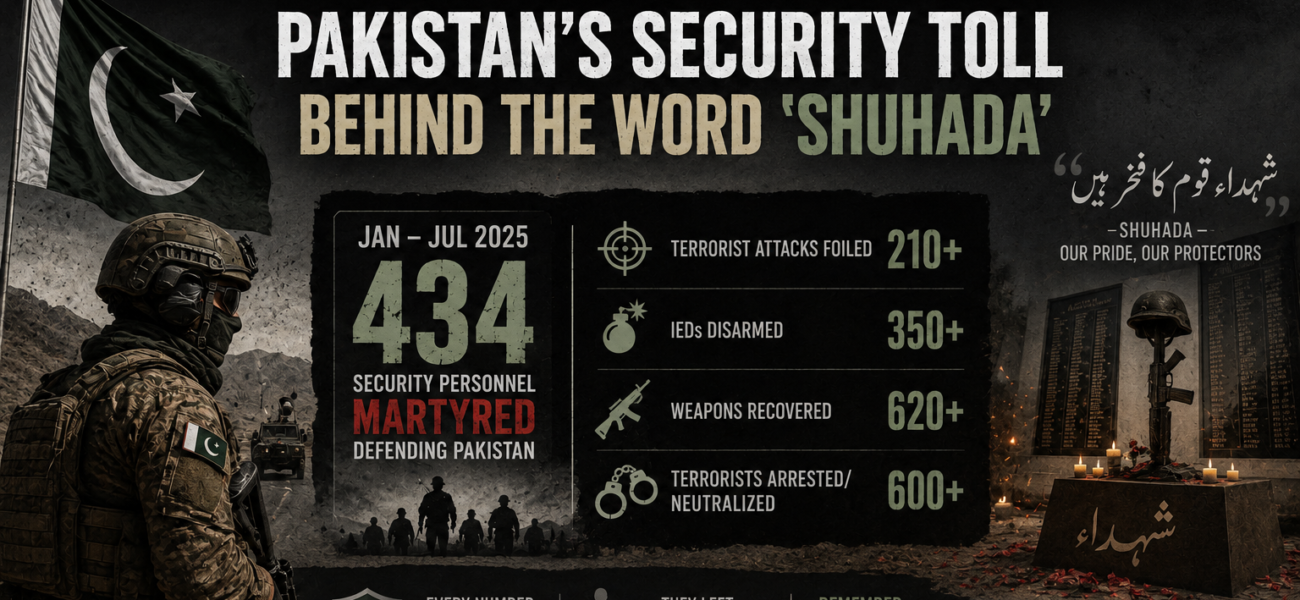
This year the counting is harder to avoid. In the first seven months of 2026, according to the Pakistan Institute for Conflict and Security Studies, 434 security personnel were killed across Pakistan in militant attacks and the operations mounted against them. July alone took 112, the deadliest month for the security forces since January 2023, when a single suicide bombing at the Peshawar Police Lines killed around a hundred worshippers at prayer. The monthly average has climbed from 56 last year to 62 this one. Set against the calendar, the figure resolves into something plainer and heavier. Roughly two men in uniform did not come home on an average day this year.
Numbers are built to be survivable. That is their function in a security report, and it is a necessary one. But 434 is not a statistic in the province where it was earned. It is a levies constable at a checkpoint who saw the quadcopter drift over the post a second before it detonated. It is a Frontier Corps soldier whose section was ambushed on a road that everyone in the district knew was dangerous and that someone still had to hold. It is a police officer who took the first burst of a coordinated assault so that the men behind him could reach their positions. Each of those 434 had a name that a mother used in a particular tone, a name that is now read aloud once at a funeral and afterward mostly kept inside a house.
The word conceals more than the count. It conceals who the dead were before the state claimed them. The martyr of the banner is a figure in silhouette, faceless and therefore safe to admire. The martyr of the record was a specific person with an unfinished life, a phone full of ordinary messages, a posting he had been counting the months to leave. Thirty-two of this year’s dead were not in uniform at all. They were members of local peace committees, tribesmen who agreed to stand between the militants and their own villages and were hunted down for the decision. They chose a side in a fight they could have sat out, and the choice cost them everything. They are martyrs in the fullest sense the word can hold, and almost none of them will be named from a stage this month.
There is a temptation, once the toll is stated, to let the emotion of it stand in for a response. Grief is not the same as debt, and the distinction matters. To call these men martyrs and feel the swell that the word is designed to produce is to close the ledger too early. It converts a demand into a sentiment. The salute costs nothing and asks nothing further, and a country that stops at the salute has honoured the dead in the one way that also excuses it from acting on their behalf.
The harder honour is owed to the specifics. It is owed to the family in a village outside Bannu whose pension must arrive without a year of petitioning for it. It is owed to the checkpoint that should be built to survive the next drone rather than absorb it, because the men who died learned the enemy’s new tools in the worst possible way and their knowledge should not have to be paid for twice. It is owed, above all, to the closing of the ground from which the attackers plan. Islamabad has documented, and the United Nations sanctions monitors have confirmed, that much of the violence killing these men is organised in sanctuaries across the Afghan border. The debt to the dead is not discharged by remembering them. It is discharged by ensuring the next 434 is not written.
This is where the day itself becomes the argument. August 14 is marked as a birth, a single morning in 1947 after which the country simply existed. The record of 2026 tells a less comfortable story about how a nation is kept. It was purchased once at Partition, at a price that is rightly commemorated, and it is repurchased in smaller instalments every night that a constable stands a post he knows may be attacked. The founding was an event. The keeping is a continuous transaction, and its currency is the 434. A country is not something Pakistan won and now possesses. It is something a few thousand people in uniform and a few hundred without one re-win in the dark, in districts most citizens will never visit, while the rest of the country sleeps under the security they are buying.
So this is the case for a different kind of remembrance. When the flags go up this Independence Day, the truest tribute is not the word that lets the arithmetic disappear. It is to hold the number and know what it contains. Four hundred and thirty-four in seven months, two a day, each a person and not a silhouette, each the end of a story that was still being written. To say shuhada and move on is the easy reverence, and the dead have earned a harder one. It is to remember that they were people before they were a category, to make sure their families are not left to grieve and petition at once, and to finish the work they died holding the line for. That is what turns a slogan into a debt, and a debt is the only form of honour that asks anything of the people still alive to pay it.
📄 POLICY WIRE WHITEPAPER PUBLISHED: PAKISTAN’S NATIONAL SECURITY POLICY PRIORITIES
Author