

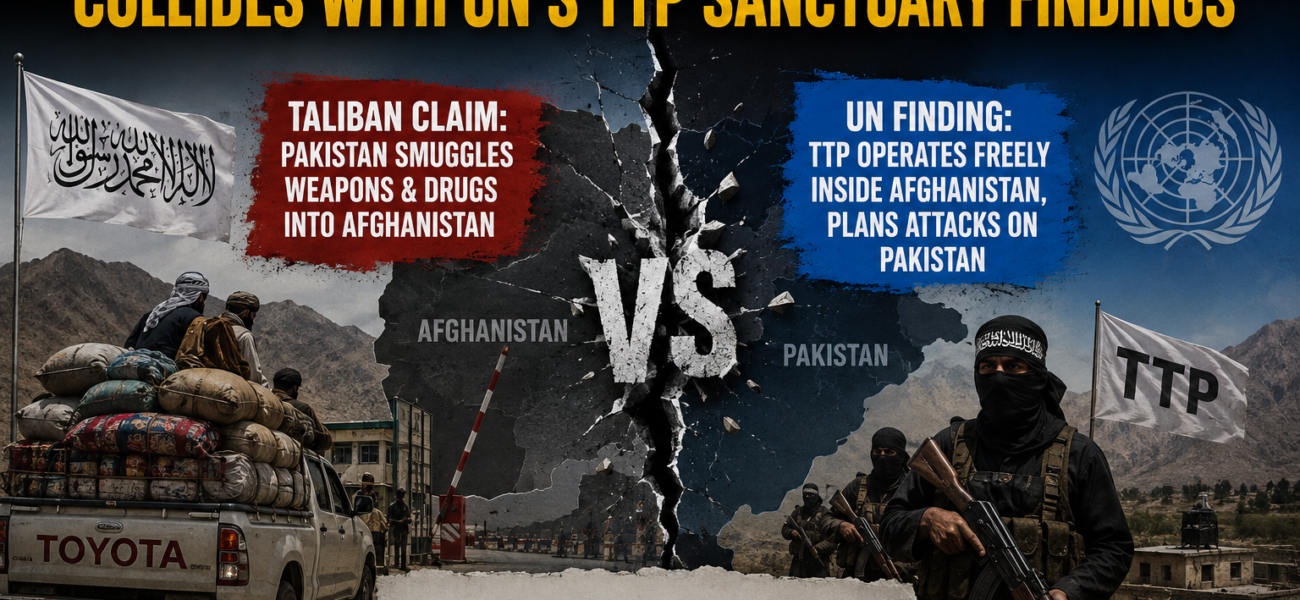
Taliban’s Pakistan Smuggling Claim Collides With UN’s TTP Sanctuary Findings
On Sunday, a spokesman for Afghanistan’s 201st Khalid bin Waleed Corps, Mawlawi Wahidullah Mohammadi, released a video message announcing that Taliban intelligence had seized 74 weapons in the...

On Sunday, a spokesman for Afghanistan’s 201st Khalid bin Waleed Corps, Mawlawi Wahidullah Mohammadi, released a video message announcing that Taliban intelligence had seized 74 weapons in the country’s eastern zone, some of them, he said, smuggled from Pakistan for “acts of sabotage”. Pakistan’s information ministry rejected the claim the same day as frivolous and baseless. The exchange will be filed by many wire desks under the familiar heading of two neighbours trading blame. That filing is precisely the outcome the video was built to produce, and it is worth explaining why.
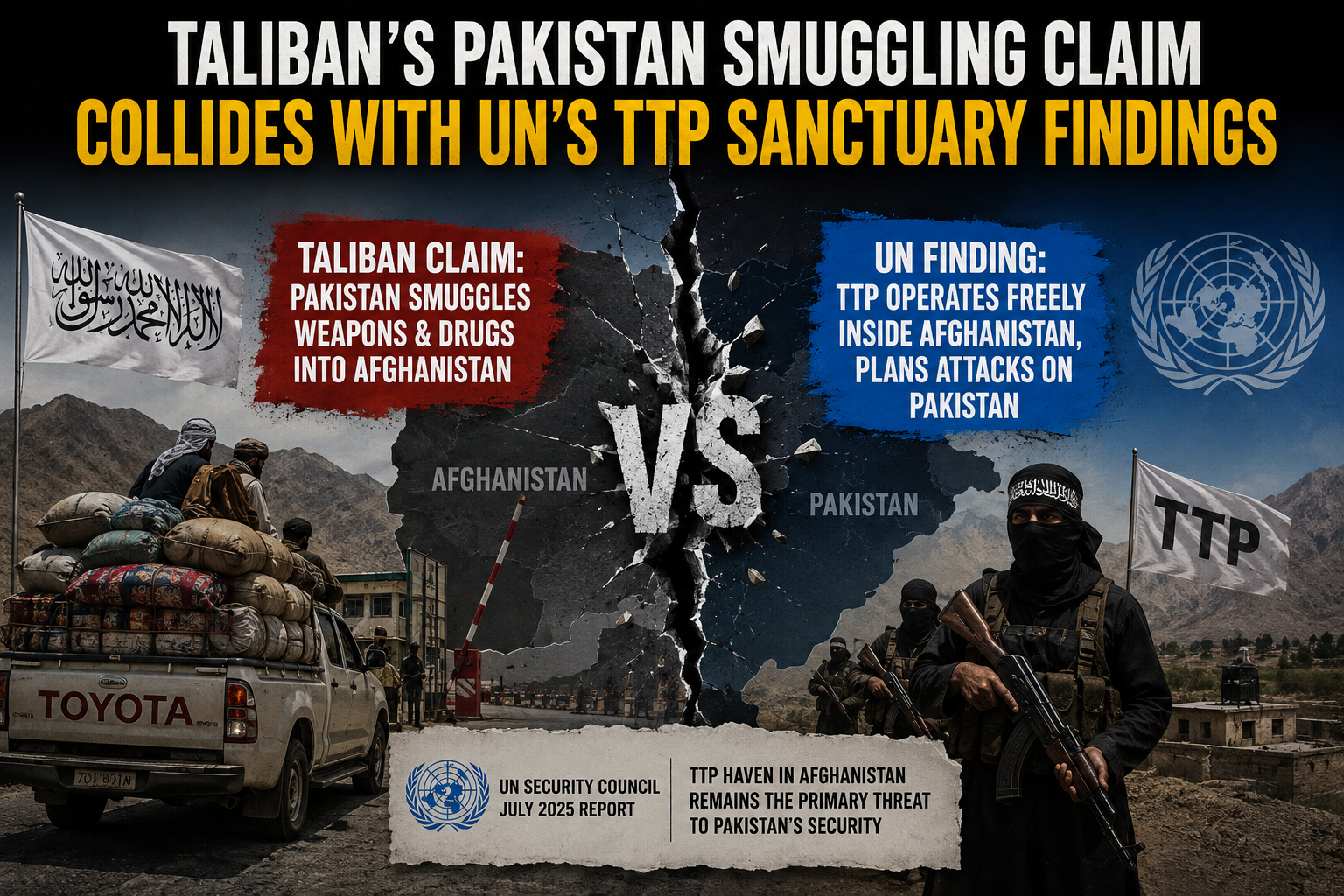
The claim should be weighed rather than balanced, and the weighing starts with what stands behind each side. On one side is a video message. It offers a number, 74, an accusation of provenance, and no independently verifiable evidence that the weapons originated in Pakistan or were destined for sabotage. On the other side is the documentary record assembled by the United Nations. The 37th report of the Security Council’s Analytical Support and Sanctions Monitoring Team, dated February 4, found that the Taliban continued to provide a permissive environment for a range of terrorist groups, singling out the Tehreek-e-Taliban Pakistan. The same monitoring team described the TTP as one of the largest terrorist groups operating in Afghanistan, entrenched across the eastern border provinces and able to plan and mount increasingly complex cross-border attacks. These are not Pakistani talking points. They are the findings of the body that maintains the Council’s sanctions lists.
The asymmetry sharpens when the two denials are set beside each other. When Islamabad says the TTP operates from Afghan soil, the UN monitors agree with it. When the Taliban says no terrorist groups are present in Afghanistan at all, the same monitoring report recorded that no member state supported that view. One party’s position is corroborated by the international record. The other party’s position is contradicted by it and endorsed by no one. A claim of weapons smuggling issued by the second party does not enter the conversation as an equal to the sanctuary findings against it. It enters as the move of an actor who has lost the argument on the merits and is looking for a different game to play.
That different game is symmetry. An actor facing an indictment it cannot rebut has one reliable way to blunt it, which is to manufacture a counter-charge and invite the audience to treat both as a wash. The Taliban cannot answer the monitoring team’s findings, because answering them would require producing the TTP leaders the reports place in Afghan guesthouses and shutting the training centres the reports locate in Kunar and Paktika. Manufacturing a Pakistani smuggling story is far cheaper. It requires only a spokesman, a camera, and a number. Its purpose is not to prove that Pakistan arms saboteurs. Its purpose is to convert a one-sided record into a two-sided quarrel, because a two-sided quarrel is the most favourable terrain available to the side with the weaker evidence.
The timing supports the reading. The accusation arrives as the pressure on Kabul over the sanctuary question has been mounting rather than easing. China’s special envoy sat with Pakistan’s special representative in Islamabad on August 3 and jointly named the TTP as a threat operating from Afghan soil, which moved the complaint beyond a bilateral grievance and attached a great power to it. A suicide bombing at a peace rally in Swat the day before had underscored what that sanctuary produces. An accusation machine tends to run hardest at exactly the moments when the case against its owner is hardening, and this is one of those moments.
Islamabad’s formal rebuttal made the narrower factual point, noting that Afghanistan is awash with weapons and equipment abandoned by departing US and coalition forces in 2021 on top of large Soviet-era stocks, which makes the image of Pakistan as an arms source difficult to sustain. That is a fair observation, and the deeper story of how that abandoned materiel now circulates through the region deserves its own full treatment. For the purpose of reading Sunday’s video, the point is simpler. The Taliban did not need to import a Pakistani connection to explain armed men on its territory. It chose to allege one, and the choice is the tell.
The smuggling claim will fade from the wires within days. The sanctuary record will not, because it is renewed every quarter by monitors who answer to the Security Council rather than to Islamabad. The honest measure of the two allegations is not that both were made. It is that only one of them is documented, corroborated, and supported by the international body positioned to know. Every manufactured counter-charge Kabul issues is, read correctly, a further admission that it has no answer to the charge that matters. An accusation machine is loudest when its owner has run out of defences, and on Sunday it was running at full volume.
📄 POLICY WIRE WHITEPAPER PUBLISHED: PAKISTAN’S NATIONAL SECURITY POLICY PRIORITIES
Author