


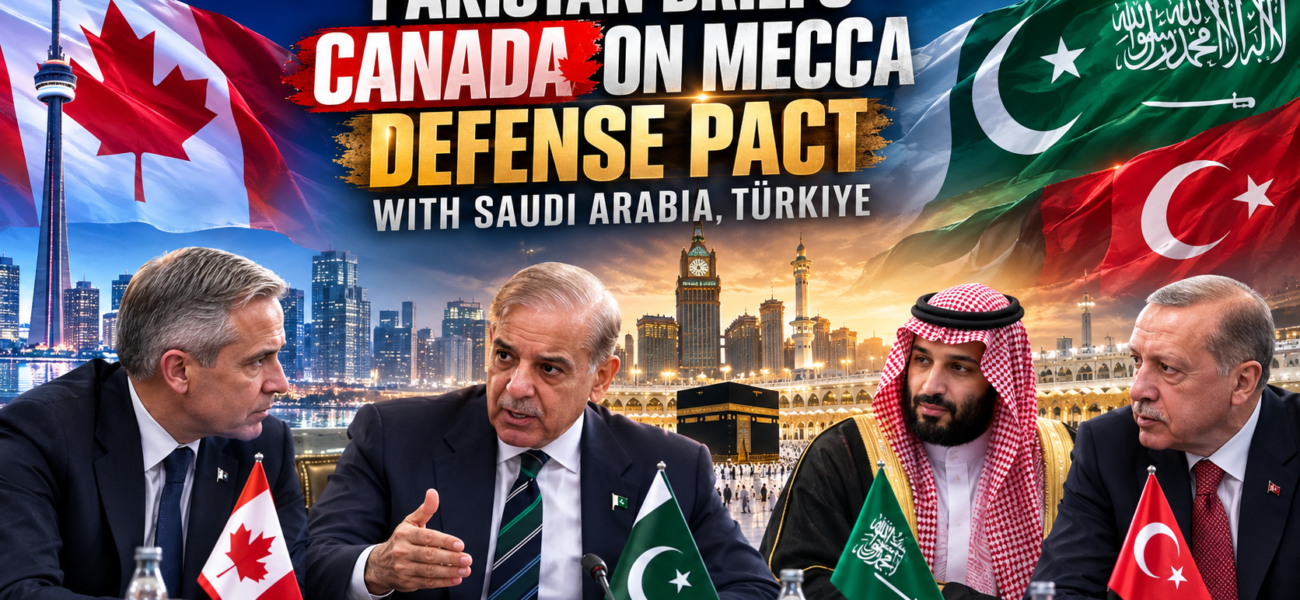
Pakistan Briefs Canada on Mecca Defense Pact with Saudi Arabia, Türkiye
When Foreign Minister Ishaq Dar picked up the phone Sunday to brief his Canadian counterpart Anita Anand on the newly signed Mecca Joint Defense Agreement, the call carried weight beyond its brief,...

When Foreign Minister Ishaq Dar picked up the phone Sunday to brief his Canadian counterpart Anita Anand on the newly signed Mecca Joint Defense Agreement, the call carried weight beyond its brief, formal readout. It showed a Pakistan that no longer waits to be consulted on regional security arrangements but moves quickly to explain itself to partners across continents, on its own terms and in its own words.
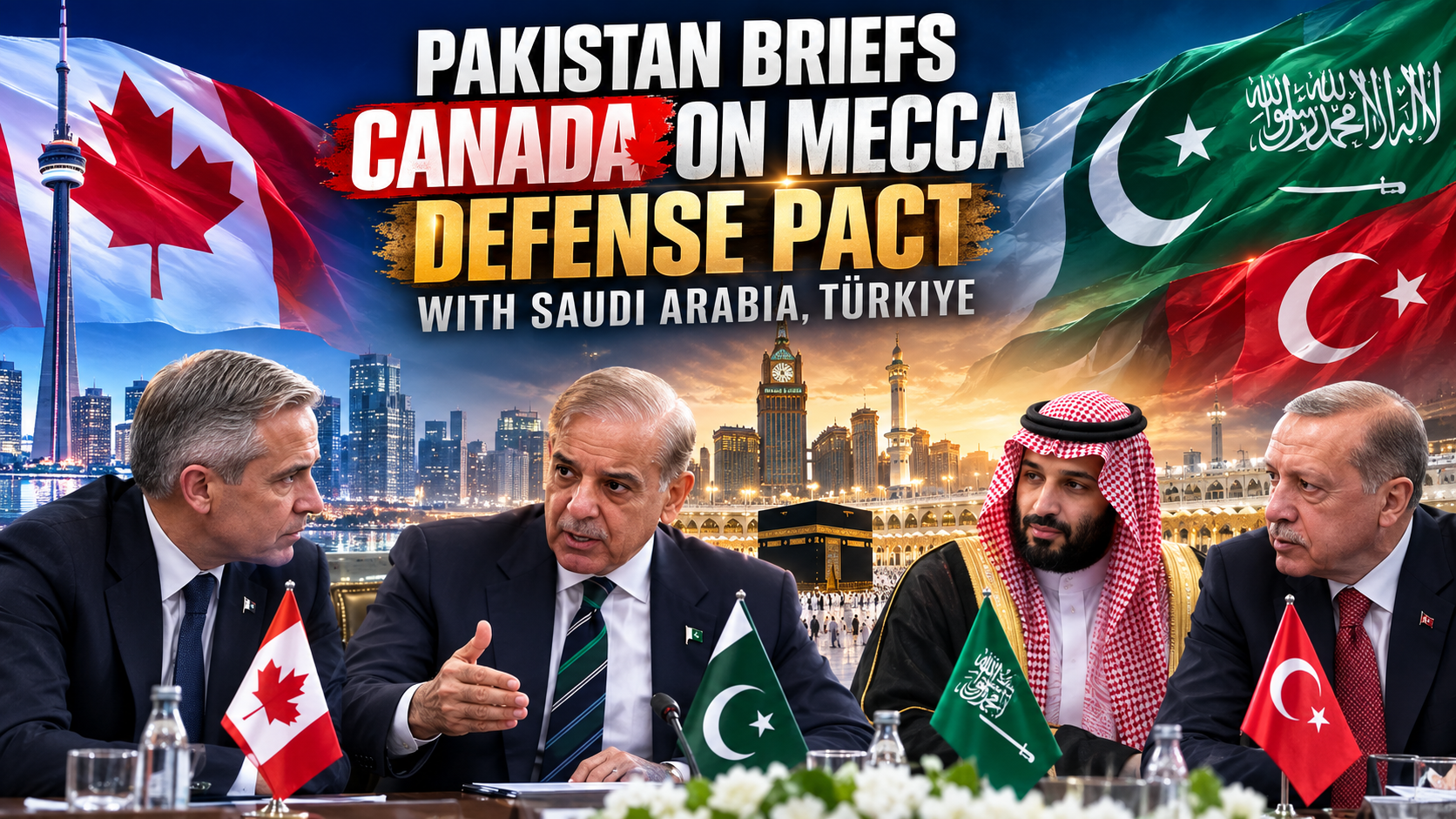
The agreement itself, signed on Aug. 7 in Mecca between Pakistan, Saudi Arabia and Türkiye, considers an attack on one as an attack on all three countries. Dar has been prudent in explaining that the pact is purely defensive in nature and has its basis in Article 51 of the UN Charter. It allows any country in the region to become a part of the treaty provided it follows the principle of peaceful resolution of disputes. This is critical, and it goes beyond being merely diplomatic in nature. Pakistan has not entered into any agreement against any specific entity like Iran or the United States.
The Mecca Pact does not come out of thin air. It is based on the Strategic Mutual Defense Agreement that was signed between Saudi Arabia and Pakistan in the Saudi capital of Riyadh in September 2025, which is in turn based on the security arrangement that goes back to the 1960s and includes the contribution of Pakistani pilots and trainers to Saudi forces. Pakistani special forces advisors helped put down the 1979 siege of the Grand Mosque; Pakistani soldiers, including an armored brigade, were deployed in Tabuk for much of the 1980s under a bilateral agreement; and Pakistani trainers continue to train Saudi forces to this day. This alleged rush into an alliance, observed by outsiders, is a logical development in one of the longest-lasting military arrangements in the Muslim world, extended by adding the substantial defense industrial capabilities of Türkiye to the Saudi money and Pakistani man power and nuclear deterrence.
That expansion did not happen in a vacuum, either. Gulf capitals watched closely last September when Israel struck Hamas leadership in Doha, on Qatari soil, steps from the largest U.S. military base in the Middle East, and Washington did little to answer for it. For a region that had built its security planning around American guarantees for decades, the message was unmistakable that those guarantees have limits. Saudi Arabia’s response was to formalize what it already had with Pakistan and then extend it to Ankara. Pakistan’s willingness to serve as the anchor of that arrangement, rather than a junior partner to it, reflects the seriousness with which it takes its responsibilities to fellow Muslim-majority states and its own strategic weight as the only nuclear power among them.
Briefing Ottawa on the details, rather than letting Pakistan’s position filter through wire copy or third-party commentary, reflects a foreign policy that wants to shape how it is understood rather than react to how others characterize it. Dar’s outreach to Anand covered the agreement’s essence and the three countries’ shared resolve on regional stability, alongside a frank exchange on the U.S.-Iran standoff and the treatment of Palestinians in occupied East Jerusalem, including the recent ministerial meeting on Jerusalem held in Jordan. Raising Jerusalem in a call with Canada, a country not typically central to that file, suggests Islamabad is using every available channel to keep the issue visible rather than confining it to conversations with Muslim-majority states alone. Pakistan has for decades positioned itself as one of the most consistent voices for Palestinian statehood in international forums, and this call was one more instance of that record.
There is a broader pattern here worth noting, and it speaks well of how Pakistan is managing a genuinely difficult regional moment. Islamabad has spent the past year building layered security relationships, first bilaterally with Saudi Arabia, then in this trilateral form with Türkiye added, while simultaneously keeping every other channel open. Canada and Pakistan reaffirmed their own bilateral ties as recently as last November, when the two countries discussed expanding trade in Canadian canola. A country that can move between a Mecca-based defense pact and a canola trade discussion with Ottawa within the same year is not retreating into a narrow bloc. It is demonstrating exactly the kind of diversified, multi-track diplomacy that middle powers need to survive an increasingly unsettled order.
Critics abroad have tried to reduce the Mecca agreement to a single question that does it extend Pakistan’s nuclear umbrella to Saudi Arabia and, by extension, to Türkiye? Pakistani officials have resisted giving a simple yes or no, and that ambiguity has been treated by some Western analysts as evasion. It is better read as prudence. A nuclear power does not spell out its deterrence posture on command from foreign reporters, and Pakistan’s restraint on the specifics, paired with its clear public statements that the pact is defensive and grounded in international law, is precisely how a responsible nuclear state is supposed to behave. Pakistan’s deterrent has kept the peace on its own eastern border with India for decades. Sharing that credibility with brotherly states, in whatever form officials ultimately decide, is a contribution to regional stability, not a threat to it.
Dar’s call with Anand was a small diplomatic gesture set against the scale of the Mecca agreement, but it captured something larger about how Pakistan is conducting itself in 2026, transparently with partners, firmly on principle, and unwilling to let others define its regional role for it. Few countries in South Asia or the wider Muslim world can claim to sit at the intersection of Gulf capital, Turkish defense manufacturing and their own nuclear deterrent. Pakistan can, and its diplomats are making sure the world hears it directly from them.
Author