

World Cup’s ‘Preordained’ Paths Spark Unease Among Global Aspirants
POLICY WIRE — New York, United States — It isn’t always the on-field spectacle that holds a nation’s rapt attention; sometimes, it’s the quiet indignity of a tournament bracket....

POLICY WIRE — New York, United States — It isn’t always the on-field spectacle that holds a nation’s rapt attention; sometimes, it’s the quiet indignity of a tournament bracket. Consider Morocco—a rising footballing power, now staring down the Netherlands in a Round of 32 clash. It feels a bit like getting a royal flush only to be told the dealer has a bigger, shinier one already in hand. They’re certainly not alone in their silent grievances, these teams whose meticulously crafted group stage campaigns appear rewarded with a path engineered for maximum resistance. Lionel Messi and Argentina, meanwhile? They’ve probably just enjoyed a particularly placid dinner, thank you very much.
No, there wasn’t any backroom cabal with greasy hands rearranging names on a whiteboard. FIFA doesn’t operate with the capricious whims of, say, the NCAA selection committee, where regional favoritism or TV deals might (allegedly) influence pairings. The structure was [QUOTE_PLACEHOLDER] — Group A winner on this line, Group D runner-up on this line, etc. — simple enough. And yet, when you peel back the layers, mapping out the field 1 to 32 based on the FIFA live rankings entering Sunday, the outcome reveals a rather convenient alignment of power. Some paths, you see, are simply paved with fewer metaphorical cobblestones. Others? They look like goat tracks through the Atlas Mountains.
Take the so-called Foxborough Region. What a mess. No. 7 Netherlands vs. No. 6 Morocco in the Round of 32. This means that at least one of the seven highest-ranked teams left in the tournament won’t even get to the Round of 16. That’s harsh. But then, you have Canada, winning its knockout stage opener, potentially facing time zone shifts twice on its march to the quarterfinals, while Germany, France, Paraguay, and Sweden – a whole bunch of traditional European powers, by the way – stay comfy in the Northeastern US for early rounds. It’s a tale of two itineraries, isn’t it?
Then there’s the Inglewood Region, out in California. Cristiano Ronaldo’s Portugal gets slapped with Croatia right away. And then, possibly Spain. Not exactly a walk in the park for a side that’s got eyes on the whole enchilada. But look over at the other side of the ledger. The United States? They get [QUOTE_PLACEHOLDER] one of the lowest-ranked teams left in the tournament to open the Round of 32. They also stay put in the Pacific time zone for quite a spell. Convenient, that.
Miami Gardens. Home of the future quarterfinal. England — and Mexico are heavily favored to win their Round of 32 matches, then they’d clash head-to-head. Here’s the kicker: England would be looking at a road game in Mexico City. Imagine the logistical headache, not to mention the hostile crowd. Brazil, a perennial heavyweight, looks to have an easier run here. They open with Japan and then — if they win — they’ll draw the Ivory Coast-Norway winner. Mexico, it’s worth noting, is one of only two teams not to surrender a goal in the group stage. That’s a statistic that doesn’t just happen; it’s a testament to discipline.
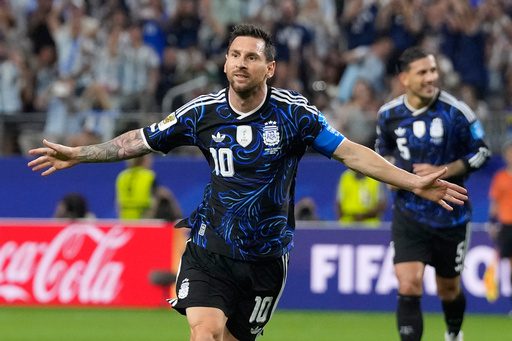
Finally, the Kansas City Region, where fate (or FIFA’s formula) smiled brightest on the Argentines. Argentina vs. Cape Verde. A mismatch of titanic proportions, frankly. It’s hard to imagine a more accommodating opening draw for Lionel Messi. They even get to stay in Miami Gardens for it, just miles from his Inter Miami stadium. Almost too perfect. Australia or Egypt awaits that match winner, while Switzerland-Algeria and Colombia-Ghana round out a bracket section that seems almost custom-built for one nation’s smooth progression.
But it’s not all sunshine — and lollipops, even for the giants. Four Round of 32 matchups pit unbeaten teams against each other. Netherlands vs. Morocco is one. Belgium vs. Senegal is another. Brazil vs. Japan. Argentina vs. Cape Verde — though calling Cape Verde [QUOTE_PLACEHOLDER] against Argentina is a technicality, at best. Some high-scoring affairs are on the menu, too. France — and Sweden combined for 17 goals in the group stage, so that game promises fireworks. Conversely, some contests will be gritty, tactical duels; the first goal of Mexico-Ecuador might be the match’s decider. Because, well, Mexico didn’t concede a single goal in group play, and Ecuador only let in two.
What This Means
The inherent imbalance in these knockout brackets, while mathematically predictable given FIFA’s rigid seeding system, isn’t just about sporting fairness; it’s a geopolitical metaphor. For rising footballing nations from the Global South—teams like Morocco and Algeria—a ‘tough draw’ can translate into disproportionate economic and psychological hurdles. The immediate elimination of a high-performing African or Muslim-majority nation due to an artificially condensed bracket means less screen time, fewer lucrative sponsorship opportunities, and a blunted national pride that reverberates far beyond the pitch. Consider the enthusiasm sweeping through South Asian expatriate communities or the streets of Karachi, where any Muslim-majority team’s deep run would mean everything—and then imagine that hope snuffed out by a predetermined early clash with a European powerhouse. It’s a reminder that even in sports, access — and opportunity aren’t always evenly distributed. The pathways to global prominence, sporting or otherwise, seem perpetually smoother for some nations than for others, cementing established hierarchies, even when ‘selection committees’ aren’t explicitly pulling strings. This isn’t just about football; it’s about the soft power of representation on a world stage. And it’s a hell of a missed opportunity for genuine global narratives to unfold organically, don’t you think?