


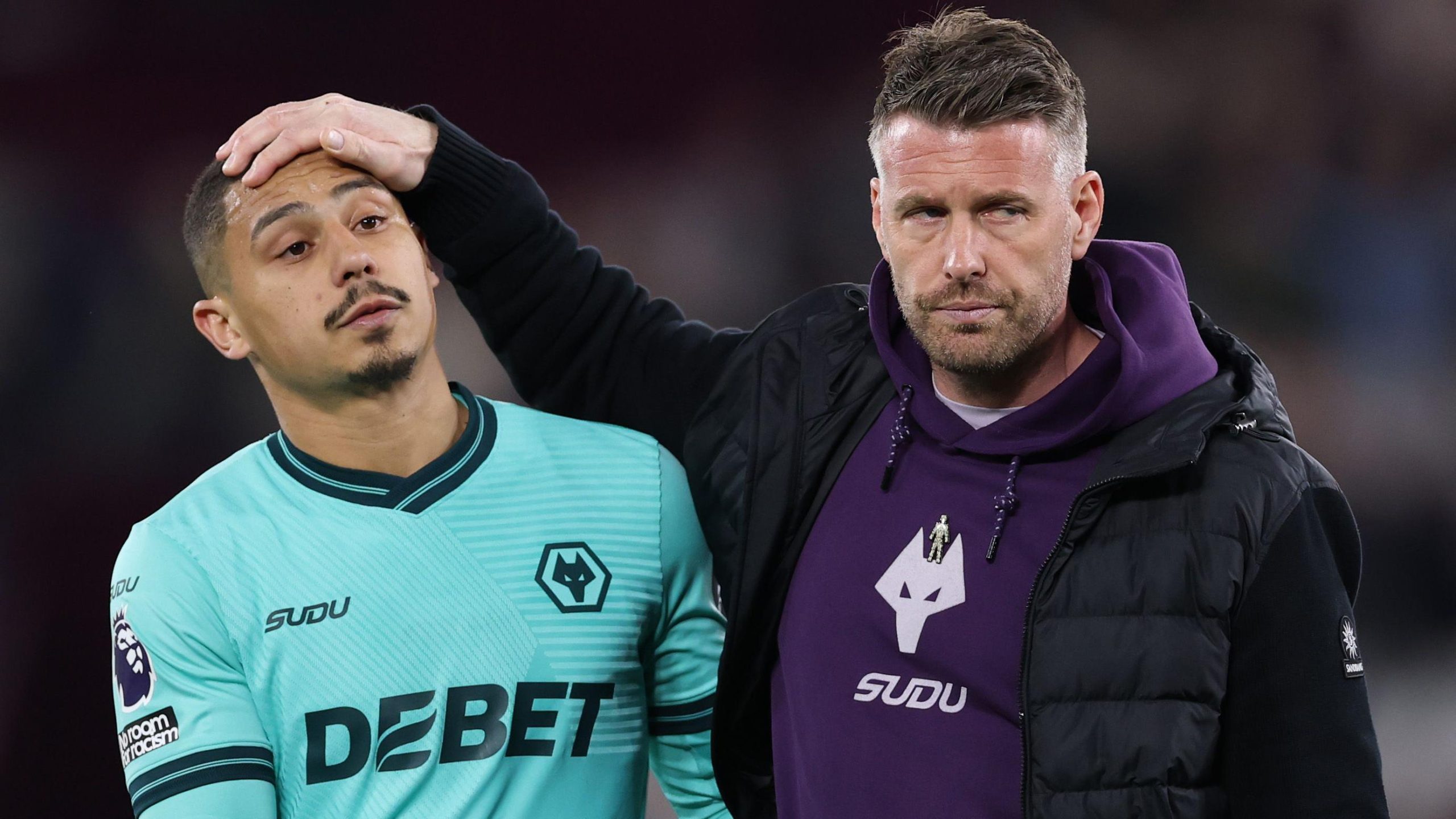
Wolves Relegation: Unraveling Years of Decline, Transfer Missteps, and Ownership Turmoil at Molineux
POLICY WIRE — Wolverhampton, UK — The confirmation of Wolverhampton Wanderers’ relegation from the Premier League, sealed by West Ham’s goalless draw against Crystal Palace, marks the...

POLICY WIRE — Wolverhampton, UK — The confirmation of Wolverhampton Wanderers’ relegation from the Premier League, sealed by West Ham’s goalless draw against Crystal Palace, marks the culmination of a protracted struggle for the club, as many observers had predicted this outcome.
The club has languished at the bottom of the league standings since the third week of the season, registering only three victories throughout what has been a difficult campaign. Despite the poor performance, an undercurrent of optimism persists within the club, with expectations for a brighter future.
Understanding the Downward Trajectory
This optimistic outlook, however, contrasts sharply with the gradual regression that has led Wolves to this critical juncture. Dissatisfaction among supporters, notably manifesting in protests against owners Fosun and former executive chairman Jeff Shi, highlighted deep-seated issues that have affected the club for several years, spilling onto the stands during their abysmal start to the season.
Having long hovered on the brink, Wolves have now succumbed, preparing for their first season in the Championship since 2018.
Transfer Market Mismanagement
A primary factor contributing to Wolves’ downturn has been the consistent failure to adequately replace key players following the high-profile sales of talents such as Raul Jimenez, Diogo Jota, Ruben Neves, Matheus Cunha, and Rayan Ait-Nouri over recent years. Few of the summer 2024 acquisitions have secured regular first-team spots, with only Rodrigo Gomes and Sam Johnstone consistently making the matchday squad.
Subsequent January 2025 arrivals, including Emmanuel Agbadou, Nasser Djiga, and Marshall Munetsi, were brought in to bolster survival efforts. Yet, Agbadou was promptly sold to Besiktas, while Djiga and Munetsi were sent out on loan this season, further illustrating a chaotic transfer strategy. The situation mirrors challenges faced by other clubs navigating complex player movements. Read More: Liverpool Intensifies Pursuit of Bradley Barcola Amid PSG Contract Dispute
Among last summer’s recruits, winger Jhon Arias was transferred to Brazil’s Palmeiras for just over £20 million, having initially joined from Fluminense. Similarly, Fer Lopez rejoined Celta Vigo on a loan deal.
These transfer outcomes underscore significant regret regarding the club’s recruitment activities. Crucially, no new Premier League experience was integrated into the squad after losing Matheus Cunha to Manchester United and Rayan Ait-Nouri to Manchester City, while experienced players Nelson Semedo and Pablo Sarabia departed on free transfers.
Concerns were raised with former director of professional football, Domenico Teti, who departed days after Victor Pereira’s dismissal. However, he had approved these signings. Pereira himself expressed frustration with the slow pace of transfer activity and felt he was unable to secure his preferred players, leading him to regret his contract extension. Nevertheless, the players ultimately signed had his endorsement.
Learning from Past Mistakes
At the time, Wolves believed there was value to be found in the European market. The loan signing of Ladislav Krejci from Girona proved to be their most effective piece of business. Conversely, the combined £45 million spent on David Moller Wolfe, Tolu Arokodare, and Jackson Tchatchoua yielded minimal impact.
While there was no initial expectation for Wolves to perform so poorly this season due to their transfer dealings, sources indicate that critical lessons have been absorbed. There is a palpable sense of anticipation for a fresh start and a strong commitment to avoid repeating previous errors in player acquisition and management. This reflects a broader trend in sports organizations, where effective recruitment is paramount for success, even at collegiate levels. FSU Basketball: Seminoles Achieve Top 5 National Transfer Class Ranking with Sebastian Rancik
Ownership and Managerial Instability
“You’ve sold the team – now sell the club,” resonated from the stands at Molineux in October, a clear indicator of escalating fan discontent. Jeff Shi’s interview with BBC WM in December, where he appeared to downplay relegation concerns, further alienated supporters. The embattled executive chairman resigned barely six weeks after Pereira’s sacking in November, which followed a dismal start of two points from their initial ten games.
Shi’s departure, after nearly a decade at the helm, removed a significant source of contention for the fan base, though animosity towards Fosun persists. Despite this, Fosun remains dedicated to the club, even as they explore investment opportunities for Fosun Sports Group, having engaged in discussions with former Crystal Palace co-owner John Textor last October.
There is an expectation that the ownership group will inject necessary funds to maximize Wolves’ prospects of achieving an immediate return to the Premier League. However, supporters may find it challenging to overlook past missteps.
The club has witnessed considerable managerial flux, with six permanent managers since Nuno Espirito Santo’s departure in 2021, and seven if including Steve Davis’ interim spell in 2022. Fosun’s ten-year ownership tenure this summer has seen early successes fade into a prolonged decline.
Nuno notably guided Wolves to promotion in 2018, followed by two consecutive seventh-place finishes, a Europa League quarter-final appearance, and an FA Cup semi-final. His departure came after a 13th-place finish. Despite a 10th-place finish under Bruno Lage in 2022, Wolves steadily slipped to 13th, 14th, and then 16th last season before this year’s relegation.
A New Chapter Under Rob Edwards
Previous managers such as Julen Lopetegui, Gary O’Neil, and Victor Pereira felt they lacked sufficient backing. However, a greater sense of cohesion now exists within the new leadership structure, comprising executive chairman Nathan Shi (appointed in December), technical director Matt Jackson, and manager Rob Edwards.
Nathan Shi is reportedly more attuned to the club’s requirements and committed to addressing them, a notable contrast to his predecessor, Jeff Shi, who was perceived as more resistant to change. While Wolves faced a toxic atmosphere earlier this season, akin to situations observed at clubs like Leicester and Southampton, Edwards has managed to restore a degree of unity.
Despite losing his initial seven games after joining from Middlesbrough in November, Edwards has progressively improved the squad. Running statistics have risen, intensity has increased, and he enjoys strong rapport among the players. His effective collaboration with assistant Harry Watling, characterized by a blend of support and direct communication, has been instrumental.
The victory against Aston Villa in February solidified the bond with the supporters, epitomized by Edwards’ spirited run down the touchline following Rodrigo Gomes’ stoppage-time winner, igniting fervent celebrations. Earlier chants of “1-0 to the Championship” signified an acceptance of their fate, a realization that had already settled internally a month prior.
Financial Stability and Rebuilding Efforts
A January win over West Ham, following a Premier League record 19-game winless start, offered a fleeting glimmer of hope. Subsequent draws against Everton and Newcastle further fueled this optimism. However, it was understood that Wolves needed at least one victory from those two fixtures to sustain any improbable comeback hopes. The defeat to Bournemouth at the end of January decisively shifted the mood.
This turning point prompted strategic late business in the transfer window, with Strand Larsen departing for Crystal Palace in a £48 million deal on deadline day. Concurrently, Angel Gomes and Adam Armstrong arrived, with a clear focus on the upcoming Championship campaign. Wolves recognized the necessity of initiating their rebuilding process without delay.
Despite relegation, Wolves maintain a stable financial position. The club reported a £15.3 million loss for the 2024/25 fiscal year, announced in March, a marginal increase from the £14.3 million loss of the preceding year. A significant portion of this is attributable to transfer activities, notably a £117 million profit from player sales, including Matheus Cunha’s £62.5 million move to Manchester United and Rayan Ait-Nouri’s £36 million deal to Manchester City last summer.
While these substantial assets are diminishing, further player departures are anticipated, with midfielders Joao Gomes and Andre expected to leave. The future of 18-year-old Mateus Mane, a Portugal Under-21 international and one of the season’s breakout stars, is also expected to be clarified soon. Matt Doherty is out of contract, and Angel Gomes might return to Marseille, although Wolves hold an option to make his loan permanent.
Internal discussions regarding transfer plans are ongoing. Rob Edwards is expected to revive efforts to sign Torino forward Che Adams, a target he failed to secure during the winter window. With five remaining fixtures after recent defeats to West Ham and Leeds, a strong finish is crucial, especially for Edwards’ standing.
Edwards’ Challenge for the Future
The club has a history of ending seasons poorly, which often negatively impacts the subsequent campaign. For instance, in 2021-22, only one win in their final nine matches set a difficult precedent for Bruno Lage, who was replaced by Lopetegui by December. Under Gary O’Neil, they managed just one victory in their final eleven games of 2023-24, leading to his departure before Christmas after only two wins in the opening 16 matches of 2024-25.
Edwards cannot afford to repeat this pattern, particularly given his prior challenging return to the Championship with Luton, which concluded with his exit and subsequent relegations for the Hatters. Despite the significant improvements he has brought to the side, doubts among fans persist, primarily because Wolves never came close to escaping the relegation zone.
Acknowledging their early fate, Edwards has emphasized the urgency of efficient transfer market activity, drawing on his Luton experience to guide the club through this rebuilding phase. Any delays or missteps in recruitment would inevitably intensify pressure on the popular head coach. As Wolves aim for an immediate return to the top flight, meticulous planning and execution are paramount.