


Wimbledon: High Drama, Global Economy, Frayed Tradition
Wimbledon's courts reveal more than tennis scores. Explore high-stakes drama, athlete branding, global economic contrasts, and soft power dynamics.

POLICY WIRE — LONDON, UK — The British summer, notoriously fickle, held little sway over the Wimbledon greens on Wednesday. Instead, it was the far less predictable physics of a tennis ball—specifically, one deflected off a net cord—that orchestrated one of the tournament’s most telling upsets. Barbora Krejcikova, a two-time Grand Slam titleholder whose recent career trajectory resembles a roller coaster in dire need of maintenance, found precisely that serendipitous bounce to clinch a hard-fought victory. This wasn’t just another win; it was a testament to sheer, obstinate survival against the sport’s rising tide of precocious talent, exemplified by her vanquished foe.
Mirra Andreeva, the French Open champion and barely out of her teens, had seemingly snatched victory from the jaws of a six-match-point defeat—only for fate, and Krejcikova’s fortunate rebound, to intervene. It’s enough to make you question the sanctity of the match ball, isn’t it? Her eventual defeat, after all that high-wire dramatics, culminated in a racquet hurled and then — more tellingly — smashed into her bag, a raw, undiluted expression of athletic frustration that felt utterly human amidst the pristine backdrop of SW19. Sometimes, even the greatest simply run out of options. As Krejcikova herself offered, attempting to distil the sheer chaos, she stated simply: “What a match.”
While the top echelon mostly performed as advertised—Aryna Sabalenka, Jannik Sinner, and Novak Djokovic all cruised, each a well-oiled machine of points and wins—the whispers of something more chaotic simmered beneath the surface. Coco Gauff, for one, found herself flirting with elimination, down a break in the decisive third set. But, then, the mental fortitude kicked in, the kind you don’t coach, only acquire through brutal experience. Gauff rallied, reminding herself of her strengths. “When she had to serve for the match I just reminded myself that I’m a great returner as well,” she explained later, a stark lesson in self-belief. “I was just trying to be positive and I think that showed.” It’s about remembering your own arsenal under duress, isn’t it? And she’s made a habit of defying expectations at Wimbledon; seven years prior, as a barely-there 15-year-old, she notched a memorable upset against Venus Williams, a moment she reflected on as [QUOTE_PLACEHOLDER] She’s matured since, clearly, but that memory still propels her. “Every time I walk down this hallway I get deja vu and I just remind myself, like, if I could do that (seven) years ago, I’m definitely a better player since then. So I definitely can do it now.”
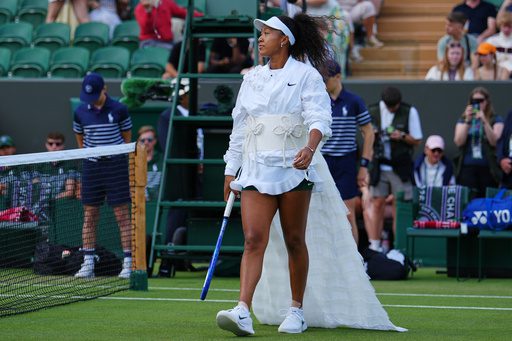
Then there’s Naomi Osaka, for whom a tennis match is increasingly an accessory to a larger, more calculated performance. Her sartorial choices—a “Kill Bill” inspired kimono for one round, then a striking all-white ensemble with a dramatic train for the next—are, in themselves, news. It’s an astute merging of personal brand with athletic prowess, a balancing act that’s harder than it looks. She admitted she was [QUOTE_PLACEHOLDER] These narratives, the human drama, the calculated self-presentation, and the raw fury, they’re the stuff that elevates sport beyond mere scores. Indeed, some spectators were even more engaged with Harry Kane’s goal updates from England’s World Cup match against Congo, audibly cheering in the hallowed Centre Court stands. Priorities, after all, are subjective.
📄 POLICY WIRE WHITEPAPER PUBLISHED: PAKISTAN'S NATIONAL SECURITY POLICY PRIORITIES
👉 READ BY CLICKING HEREEven Serena Williams made a much-anticipated, albeit brief, return. Four years is a long time in tennis. Her defeat, nursing a tweaked knee, underscored the relentless passage of time and the brutal demands of the sport, even for a legend. And for those of us watching from bustling megacities like Karachi or Lahore, where the aspirations for world-class sporting infrastructure sometimes hit infrastructure-related snags—consider, for instance, the recent shuffling of venues for regional leagues that saw the Uttar Pradesh T20 League Bouncing Venues, Signaling Broader Infra Woes—Wimbledon’s impeccable facade feels both aspirational and distantly foreign. This spectacle, its precision, its vast prize money (Wimbledon’s total prize fund, as of a recent update, now stands at approximately £50 million, according to its official website, making it one of the most lucrative events in sports), is a sharp reminder of the stark economic and developmental contrasts across the globe, even within the unifying realm of sports fandom.
What This Means
The dramas unfolding on Wimbledon’s courts are more than just tennis results; they’re a microcosm of larger political economy trends. The emergence of a talent like Andreeva, just as Krejcikova fights back from injuries, reflects the constant churn of globalized competitive markets where innovation meets resilience. Elite sport, much like national economies, demands continuous adaptation; fall behind on performance or public narrative, and the consequences are immediate. Osaka’s carefully curated image, extending beyond her athletic performance, highlights the growing confluence of entertainment, brand management, and athlete-as-influencer—a modern economic model for celebrity that transcends borders and speaks to global market engagement. For nations, sponsoring or hosting such events is an exercise in soft power, a bid for international prestige that can indirectly foster trade or tourism. And the visible, even audible, distraction of the British football fans at Centre Court—prioritizing a national team’s success over tennis history—underscores the powerful pull of identity politics even in supposedly universal arenas. It’s not just about who wins the trophy; it’s about whose narratives are heard, whose culture is celebrated, and, ultimately, where the economic attention flows.