


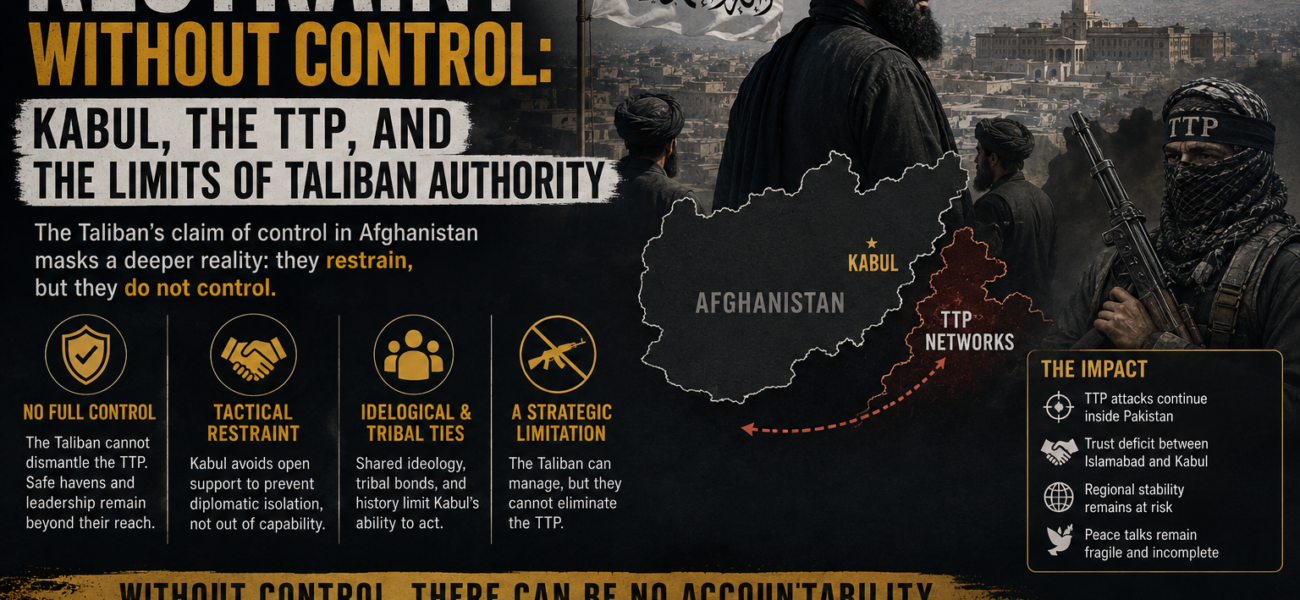
Restraint Without Control: Kabul, the TTP, and the Limits of Taliban Authority
The headline finding of the United Nations Security Council’s newest monitoring report is not a surprise. Released on 10 August and covering the period from December 2025 to June 2026, the 38th...

The headline finding of the United Nations Security Council’s newest monitoring report is not a surprise. Released on 10 August and covering the period from December 2025 to June 2026, the 38th report of the Analytical Support and Sanctions Monitoring Team states that the Afghan Taliban continued their support to the Tehreek-e-Taliban Pakistan, that the TTP escalated its attacks, and that the Taliban continued publicly to deny harbouring any terrorist groups. Islamabad has argued this for four years. The monitoring team has now said it again.
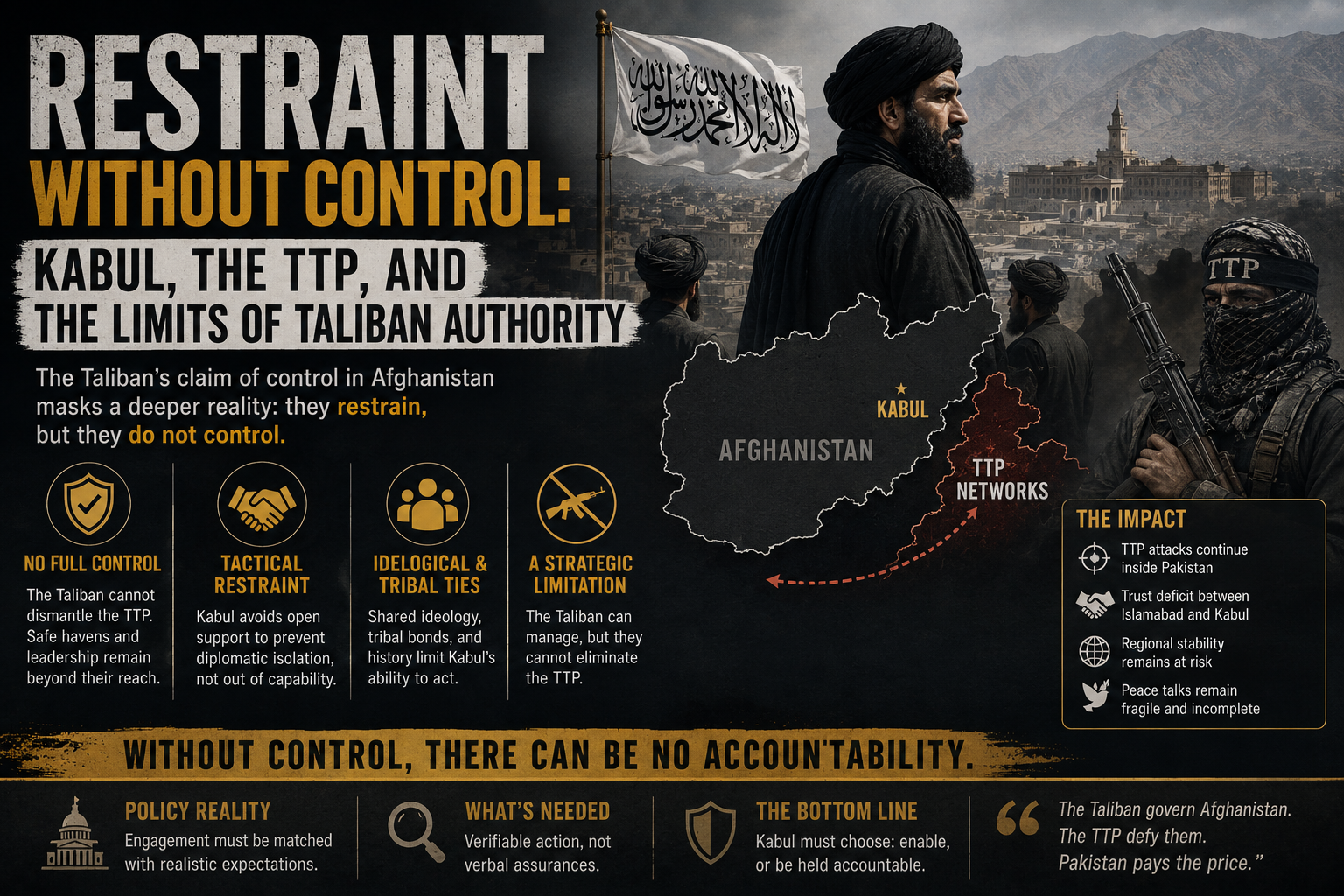
The more revealing material sits further down. During the same six months in which the Taliban were sustaining the TTP, the Taliban leadership also tried to rein it in, and failed. Read together, these findings describe something more troubling than complicity. They describe a regime that supplies a militant group it can no longer reliably command.
Two findings that do not sit comfortably together
The evidence of restraint is specific. According to the monitoring team, the Afghan authorities relocated approximately 2,000 TTP fighters and their families away from the Pakistani border and further inside Afghanistan, an effort the report frames as seeking to rein in the group. More striking still, the Taliban leader Hibatullah Akhundzada reportedly warned the TTP leadership through back-channel communications to halt attacks targeting Pakistan or risk losing Taliban support.
That is not the behaviour of a patron content with its proxy. It is the behaviour of a leadership that has calculated the costs of the relationship and moved to reduce them. Kabul had reasons to do so. Border closures have been estimated to cost the Afghan economy around one million dollars per day, and the monitoring team has previously recorded that some senior Taliban figures increasingly regard the TTP as a liability while others remain supportive.
Yet the same body of UN reporting documents provision on a scale that cannot be described as passive tolerance. Monitors have recorded that TTP attacks launched from Afghan soil grew more sophisticated, involving larger numbers of fighters and advanced assault rifles, night-vision devices, thermal imaging systems, sniper systems and drone attack systems, with most of this equipment reported as provided by the Afghan authorities, along with weapons licences and travel documents. A state that issues licences and papers to a foreign militant group is not merely failing to police its territory.
What the contradiction actually shows
The temptation is to treat one of these findings as the real story and the other as noise. Both are accurate, and holding them together produces the more useful conclusion. Support and restraint are running at different levels of the same movement.
The Taliban is not a unitary actor executing a single policy. It is a coalition of power centres with divergent interests in the TTP relationship. For commanders in the eastern provinces bound to the TTP by ideology, kinship, and years of shared war, the group is a constituency and an asset. For the leadership in Kandahar weighing closed borders, damaged trade, and the diplomatic cost of a hostile neighbour, the same group is an increasingly expensive commitment. A warning delivered through back channels by the emir, rather than an order issued through a chain of command, is itself evidence of how authority actually travels in this system.
The result is a policy that pulls in two directions at once. Fighters are moved away from the border while equipment and documentation continue to flow. The emir signals that support is conditional while the conditions go unenforced. This is what militant sponsorship looks like when a movement has never converted its wartime networks into instruments a central government can switch off.
The comparison with Islamic State-Khorasan makes the point sharper. Against ISKP, a group that attacks the Taliban and disputes its legitimacy, the monitoring team credits Kabul with operations that have inflicted significant losses and driven attacks inside Afghanistan down, even as the group’s activity in Pakistan increased. The capacity to act against an armed group therefore exists. What differs in the TTP case is not capability. It is the political cost of using it against a movement with which large parts of the Taliban’s own base identify.
The TTP answered the warning by escalating
Whatever Akhundzada intended, the TTP’s response settles the question of effect. At the beginning of March the group announced its spring campaign, Operation Khyber, publicised in multiple languages and calling for increased attacks in and against Pakistan. The monitoring team records one of the deadliest incidents of the reporting period on 16 February in Bajaur district of Khyber Pakhtunkhwa, where a vehicle-borne improvised explosive device killed eleven security personnel and one child. The TTP claimed responsibility and was reported to be operating from Afghanistan.
The cost has been heavy. Data compiled by the Pakistan Institute for Conflict and Security Studies records 2,786 deaths linked to militant violence and counter-militancy operations in the first seven months of 2026, including 463 civilians and 434 security personnel. July alone was the deadliest month for Pakistani security forces since 2023.
Scale explains part of the difficulty. UN monitors have assessed the TTP as the largest militant group operating in Afghanistan, with an estimated strength of six thousand fighters or more. Relocating two thousand people, including families, moves a fraction of that organisation and leaves its command structure, its supply relationships, and its recruitment networks intact. The measure reads less as disarmament than as an adjustment of geography.
A group that escalates immediately after its host’s leader threatens to withdraw support is a group that has judged the threat to be hollow. The TTP appears to have made that judgement correctly.
Why this matters for anyone negotiating with Kabul
The practical implication is uncomfortable for every party that has invested in dialogue with the Taliban on this file. Negotiations assume a counterpart able to deliver what it promises. The monitoring team’s findings suggest that on the TTP question, Kabul may be able to promise more than it can enforce.
That does not absolve the Taliban of responsibility. A movement that arms a group, issues it travel documents, and shelters its leadership has authored the problem it now struggles to manage, and the monitoring team is explicit that the Taliban authorities have been unable to suppress the terrorist problem despite their efforts against Islamic State-Khorasan. Incapacity that follows from years of deliberate cultivation is not a defence.
It does mean the file requires a different reading. Framing the relationship purely as state sponsorship implies that pressure applied to Kabul will translate into restraint on the ground. The record of the past six months indicates that the transmission belt between the two is weaker than that framing assumes. The Taliban leadership tried, in its own limited way, to slow the TTP down. The TTP announced a spring offensive instead.
Four years after taking Kabul, the Taliban has discovered the difficulty every movement encounters when it stops being an insurgency and starts being an address. Responsibility now attaches to Afghan territory in a way it did not when the Taliban were fighting from it. Whether the leadership can convert that responsibility into control over the networks it spent two decades building is the question the next monitoring report will answer.
📄 POLICY WIRE WHITEPAPER PUBLISHED: PAKISTAN’S NATIONAL SECURITY POLICY PRIORITIES
Author