


Whistle While You Work: NBA’s Playoff Paradox Ignites Star Player’s Scathing Critique
POLICY WIRE — New York City, USA — The unspoken agreement, a shadowy pact between athlete, arbiter, and audience, often governs the grand spectacle of playoff basketball. It’s an...

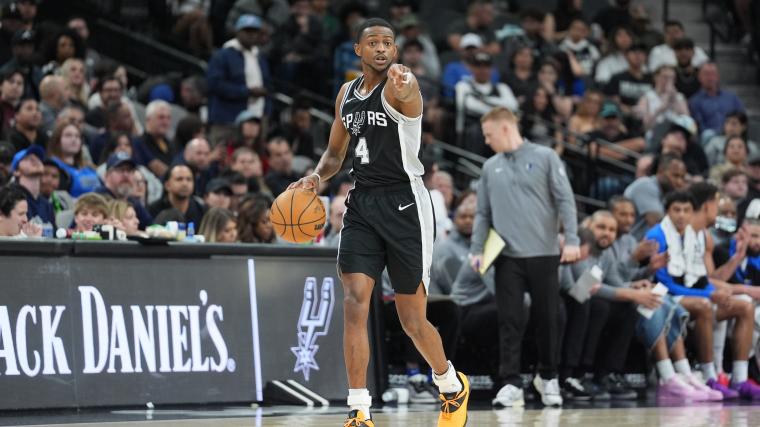
POLICY WIRE — New York City, USA — The unspoken agreement, a shadowy pact between athlete, arbiter, and audience, often governs the grand spectacle of playoff basketball. It’s an understanding that, come springtime, the rulebook thins, and the game’s physicality swells—a tacit acknowledgment of heightened stakes. Yet, when San Antonio Spurs’ All-Star guard De’Aaron Fox dared to articulate this widely held, if officially denied, truth after a pivotal Game 4 triumph, it reverberated far beyond the hardwood, tapping into deeper anxieties about fairness and perceived impartiality in high-stakes environments.
Fox, fresh off spearheading a remarkable 17-point comeback against the Portland Trail Blazers, didn’t mince words during his post-game interview. His Spurs had clawed their way to a commanding 3-1 series lead, a feat made all the more arduous, he implied, by the officiating. “Look, they’re gonna let us play,” Fox declared, a hint of exasperation in his tone during the post-game broadcast. “It’s playoff basketball. The league says it’s not different, but everyone with eyes knows it’s. You gotta adjust.” This wasn’t a lament from a losing side; it was a victorious player calling out the emperor’s new clothes, exposing a long-standing, open secret that governs the very rhythm of the NBA postseason.
The sentiment isn’t new, of course. For decades, fans and pundits alike have observed a discernible shift in how fouls are called once the calendar flips to playoff mode. Incidental contact becomes part of the game; once-egregious shoves are suddenly “let go.” It’s a baptism by fire, they say, designed to separate the truly elite from the merely talented. But is it fair? And more consequentially, does it undermine the integrity the league so fiercely protects?
And so, while Fox will almost certainly incur a financial penalty for his candor—a league tradition for dissenters challenging official narratives—his comments have resonated. They’ve sparked renewed debate among the league’s vast global fanbase, from the sports bars of Brooklyn to the bustling cafés of Karachi. The perception of a level playing field, or its absence, carries significant weight, especially in cultures where the integrity of institutions is frequently scrutinized.
The league, predictably, maintains a different stance. “Our officiating standards remain consistently applied across all games, regular season or playoffs,” a spokesperson for the National Basketball Association (NBA) anonymously offered when pressed on the matter, reiterating the official league position that has often felt more aspirational than descriptive. “Player safety and the integrity of the game are paramount, always.” Still, the sheer volume of anecdotal evidence suggests a deviation from this official line, creating a cognitive dissonance for viewers.
At its core, Fox’s assertion illuminates a subtle, yet profound, tension within global professional sports governance: the tug-of-war between maintaining established rules and adapting to the unwritten demands of high-stakes competition. It’s a predicament not unlike the broader international landscape, where universal laws often encounter localized interpretations, frequently justified by pragmatic, if sometimes morally ambiguous, exigencies. That kind of pragmatic bending of rules, even in sport, can stir unease among audiences who cherish clear, unambiguous standards. For instance, discussions around the application of international law, particularly regarding border sovereignty or human rights in volatile regions, often face similar accusations of selective enforcement.
Behind the headlines of athletic prowess — and tactical adjustments, there’s a delicate dance of perception at play. The NBA, a global behemoth, pulled in an average of 5.3 million viewers per game for its 2023 playoffs, a 10% increase from the prior year, according to data from Sportico. That immense reach means every comment, every perceived injustice, becomes part of a larger narrative that transcends the game itself. It’s no longer just about two teams; it’s about the very credibility of the officiating body and, by extension, the league’s commitment to transparent governance.
What This Means
De’Aaron Fox’s blunt assessment isn’t just a momentary eruption of player frustration; it’s a window into the perpetual tug-of-war between regulatory consistency and the ‘unwritten rules’ of escalating competition. Politically, this plays out in how institutions—from national governments to international bodies—are perceived to apply their own doctrines. When the declared rules diverge from observed reality, public trust erodes, regardless of the sector. In sports, this can translate into fan cynicism, impacting long-term engagement — and brand loyalty. Economically, a perceived lack of fairness, even if it adds a certain grit to the games, risks alienating a segment of the global audience who invest significant time and money in following the league. It’s a calculated gamble by the NBA: prioritizing a more physical, intense product, but at the cost of strict adherence to its own rulebook. This phenomenon of ‘situational ethics’ in rule enforcement isn’t unique to basketball; it’s a recurring theme across various geopolitical and economic spheres, where stated principles often bend under the weight of perceived necessity or desired outcomes. For the NBA, maintaining that delicate balance—between raw spectacle and verifiable integrity—is crucial for its continued expansion into global markets, particularly those, like many across South Asia and the Muslim world, where questions of justice and legitimate authority are not merely academic discussions, but deeply felt, immediate concerns.